

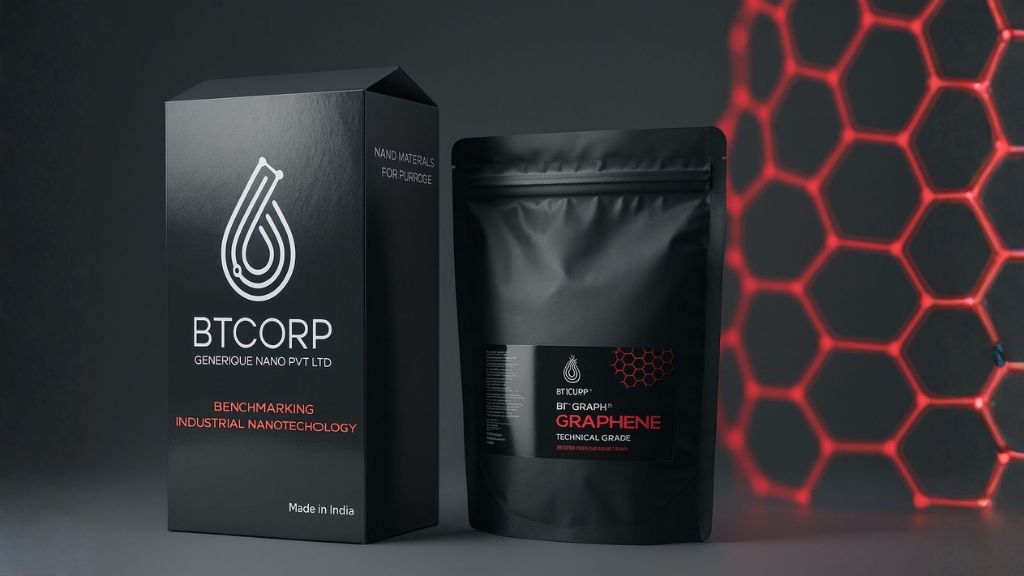
Graphene Price in India [current_date] : Cost per Kg, Types, Quality & Buying Guide
By the Research & Materials Team at ARMI® Nano [current_date]
Understanding the graphene price in India is not as straightforward as it sounds — and if you have spent even a few hours researching it, you already know that. A few months back, our team at [BTCORP GENERQIUE NANO] India’s first graphene manufacturer — was evaluating a batch of graphene samples from five different Indian suppliers. The variation was staggering — not just in price, but in what was actually inside the packaging. One vendor quoted Rs. 500 per gram. Another offered the same material — or so they claimed — for Rs. 6 per gram. Without proper characterisation data, there was simply no way to compare them meaningfully.
That experience is not unique to us. Anyone who has seriously tried to navigate the graphene price in India knows exactly how disorienting it can be. The numbers seem random. The terminology is inconsistent. And suppliers are not always transparent about what they are actually selling.
The thing is, the pricing is not random — it just looks that way until you understand what is actually being sold. Graphene is not one material. It is a whole family of carbon-based materials, each with different properties, different production methods, and very different price points. Once that clicks, the market starts making a lot more sense. This guide breaks it all down — types, price ranges, what drives cost, how to buy smartly, and where the market is heading.
What Is Graphene — And Why Does the Price Vary So Much?
At its most basic level, graphene is a single layer of carbon atoms arranged in a flat, hexagonal pattern — like a honeycomb, but one atom thick. It is incredibly strong, conducts electricity and heat very efficiently, and is flexible enough to bend without breaking. When scientists at the University of Manchester first isolated it in 2004, it felt like a material that could genuinely change manufacturing as we know it.
But here is the part that most buyers miss: producing a perfect, single-layer graphene sheet at commercial scale is genuinely difficult and expensive. What the market actually sells — and what most applications actually need — is a range of graphene-related materials. Graphene nanoplatelets, graphene oxide, reduced graphene oxide, CVD graphene films. These are all real, legitimate materials with real uses. But they are not the same thing, and they should not cost the same thing.
When you see graphene powder price per kg ranging from Rs. 3,000 to Rs. 80,000 across different Indian suppliers, it is mostly because different sellers are quoting different materials under the same name. Before you ask anyone about graphene price in India, the first question to answer is: which type of graphene do you actually need? That one decision shapes everything else — specification, supplier selection, and budget.
Types of Graphene and Current Prices in India
Graphene Nanoplatelets — Most Affordable, Most Widely Available
Graphene nanoplatelets, commonly sold as GNP, are produced by breaking apart graphite into thin stacks of graphene layers — usually between 5 and 30 layers thick. This is the most commercially mature form available in India, which means supply is reliable and graphene price in India for this grade is reasonable. For industrial-grade GNP with carbon purity above 95%, you are typically looking at Rs. 3,000 to Rs. 15,000 per kg depending on the supplier and order volume.
These work well in polymer composites, rubber compounds, lubricants, thermal pastes, and anti-corrosion coatings. For most manufacturers adding graphene for mechanical reinforcement or thermal improvement, nanoplatelets deliver excellent results without the premium cost of higher grades. GNP is the starting point for at least 70% of industrial applications — and it performs well when properly specified and dispersed.
Graphene Oxide — The Research and Biomedical Grade
Graphene oxide, or GO, is made by treating graphite with strong oxidising chemicals. The process adds oxygen-containing groups to the surface, making the material water-dispersible and chemically versatile. This is why researchers favour it — biomedical applications, filtration membranes, sensors, functional coatings, and as a precursor to reduced graphene oxide all rely on GO’s surface chemistry.
Graphene oxide pricing in India generally falls between Rs. 8,000 and Rs. 60,000 per kg. The spread is wide because purity, layer count, and oxygen-to-carbon ratio vary significantly between suppliers. Research-grade GO with confirmed single-to-few-layer composition and a C:O ratio below 2.5 sits at the upper end. Bulk industrial GO for water treatment membranes or coatings can be sourced considerably cheaper. Understanding this distinction alone can save procurement teams a significant amount on each order.
Reduced Graphene Oxide — Conductivity Without the CVD Price Tag
When graphene oxide is chemically or thermally treated to remove most of its oxygen content, you get reduced graphene oxide, or rGO. It does not fully recover the conductivity of pristine graphene, but it gets close enough for most practical applications — conductive inks, battery electrodes, printed electronics, and composite materials all benefit from rGO’s partial conductivity recovery.
In India, rGO typically costs between Rs. 10,000 and Rs. 80,000 per kg. The key variable is the degree of reduction. Genuine high-quality rGO has electrical conductivity above 10,000 S/m and a carbon-to-oxygen ratio above 6. Some Indian suppliers sell poorly reduced material at inflated rGO prices — always ask for conductivity values and C:O ratios before committing. If a supplier cannot provide these numbers, that tells you something important about their quality control.

CVD Graphene — Premium Quality, Very Specific Applications
Chemical vapour deposition graphene is grown directly on metal substrates at high temperatures using hydrocarbon gases. The result is the closest commercially available material to textbook-perfect graphene — a continuous, single-layer film with near-ideal electronic properties. CVD graphene is rarely quoted per kilogram because quantities are small. Pricing is typically per square centimetre, starting from around Rs. 500 to Rs. 5,000 per cm² depending on substrate and specifications.
This is the material for high-frequency transistors, photodetectors, advanced sensors, and precision research. For most industrial buyers asking about graphene price in India, CVD graphene is not the answer — the cost is simply not justified unless your application specifically requires near-perfect electronic properties.
What Actually Drives Graphene Cost Per Gram in India
Once you understand the types, the next question is why prices vary even within the same category. Three things drive most of the variation: purity, characterisation quality, and supplier investment in testing infrastructure.
Purity is the most straightforward driver. Carbon content in commercial graphene powder ranges from below 80% — barely better than expensive graphite — to above 99.5% for research and electronics applications. The price difference between 85% and 99% purity at the same supplier can be three to five times. Layer count matters equally. A genuine few-layer material behaves very differently from a 20-layer platelet, and specific surface area measured in m²/g is the most reliable way to confirm what you are actually getting. Genuine single-to-few-layer graphene has BET surface area above 400 m²/g; most industrial GNP falls between 100 and 300 m²/g.
Testing and documentation add visible cost to the graphene price in India — but they protect you. A supplier providing third-party Raman spectroscopy data, BET surface area measurements, and TGA results for each production batch is investing seriously in quality assurance. Their graphene 1kg price may be 30 to 50 percent higher than an uncertified competitor. But the probability of actually receiving what you paid for increases dramatically. Cheap, undocumented graphene is a gamble that rarely pays off when you account for the full cost of failed experiments or wasted production batches.
Production origin matters too. India now has meaningful domestic graphene manufacturing capacity, particularly in Gujarat, Tamil Nadu, and Karnataka. For standard GNP and GO grades, domestic suppliers are often price-competitive with imports once customs duties and shipping are factored in. For high-specification materials — CVD films, ultra-high-purity powders, electronically characterised few-layer graphene — imports from South Korea, Germany, the UK, and established manufacturers still generally offer more reliable specification consistency.
Domestic vs. Imported Graphene: What Makes Sense for Indian Buyers
This question comes up in almost every procurement conversation, and the honest answer is that it depends heavily on application and volume.
For graphene nanoplatelets and graphene oxide in volumes above 100 grams, Indian suppliers have become genuinely competitive. Several manufacturers in Gujarat and Tamil Nadu have invested in proper characterisation infrastructure and are producing materials referenced in peer-reviewed publications — a reasonable proxy for quality. The cost advantage over imports, after factoring in 15 to 25 percent import duties and shipping lead times of two to four weeks, is real and meaningful for routine procurement.
For high-specification applications — CVD films, few-layer graphene with tight electronic specs, semiconductor-grade purity — imported material from established international suppliers remains more reliable in 2026. Indian capability in this segment is improving, but the depth of available specifications and the track record of international suppliers still gives them an edge for demanding work.
Lead times also affect the decision. Most domestic Indian suppliers offer 5 to 50 gram trial samples before bulk commitment, with minimum orders typically in the 100 to 500 gram range for commercial grades. International suppliers, particularly European ones, often have longer lead times and higher minimum quantities. For fast-iteration development cycles, domestic sourcing makes practical sense even if specification depth is slightly lower.
For most Indian buyers the practical recommendation is: start with a domestic supplier for standard industrial grades, verify with characterisation data, and only move to imports when the domestic market genuinely cannot match your specification requirements.
How to Buy Graphene Smartly in India
The most important step before contacting any supplier is clarifying what your application actually needs. A thermal interface material needs high in-plane conductivity and good flake aspect ratio. An antibacterial coating needs surface functionality and water dispersibility. A structural composite needs large flake size and controlled layer distribution. A supercapacitor electrode needs high surface area and electrical conductivity. Each requirement maps to a different material specification — and therefore a different graphene price in India from your supplier shortlist.
Going to a supplier without this clarity leads either to overspending on specifications you do not need, or under-buying material that fails in your application. Both outcomes are expensive. Define the specification first, then approach suppliers.
When you do contact suppliers, a few specific questions reveal within minutes whether you are dealing with a quality-oriented company or someone repackaging graphite and hoping you do not test it. Ask for the Raman spectrum for the specific batch you are purchasing. Ask for BET surface area data. Ask whether characterisation comes from an in-house instrument or an independent third-party lab. Ask about batch-to-batch consistency and whether they can match a previously purchased specification. Ask explicitly about sample availability before bulk commitment.
A supplier who welcomes these questions and answers them with batch-specific data is almost always a better long-term partner than one who deflects to brochure language. If they cannot answer technical questions about their own product, the graphene price in India they are offering is not the real cost — the real cost includes whatever you lose when the material underperforms.
One thing that often gets overlooked is dispersion. Raw graphene powder — even excellent quality material — tends to agglomerate. Without the right dispersant, solvent system, and mixing process for your application, the graphene will not distribute uniformly and will not deliver its benefits. Several suppliers now offer pre-dispersed concentrates or masterbatches formulated for specific applications. For buyers without strong formulation expertise in-house, these products often deliver better real-world performance even when the graphene cost per gram appears higher on paper.
Common Mistakes That Keep Costing Indian Buyers Money
The most common and costly mistake is treating all graphene as interchangeable. This usually happens when procurement and technical specification are handled by different people, and someone cuts cost by switching suppliers without checking specifications. The R&D team specified a particular graphene oxide grade with a specific C:O ratio; procurement sourced something cheaper; results stopped being reproducible. This pattern plays out regularly across Indian research and manufacturing setups, and it invariably costs more to untangle than the original saving justified.
The second mistake is skipping sample testing before bulk purchase. A proper evaluation — a few hundred grams from two or three suppliers, tested in your actual application — almost always saves money compared to a failed kilogram-scale commitment. One failed production batch costs far more than a thorough sample evaluation ever would.
Over-specification is also surprisingly common. Many buyers, having read about the extraordinary theoretical properties of perfect single-layer graphene, insist on the highest-specification material even for applications that work perfectly well with nanoplatelets at a fraction of the cost. For composite reinforcement, thermal management, and corrosion protection, well-characterised GNP consistently delivers strong results. Paying CVD-grade graphene prices for these use cases is simply wasted budget.
Finally, ignoring dispersion chemistry is a mistake that only becomes visible after purchase, when results disappoint and no one can identify why. This is not a material quality issue — it is a formulation issue. Getting proper guidance on dispersion early, either from the supplier or a formulation specialist, prevents a lot of unnecessary frustration later.
Where the Indian Graphene Market Is Heading Through 2028
The graphene price in India has been on a consistent downward trajectory for standard grades, and this will continue. Prices for GNP and graphene oxide have fallen 40 to 60 percent over the past four years as domestic production has scaled and international competition has increased. This trend has meaningful implications for buyers in cost-sensitive industrial applications — materials that were borderline economical three years ago are increasingly viable today.
The more significant development is the shift toward application-specific graphene products. Rather than generic powder, more suppliers are offering graphene concentrates, masterbatches, and functional coatings designed for specific manufacturing processes. This lowers the technical barrier for manufacturers who want graphene’s benefits without in-house formulation expertise. Expect this segment to expand considerably through 2027 and 2028, particularly in rubber, plastics, and protective coatings.
Energy storage is the largest near-term growth market for graphene in India, driven by EV battery development, grid storage, and the expanding solar sector. Graphene’s role in supercapacitors and as a conductive additive in lithium-ion battery electrodes is commercially established globally and is gaining serious traction with Indian battery manufacturers. As volumes scale, procurement teams in this sector will have growing leverage on graphene price in India negotiations.
Construction and infrastructure applications are also emerging — graphene as a cement additive, in waterproofing membranes, and in corrosion-resistant coatings for structural steel. These are high-volume, price-sensitive markets that will accelerate the commoditisation of GNP grades significantly over the next few years, pulling the graphene price in India further down for buyers across all sectors.
For buyers navigating this market today: build supplier relationships early, invest in basic characterisation capability, and treat graphene procurement the way you would any other engineered functional material. The market is maturing fast, and informed buyers are increasingly well-positioned.
Conclusion: Get the Specification Right and the Price Takes Care of Itself
The graphene price in India in 2026 spans a wide range for good reason — and that range reflects real differences in material quality, production method, and application suitability. It is not arbitrary, and it does not need to be confusing once you understand what you are actually comparing.
The buyers who consistently get value from graphene are not the ones who find the cheapest option. They are the ones who define their application requirement clearly, translate that into a material specification, test before committing to volume, and build supplier relationships that deliver consistent and properly characterised material over time. That approach is not complicated — it just requires discipline upfront and the willingness to ask the right technical questions.
India’s graphene ecosystem has matured considerably. Domestic supply is stronger, the graphene price in India for standard grades is more accessible than ever, and the gap between informed and uninformed buyers is narrowing. If you approach this market with clarity and technical rigour, graphene can absolutely deliver on its considerable promise — at a cost that increasingly makes sense for industrial-scale use.
About Nano [BTCORP GENERQIUE NANO PVT LTD]
BTCORP GENERQIUE NANO holds the distinction of being India’s first graphene manufacturer, pioneering the development and commercialisation of graphene-based materials in the country. With deep expertise across carbon-based materials and graphene characterisation, BTCORP GENERQIUE NANO supports researchers, manufacturers, and procurement teams across India in identifying the right graphene specifications for their applications — and sourcing them reliably..
Frequently Asked Questions
Q1: What is the current graphene 1kg price in India in 2026?
The graphene 1kg price in India varies significantly by type and grade. Industrial-grade graphene nanoplatelets typically cost between Rs. 3,000 and Rs. 15,000 per kg. Graphene oxide ranges from Rs. 8,000 to Rs. 60,000 per kg depending on purity and layer count. Reduced graphene oxide generally falls between Rs. 10,000 and Rs. 80,000 per kg. If a supplier quotes a flat graphene price in India without specifying grade and providing characterisation data, always verify what you are actually receiving before placing a significant order.
Q2: How do I verify that the graphene powder I am buying is genuine?
The most reliable method is requesting Raman spectroscopy data for the specific batch. Raman is the gold standard for graphene characterisation — the D, G, and 2D peaks confirm layer count and defect density. BET surface area data and TGA results for purity are equally important. If a supplier cannot provide batch-specific data, or if the characterisation reports look templated rather than genuinely batch-specific, treat that as a significant warning. Sending a small sample to an independent characterisation facility before committing to bulk purchase is always the safer approach.
Besides must check the graphitic carbon contente generally more than 92% [Which is ot available in all carbon source,major difference how graphene is different from any other carbon particle and its lattices align to turbostratic graphitic family.
Q3: What is the difference between graphene oxide and reduced graphene oxide?
Graphene oxide has oxygen functional groups on its surface that make it water-dispersible and chemically versatile — ideal for biomedical applications, filtration membranes, and sensors, but electrically insulating. Reduced graphene oxide has had most of those groups removed, partially restoring electrical conductivity, making it better suited for conductive inks, battery electrodes, and electronic composites. The choice depends entirely on your application. Getting it wrong is one of the most common reasons graphene experiments and products underperform despite using quality material.
Q4: Are Indian graphene suppliers reliable compared to international ones?
Increasingly yes, for standard industrial grades. Several manufacturers in Gujarat and Tamil Nadu are producing quality GNP and graphene oxide with credible analytical data, and their graphene price in India is competitive once import duties and shipping on foreign alternatives are factored in. For high-specification electronic applications, imported material from established international suppliers remains more reliable in 2026. The key quality indicator is always whether the supplier provides batch-specific Raman and BET data and supports independent verification.
Q5: Can graphene nanoplatelets replace single-layer graphene in composite applications?
For most composite applications — polymer reinforcement, rubber toughening, thermal interface materials, and anti-corrosion coatings — graphene nanoplatelets are not just a substitute, they are the preferred choice. Single-layer graphene is extremely difficult to disperse uniformly and significantly more expensive. Well-characterised GNP with appropriate aspect ratio delivers excellent mechanical and thermal performance in composites at a fraction of the cost. Single-layer graphene is genuinely necessary only for high-frequency electronics, precision sensors, and fundamental research.
Q6: What minimum order quantities should I expect from Indian graphene suppliers?
Most established domestic suppliers provide trial samples of 5 to 50 grams for characterisation purposes at a premium per-gram rate. Standard minimum orders for commercial grades are typically in the 100 gram to 500 gram range, with per-kilogram pricing available beyond that threshold. For bulk orders of 10 kg and above, domestic GNP pricing becomes quite competitive. For CVD graphene and other high-specification materials, quantities are typically much smaller by weight but priced per cm² rather than per kilogram, reflecting the fundamentally different production economics involved.
Why BTCORP’s Graphene Stands Apart: The Truth Behind Its Leadership
- Premium Natural Vein Graphite Only
BTCORP uses high-purity natural vein graphite as its exclusive precursor, ensuring graphene with superior crystallinity, conductivity, and minimal defects. - A Decade of Bulk-Scale Excellence (Since 2012)
One of India’s earliest and most iconic large-volume graphene producers, delivering consistent quality through mature, stable, and optimized processes. One metric ton is maintained as our minimum buffer stock, and our annual supply capacity is 10 metric tons with further scalability. Production is executed through a proprietary wet-chemical process using specialized proprietary equipment, with natural graphite as the starting material. - Custom Engineering for Every Application
From functionalized graphene to specialized dispersions, BTCORP tailors each grade to meet the exact needs of coatings, polymers, composites, energy systems, and more. - Free Technical Support After Every Supply
Clients receive hands-on guidance to maximize dispersion, compatibility, and performance—turning raw graphene into real-world results. - Patents Across the Entire Value Chain
The company’s IP covers production, functional intermediates, dispersions, and finished nanotech products—ensuring full control from source to solution. - Trusted by Global Corporates & Top Labs
BTCORP’s materials are used worldwide by leading industries and research institutes that demand reliability, purity, and performance.
This guide is published by ARMI® Nano of BTCORP GENERIQUE NANO PVT LTD and is intended for researchers, procurement professionals, and product developers working with graphene in India. Price ranges reflect market conditions as of early 2026 and may vary based on supplier, specifications, and order volume.
If you want to explore the product directly, find them on Instagram at @graphene_products for updates, usage tips, and more.
shop now at www.arminano.com
I was skeptical about signing up at first, like why would this be any different right? But honestly I was pleasently surprised by how straightforward everything is—no confusing menus or sketchy vibes, just a clean site that actually works how its supposed to. [url=https://zodiac-onlinecasino.com/]zodiac login[/url]