

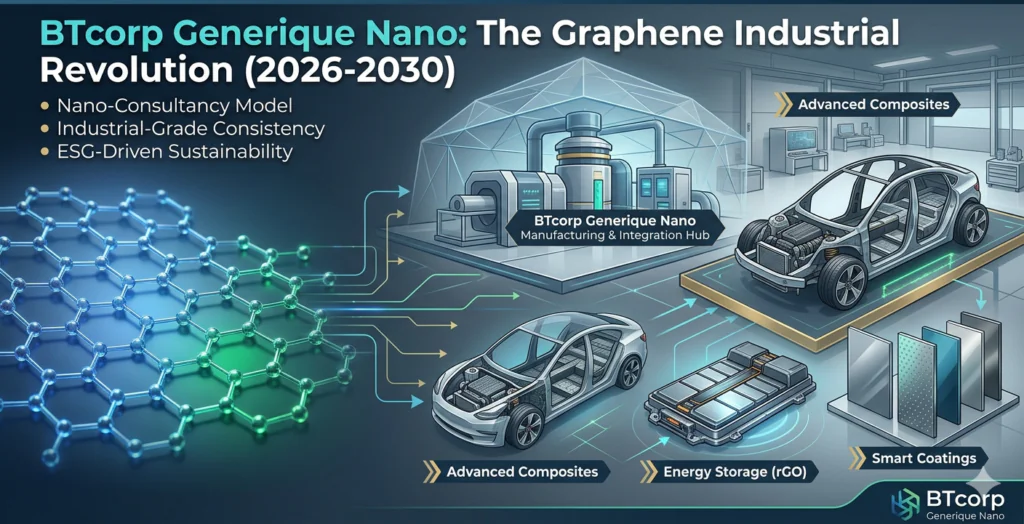
The Industrial Graphene Revolution & The Role of BTcorp Generique Nano
Navigating the transformation of nanotechnology from laboratory experiments to the cornerstone of global manufacturing.
1. Introduction: The Age of Carbon Nanomaterials
Graphene, frequently celebrated as the “Wonder Material” of the 21st century, has systematically dismantled the traditional boundaries of material science. Since the groundbreaking experiments at the University of Manchester, which earned Geim and Novoselov the Nobel Prize in Physics in 2010, the global perception of carbon-based nanomaterials has undergone a seismic shift. For over a decade, graphene remained largely confined to academic journals and highly specialized laboratory environments, often cited for its theoretical properties rather than its practical utility.
However, by 2026, we have witnessed a definitive transition from purely scientific curiosity to an essential pillar of industrial manufacturing. Today, graphene is no longer just a research subject; it is the fundamental building block for the next generation of materials that are lighter, stronger, and more conductive than anything previously available. The industry has reached an inflection point where the cost-to-performance ratio has finally tipped in favor of mass adoption.
In this rapidly evolving industrial ecosystem, BTcorp Generique Nano Pvt Ltd has emerged as a formidable pioneer. By focusing on scalability, industrial-grade quality control, and deep-tech consultancy, BTcorp has successfully bridged the notorious gap between laboratory-scale synthesis and mass-market industrial implementation. As manufacturers worldwide seek to optimize energy density, thermal management, and structural integrity, BTcorp stands at the forefront of providing the high-purity, consistent graphene required to power the products of tomorrow.
2. Market Dynamics & Global Demand (2026 Context)
The global graphene market is currently experiencing an era of exponential growth. As of 2026, the demand is no longer driven by prototypes but by full-scale production cycles. Manufacturers worldwide are racing to integrate graphene into electronics, high-capacity energy storage systems, and advanced anti-corrosion coatings. The ability to source consistent, high-purity graphene at a commercial scale has become the primary bottleneck for many, and this is precisely where BTcorp Generique Nano has redefined the playing field.
Strategic Growth Segments
The acceleration of graphene adoption is primarily attributed to four core sectors. Each sector demands unique material specifications, requiring suppliers to possess not just volume, but technical versatility.
Energy Storage
The shift toward electric mobility and renewable energy storage requires electrodes with higher surface areas and superior conductivity. Graphene is now standard in next-gen batteries.
Advanced Electronics
From thermal management in high-power chips to flexible displays, graphene provides the conductivity and cooling that silicon-based materials simply cannot match.
Global Graphene Market Growth Metrics
| Sector | Demand Growth (CAGR %) | Primary Application |
|---|---|---|
| Energy (Batteries/Supercaps) | 35% | Electrode Conductivity |
| Automotive/Aerospace | 28% | Lightweighting/Strength |
| Coatings & Polymers | 22% | Anti-corrosion/Durability |
| Electronics | 30% | Thermal Management |
3. The Scalability Challenge & The BTcorp Solution
For many years, the primary barrier to graphene adoption was the “scalability challenge.” Producing graphene in milligram quantities is a standard laboratory procedure, but scaling that process to metric tons without compromising the structural lattice is an engineering hurdle of the highest order. Many suppliers struggle to maintain batch-to-batch consistency, leading to variability that disrupts industrial manufacturing lines.
BTcorp Generique Nano solves this by utilizing proprietary manufacturing processes that ensure consistency across large batches. Unlike traditional commodity suppliers, BTcorp views graphene as a “solutions-based product.” They work directly with R&D teams to optimize the functionalization of graphene, ensuring it integrates perfectly with the client’s existing manufacturing parameters, whether that be in polymer injection molding, paint formulation, or electrochemical slurry preparation.
By providing technical support alongside raw materials, BTcorp has effectively lowered the barrier to entry for manufacturers who previously found the costs and logistics of nanomaterials prohibitive. Their commitment to supply chain reliability ensures that when an automotive manufacturer or battery OEM begins a production cycle, they receive the exact material specifications required, on time, every time.
Why BTcorp Generique Nano Leads the Market
Bridging the gap between scientific innovation and industrial-grade reliability.
In the high-stakes world of nanotechnology, the industrial journey is often derailed by the “Purity vs. Scalability” paradox. For years, material scientists faced a daunting trade-off: produce microscopic quantities of ultra-pure graphene in a laboratory, or settle for industrial-grade volumes that lack the structural lattice integrity required for advanced applications. Most market participants fall into this trap, leaving manufacturers with a supply chain characterized by either exorbitant costs or unacceptable batch variability.
BTcorp Generique Nano Pvt Ltd has effectively dismantled this paradox. By integrating a “solutions-first” philosophy with proprietary manufacturing technology, BTcorp has emerged as the definitive choice for industries that demand consistency, volume, and technical performance in equal measure.
1. The Natural Edge: High-Purity Natural Vein Graphite
While many competitors focus on synthetic methods—which are often energy-intensive and prone to introducing unwanted structural defects—BTcorp leverages high-purity natural vein graphite. This strategic choice is grounded in thermodynamics and molecular efficiency. Natural graphite, when processed with BTcorp’s refined extraction methods, provides a superior starting point for graphene synthesis. This approach significantly reduces the energy footprint and the chemical complexity of the exfoliation process. The result is a cost-efficient, high-performance material that retains the intrinsic conductivity and thermal stability of the raw ore, without the “synthetic tax” that plagues other manufacturers.
2. Unmatched Scalability: From Lab to Metric-Tons
Reliability is the currency of the industrial supply chain. Automotive, battery, and coating manufacturers cannot build production lines around a supplier that cannot guarantee batch-to-batch consistency. BTcorp has engineered its facilities to support multi-metric-ton output per month. This isn’t just about larger reactors; it’s about the integration of automated quality control systems that monitor the lattice structure in real-time. By mastering the art of scaling without compromise, BTcorp provides manufacturers with the confidence to transition from pilot projects to full-scale, global production cycles, knowing their supply of graphene will never be the bottleneck.
3. Application-Driven Engineering: Beyond the Powder
The most distinctive feature of BTcorp’s leadership is its refusal to operate as a simple commodity vendor. Raw graphene powder is often difficult to disperse into host materials, leading to clumping and reduced efficiency. BTcorp solves this through deep-tech consultancy and application-driven engineering. By providing pre-dispersed graphene solutions and advanced polymer masterbatches, BTcorp allows clients to integrate nanomaterials directly into their existing manufacturing workflows. Whether it’s an electrochemical slurry for a battery electrode or a pigment-dispersed resin for anti-corrosion paint, BTcorp ensures the material is “integration-ready” upon delivery, eliminating the need for complex, in-house technical refining.
4. Manufacturing Excellence: The Technical Edge
Atomic-level precision driving industrial performance.
At BTcorp Generique Nano, we define manufacturing not just as a production process, but as an exercise in structural preservation. In the high-stakes domain of nanotechnology, material synthesis is an exercise in “Functionalization”—the deliberate modification of carbon structures to bridge the gap between theoretical potential and real-world utility. For our industrial partners, functionalization is the critical bridge that allows graphene to behave predictably within complex host matrices like polymers, resins, or solvents.
Our approach minimizes aggressive mass-exfoliation techniques that often introduce structural lattice defects. By strictly controlling oxidation levels and the precise attachment of specific functional groups, BTcorp engineers tune surface energy. This allows our graphene variants to bond harmoniously with various host materials, moving far beyond the primitive “mixing” strategies used by competitors. This level of atomic-scale control distinguishes a research-grade prototype from an industrial-grade supply chain solution.
Pristine Graphene
Our flagship material is engineered specifically for applications where absolute electrical conductivity is the primary KPI. Through proprietary mechanical exfoliation that avoids oxidative damage, we preserve the pristine, hexagonal honeycomb carbon lattice. By maintaining a defect-free structure, we ensure minimal electron scattering and remarkably low electrical resistance. This is the premier choice for mission-critical sectors including high-power electronics, supercapacitor electrodes, and aerospace-grade conductive tracks.
Graphene Oxide (GO) & Reduced Graphene Oxide (rGO)
GO and rGO serve as our versatile industrial workhorses. Graphene Oxide, with its abundant oxygen-containing functional groups, offers unparalleled solubility in both aqueous systems and polar organic solvents. This makes it ideal for complex chemical formulations where reactivity is paramount. Through our controlled reduction process (rGO), we recover a substantial portion of the material’s original electrical conductivity while retaining enough functional groups to ensure easy dispersion in inks, conductive glues, and smart paints. This tunability allows manufacturers to dial in the exact performance profile required for their specific chemical matrix.
Polymer Masterbatches
This is our premier “Integration-Ready” solution designed to solve the age-old problem of particle clumping (agglomeration) at the client’s facility. By pre-dispersing high-quality graphene into concentrated thermoplastic pellets, we deliver a product that integrates seamlessly into standard plastic manufacturing workflows. Injection molders and extruders can treat these masterbatches like standard resin additives, completely bypassing the need for specialized nanotechnology handling infrastructure. This allows for the mass production of conductive, lightweight, and high-strength plastic components without altering existing factory equipment.
5. Industrial Applications: Beyond the Hype
Transforming raw carbon potential into tangible industrial output.
The true value of graphene is not measured by the sophistication of the laboratory, but by the efficiency it drives across global manufacturing lines. BTcorp Generique Nano has systematically transitioned from theoretical research to the deployment of mission-critical materials. We are helping our clients reduce their total cost-of-ownership while exponentially increasing the performance metrics of their finished goods.
Thermal Management
As consumer electronics shrink in size while increasing in power, the “Thermal Wall” has become the primary bottleneck for performance. BTcorp’s graphene-infused thermal interface materials (TIMs) leverage the exceptionally high phonon-mediated heat transfer of the graphene lattice. By wicking heat away from silicon dies and power-dense circuitry, our solutions prevent thermal throttling, extend device longevity, and improve reliability in data centers and high-performance mobile computing.
Structural Composites
The global mandate in automotive and aerospace engineering is to reduce weight to improve fuel economy without sacrificing crash-test safety. When compounded into polymers, our graphene additives create a reinforced “nanonetwork” that significantly enhances tensile strength and impact resistance. This allows engineers to use thinner, lighter sections while maintaining structural integrity, creating vehicles that are not only more fuel-efficient but also stronger than those built with traditional fiber-reinforced materials.
Advanced Coatings
Corrosion is an invisible multi-billion dollar annual tax on the global economy. BTcorp’s functionalized graphene coatings form a complex, “tortuous path” nano-barrier that is essentially impermeable to oxygen, moisture, and salt ions. By preventing these corrosive agents from reaching the metal substrate, our coatings provide protection that vastly outperforms standard chromate or epoxy primers. Beyond rust prevention, these coatings inherently resist UV degradation and surface scratching, making them the standard-bearer for longevity in marine, infrastructure, and heavy industrial environments.
1. Market Price Dynamics: Research vs. Industrial Grade
In the nascent but rapidly maturing landscape of nanotechnology, the distinction between “Research-Grade” and “Industrial-Grade” graphene is not merely a label—it is a fundamental barrier to commercial viability. For over a decade, the narrative surrounding graphene was defined by its astronomical price point, with lab-scale quantities fetching between $500 and $5,000 per gram. This valuation was rooted in the artisanal, cleanroom-dependent nature of early synthesis, where characterization costs alone often dwarfed the intrinsic material value.
However, the 2026 industrial reality demands a shift from the boutique, “gram-based” pricing model to a “metric-ton-based” commodity reality. At BTcorp Generique Nano, we have systematically engineered our supply chain to bridge this dichotomy. The transition to industrial-grade supply is not about simply increasing volume; it is about achieving process stability. While competitors often rely on erratic, high-cost batch methods, our infrastructure leverages proprietary chemical vapor deposition (CVD) and electrochemical exfoliation protocols that optimize throughput without sacrificing structural integrity.
The “Integration Tax” & Our Solution: A primary reason raw graphene remains expensive for many is the “Integration Tax”—the implicit cost a manufacturer pays to turn raw, clumpy powder into a functional, dispersed solution. BTcorp internalizes this burden. By providing pre-dispersed slurries, functionalized masterbatches, and integration-ready resins, we effectively reduce the Total Cost of Ownership (TCO) for our partners. This allows us to offer industrial-grade material in the $100 to $1,000 per kilogram range—a price point that makes graphene not just a performance additive, but a cost-competitive engineering necessity for automotive, battery, and coating sectors worldwide.
2. Comparative Market Analysis (2026)
The global graphene market valuation of $803.51 million in 2026 represents merely the “early majority” phase of adoption. With projections aiming for $8,051.65 million by 2035, we are witnessing a hyper-growth inflection point. In this environment, the winners are not the companies with the most academic publications, but the companies with the most robust supply chains.
| Metric | BTcorp Generique Nano | Standard Competitor |
|---|---|---|
| Production Capacity | Metric-ton scale facilities | Limited to grams/kilograms |
| Purity Control | Scientist-led, real-time monitoring | Variable, batch-based inconsistency |
| Service Paradigm | Application-first consultancy | Commodity-first (shipping powder) |
| Integration Readiness | Pre-formulated solutions/Masterbatches | Raw material only (user must mix) |
Our strategy is predicated on the “Consistency Guarantee.” In the 2026 industrial ecosystem, a 5% variance in flake size or defect density is sufficient to halt a multi-million dollar production line. While standard competitors treat graphene as a chemical commodity, BTcorp operates as a Technical Partner. We monitor atomic lattice defects in real-time, ensuring that every ton supplied meets the precise electro-chemical requirements of our clients—whether they are building high-density EV batteries or extreme-durability marine coatings.
By shifting from a volume-centric to a value-centric model, BTcorp Generique Nano has effectively commoditized high-end performance. We have eliminated the unpredictability that previously plagued nanomaterial procurement, providing our partners with the supply-chain security required for the next decade of industrial innovation. We are not just supplying carbon; we are supplying the predictable, performance-validated, and scalable infrastructure that the future of manufacturing depends upon.
3. Formulation & Application: Technical Implementation
In the evolving landscape of high-performance materials, the primary challenge for engineers has shifted from the mere acquisition of high-quality nanomaterials to the mastery of their integration. At BTcorp Generique Nano, we categorize graphene not as a passive additive, but as a “matrix-dependent catalyst.” This fundamental change in perspective governs our entire formulation strategy. When graphene is introduced into a host material—whether it be a thermoplastic polymer, an epoxy resin, or a high-energy electrode slurry—the success of the final product is determined by the electrochemical interface between the graphene flake and the surrounding media.
Our technical team acknowledges that graphene is inherently prone to agglomeration due to its high surface-to-volume ratio and strong van der Waals forces. If these flakes “clump,” they create structural defect points rather than reinforcement nodes. Therefore, our formulation protocols are designed to ensure that each individual atomic layer is liberated from its bulk state and harmoniously integrated into the host matrix, effectively turning the graphene into a functional catalyst that optimizes the matrix’s intrinsic properties.
Graphene Integration Guidelines
Achieving structural and electrical synergy requires rigorous technical protocols. BTcorp employs a proprietary “Functionalized Bridge” methodology to ensure that our graphene variants become integral components of the materials they enhance.
Active Dispersion
Standard graphene is hydrophobic and naturally tends to float or cluster in resin systems. Our “Active Dispersion” protocol utilizes targeted chemical functionalization to match the surface energy of the host material. By creating a chemical bridge, we prevent phase separation, ensuring that the graphene forms a continuous, ultra-fine network throughout the polymer or solvent matrix.
Percolation Threshold
The “Percolation Threshold” is the critical concentration where graphene flakes form a continuous conductive pathway. BTcorp engineers proprietary formulations that reach this threshold at significantly lower concentrations. This allows our partners to achieve extreme electrical conductivity and thermal dissipation while preserving the mechanical ductility and lightweight nature of the base material.
Visualizing Performance: Percolation Efficiency
Note: BTcorp’s optimized dispersion achieves superior network formation at lower loading levels compared to industry standards.
Quality Validation Metrics
Consistency is guaranteed through rigorous laboratory validation. We utilize the following metrics as the gold standard for defining high-performance carbon lattices:
| Metric | Standard/Benchmark | BTcorp Specification |
|---|---|---|
| Raman Spectroscopy | I(D)/I(G) > 0.3 (High Defect) | I(D)/I(G) < 0.1 (Pristine Lattice) |
| BET Surface Area | Variable (Uncontrolled) | Precision-Tuned (±5%) |
| Functional Groups | Inconsistent/Random | Application-Specific |
Raman Spectroscopy (The Lattice Integrity Indicator): The D-peak and G-peak ratio is the definitive signature of graphene quality. A higher D-peak indicates structural defects and lattice damage. BTcorp maintains an I(D)/I(G) ratio of less than 0.1, ensuring the electrons move with minimal scattering. This is the difference between a material that merely acts as a filler and one that acts as a performance catalyst.
BET (Brunauer-Emmett-Teller) Analysis: Surface area is critical for electrochemical performance. Whether you are optimizing the power density of a lithium-ion battery anode or the capacitance of a supercapacitor, our precise tuning of the BET surface area allows for maximum electrolyte-to-electrode contact, significantly extending battery cycle life and charge-discharge rates.
4. Global Supply Chain & Strategic Influence
In the global race for material dominance, the difference between a material supplier and a strategic partner lies in the supply chain architecture. BTcorp Generique Nano has discarded the conventional, impersonal “ship-and-forget” model of commodity distribution, opting instead for a “consultancy-first” strategic framework. For industries where precision is non-negotiable—such as aerospace, electric mobility, and maritime infrastructure—a 5% variance in material purity or particle size isn’t just a minor deviation; it is a critical failure point that can result in multi-million dollar production losses.
BTcorp’s strategic influence is built upon the understanding that nanotechnology is not a “one-size-fits-all” solution. Our supply chain is designed to integrate deeply into the client’s R&D process from the start. By positioning our technical engineers as extensions of our clients’ teams, we identify the exact mechanical or electrochemical bottlenecks in their current production and tailor our graphene variants to solve them specifically. This high-touch consultancy ensures that our partners not only receive a raw material but a verified performance solution that has been stress-tested for their specific application.
Energy Storage: The Conductivity Powerhouse
The transition to high-density lithium-ion batteries has hit a structural wall in traditional carbon architectures. BTcorp addresses this by providing ultra-high-surface-area graphene that serves as a conductive bridge within the electrode slurry. Our graphene additive effectively increases the electron transport rate at the anode, allowing for significantly higher energy density and faster charging cycles. Furthermore, the inherent thermal conductivity of our graphene flakes assists in the heat dissipation during high-load battery operation, drastically improving the overall safety profile of the battery pack and mitigating the risk of thermal runaway. We aren’t just selling additive; we are selling the future of energy endurance.
Advanced Coatings: The Nano-Barrier
Corrosion is a silent killer of industrial infrastructure, costing the global economy billions annually. BTcorp’s nano-infused coatings operate on the principle of the “tortuous path.” When applied, our graphene-infused pigments form a dense, microscopic barrier that is effectively impermeable to moisture, salts, and oxygen. Unlike conventional epoxy coatings, which are susceptible to microscopic fissures over time, our coatings are structurally reinforced at the atomic level, providing superior anti-corrosion properties and extreme durability. Whether for deep-sea oil platforms or high-speed automotive chassis, our coatings extend the structural lifespan of the substrate by an order of magnitude, transforming long-term maintenance cycles into efficiency assets.
Strategic Impact Metric
Our commitment to supply chain reliability is codified through our “Integration Assurance” protocol, which differentiates us from standard distributors who lack the technical expertise to support complex industrial scaling.
| Parameter | Standard Supply Chain | BTcorp Consultative Model |
|---|---|---|
| Support Depth | Logistics Only | End-to-End Technical Integration |
| Quality Tolerance | Batch Variance Allowed | Precision-Tuned (±5%) |
| Implementation | Generic Specification | Application-Specific Tuning |
Ultimately, BTcorp’s strategic influence is defined by its consistency. By creating a supply chain that guarantees the same atomic-level performance in New Delhi as it does in Munich or Detroit, we allow our global partners to standardize their products with total confidence. We are setting the global benchmark for what industrial-grade nanomaterial procurement looks like in 2026: predictable, scalable, and obsessively precise.
Defining the Standard: Lattice-First Manufacturing
In the landscape of 2026, the proliferation of “nanomaterials” has led to a market flooded with low-grade carbon powder that often fails to deliver on the revolutionary promises of graphene. At BTcorp Generique Nano, we recognize that the true value of graphene resides in the perfection of its atomic structure—the hexagonal honeycomb carbon lattice. Our manufacturing philosophy is anchored in a non-negotiable commitment to the preservation of this lattice. While many industry participants prioritize speed and sheer production volume, BTcorp has chosen a more difficult, yet fundamentally more rewarding path: engineering structural integrity from the atomic level upwards.
The core of this philosophy is the understanding that a graphene flake with structural defects—missing atoms, unintended oxidative attachments, or multi-layer stacking faults—is not “graphene” in the functional sense. Instead, it behaves merely as high-surface-area carbon black. To prevent this, BTcorp operates a highly controlled, multi-stage synthesis environment. We operate under the premise that every step of the production process must be engineered to minimize the thermodynamic stress placed on the graphite precursor. This focus ensures that our final output maintains its theoretical mechanical strength, extraordinary electrical mobility, and unmatched thermal conductivity, effectively translating laboratory-scale performance into industrial-scale output.
Manufacturing Comparison: Volume vs. Value
The manufacturing gap between conventional volume-driven synthesis and BTcorp’s lattice-driven philosophy is the primary differentiator in the performance of the end products we supply. The following table illustrates why our approach yields superior results for demanding applications.
| Metric | Volume-Driven Competitors | BTcorp Lattice Philosophy |
|---|---|---|
| Lattice Preservation | Often sacrificed for speed | Primary focus; atomic-scale control |
| Synthesis Stress | High, often chemical-heavy | Low, controlled mechanical exfoliation |
| Product Purity | Variable (High D-peak content) | Consistent (I(D)/I(G) < 0.1) |
| Performance Outcome | Standard filler behavior | Performance catalyst behavior |
The Three Pillars of Integrity
Our manufacturing philosophy is codified through three distinct pillars, ensuring that our material never becomes the weak link in our clients’ complex supply chains. By isolating these performance metrics, we provide our engineers with a roadmap for quality that transcends standard industry practices.
Mechanical Resilience
Mechanical integrity is the backbone of composite applications. Through our controlled exfoliation process, we prevent the “over-processing” that can shear graphene flakes into sub-micron fragments. By maintaining a high aspect ratio, our graphene effectively reinforces the host matrix, creating a robust, interwoven nanonetwork that significantly elevates the tensile strength and modulus of automotive plastics and aerospace structural components.
Electrical Mobility
Conductivity is governed by the mean free path of charge carriers. Any defect in the graphene lattice creates a scattering site that drastically increases resistance. BTcorp’s proprietary multi-stage processing creates a “clean” path for electrons. This ensures that the material we ship functions as an efficient conductive bridge, whether for high-speed flexible electronics or high-energy battery electrodes that require rapid ion-diffusion paths.
Thermal Dissipation
Thermal management is increasingly the critical constraint for modern microelectronics. Because our material is free from structural defects, it allows for unimpeded phonon transport—the primary mechanism for thermal dissipation in carbon lattices. By preserving this integrity, our TIMs (Thermal Interface Materials) are capable of moving heat away from power-dense dies with efficiency that rivals pure copper, but at a fraction of the weight.
Sustainability as a Technical Standard
Finally, our commitment to structural integrity is an inherently sustainable manufacturing model. By ensuring that every unit of graphene we produce is functional and “application-ready,” we eliminate the need for over-dosing. Clients often feel forced to add excessive quantities of low-grade graphene to overcome its lack of efficacy, which introduces massive waste. Because BTcorp’s material delivers the promised performance at the lowest possible loading concentration, our clients realize their sustainability goals by reducing total chemical usage. In 2026, we don’t just view sustainability as an environmental initiative; we view it as a measurement of engineering efficiency. When manufacturing is executed with atomic precision, waste is minimized, and performance is maximized. This is the BTcorp standard.
2. The Technical Production Workflow: From Ore to Advanced Material
In the landscape of 2026 industrial material science, the transformation of raw natural vein graphite into high-performance graphene is not merely a manufacturing step—it is an exercise in precision engineering. At BTcorp Generique Nano, we have codified a rigorous, four-stage workflow that ensures every batch of material achieves the maximum theoretical potential of the carbon lattice. This workflow is the foundation of our supply chain reliability, ensuring that our partners receive material that is not just “graphene,” but an optimized performance catalyst.
1. Raw Material Sourcing
The integrity of the final product is dictated at the point of origin. BTcorp begins with the procurement of high-purity natural vein graphite. Unlike synthetic precursors that often introduce uncontrollable impurities during the deposition process, natural vein graphite offers a superior, high-crystallinity structure. We select only the highest grade of graphite, ensuring the atomic arrangement provides the optimal baseline for exfoliation, which is critical for reducing lattice defects before the synthesis process even begins.
2. Controlled Mechanical Exfoliation
Once the precursor is secured, we initiate our proprietary mechanical exfoliation. The prevailing industry mistake is to utilize aggressive, high-energy chemical etching, which essentially “shreds” the lattice. BTcorp utilizes a highly controlled physical exfoliation methodology. By applying precise shear forces, we gently peel individual graphene layers from the bulk graphite. This technique keeps the hexagonal honeycomb structure intact, preserving the inherent electrical mobility and mechanical strength that are lost in traditional bulk manufacturing methods.
3. Chemical Functionalization
Pure graphene is often hydrophobic, making it notoriously difficult to integrate into standard polymers or polar solvents. To resolve this, BTcorp employs targeted chemical functionalization. We introduce specific chemical groups onto the edges and surface of the graphene flakes. This isn’t random grafting; it is a precision process that tunes the surface energy of the graphene to match the target host matrix. This makes our material “integration-ready,” forming an unbreakable chemical bridge between the nano-additive and the resin, polymer, or electrode slurry.
4. Rigorous Quality Validation
Before any batch is cleared for shipment, it enters our “Validation Suite.” We verify the material against two critical benchmarks: Raman Spectroscopy, where we demand an I(D)/I(G) ratio of less than 0.1 to prove a pristine lattice, and BET Analysis to measure specific surface area. These aren’t just quality checks; they are the “fingerprint” of the material, proving that our production workflow has successfully maintained the integrity of the carbon lattice at scale.
Production Precision Metrics
Our production workflow is guided by quantitative data, ensuring that every ton of material supplied to our industrial partners meets their exact performance requirements.
| Parameter | Standard Metric | BTcorp Target Performance |
|---|---|---|
| Lattice Integrity | I(D)/I(G) > 0.3 | < 0.1 (High Crystallinity) |
| Exfoliation Method | High-Stress Acid Etching | Controlled Physical Shear |
| Surface Reactivity | Uncontrolled/Agglomerated | Tunable Functionalization |
This technical production workflow represents the intersection of material science and industrial scaling. By replacing guesswork with metrology, we provide our partners in the automotive, energy, and electronics sectors with a consistent, performance-validated material that they can rely on for their most demanding production cycles. This is the BTcorp technical standard.
3. Application-Driven Formulation Matrix: The Era of Engineered Integration
In the global materials marketplace, the primary differentiator between a commodity supplier and a strategic industrial partner is the transition from “raw material distribution” to “formulated solution delivery.” At BTcorp Generique Nano, we recognize that raw graphene, in its powdered form, represents only the beginning of a complex material lifecycle. The true technical challenge—and the ultimate value-add—lies in the successful integration of nanomaterials into established industrial matrices. Our methodology is rooted in the “Matrix-Dependent Catalyst” paradigm: treating the graphene not as a filler, but as a performance-tuning agent that must be chemically and structurally optimized for the host environment.
By moving beyond raw material supply and providing “Formulated Solutions,” BTcorp ensures that every gram of graphene we ship is “Integration-Ready.” This drastically reduces the R&D burden on our clients, allowing them to bypass the complexities of nanomaterial handling and instead focus on their finished product’s output. The following formulation matrix highlights how we engineer performance across critical industrial sectors, ensuring that the intrinsic benefits of the carbon lattice are fully realized in the final application.
Energy Storage (rGO)
For the lithium-ion and supercapacitor industry, we deploy specialized Reduced Graphene Oxide (rGO) slurries. By carefully tuning the oxidation-reduction state, we create flakes with high electronic conductivity that prevent the electrolyte degradation common in traditional electrode materials. The slurry formulation allows for rapid integration into electrode casting lines, resulting in an enhanced charge-discharge cycle efficiency that pushes battery capacity to theoretical limits. This is crucial for long-range EV performance.
Anti-Corrosion (Functionalized)
Our functionalized graphene for coating applications is engineered to solve the “permeability problem.” In standard paints, oxygen and moisture eventually reach the metal substrate. BTcorp’s graphene flakes are dispersed via solvent-based protocols to create a “tortuous path” barrier. This dense, nanoscopic lattice prevents corrosive agents from reaching the metal, offering a durability profile that conventional epoxy or zinc-rich primers cannot match, extending infrastructure life by years.
Polymer Composites (Masterbatches)
Handling nano-powders at an industrial scale is a significant challenge for injection molders. Our proprietary Graphene Masterbatches solve this by pre-dispersing the material into a resin carrier. Through melt compounding, the graphene is locked into a matrix that can be fed directly into standard extruders. The result is a significant improvement in tensile strength and structural weight reduction without the need for specialized laboratory equipment or expensive nanotechnology handling infrastructure.
Thermal Management (Pristine)
In the high-power electronics sector, managing thermal load is critical. We provide pristine, high-aspect-ratio graphene specifically formulated for resin/matrix integration. By maintaining the perfect lattice structure, we facilitate phonon transport that effectively moves heat away from sensitive silicon dies. This allows our partners to develop smaller, thinner, and more powerful devices while keeping operating temperatures well below failure thresholds, significantly reducing thermal throttling.
Strategic Formulation Overview
Our formulation matrix is defined by a rigorous understanding of the interface between the nanomaterial and the host substrate. The table below outlines the core technical synergy that defines our application-specific approach, where the “Integration Mechanism” is just as important as the material purity itself.
| Application Field | Preferred Graphene Form | Integration Mechanism | Key Industrial Benefit |
|---|---|---|---|
| Energy Storage | Reduced Graphene Oxide (rGO) | Slurry Formulation | Higher Cycle Efficiency |
| Anti-Corrosion | Functionalized Graphene | Solvent Dispersion | Tortuous Path Barrier |
| Polymer Composites | Graphene Masterbatches | Melt Compounding | Strength & Weight Savings |
| Thermal Mgmt | Pristine Graphene | Matrix Integration | Superior Heat Dissipation |
This “Formulated Solution” strategy represents the intersection of material science and industrial logistics. In 2026, the success of a material isn’t just about its properties; it’s about its processability. By ensuring that our graphene variants are chemically and physically compatible with existing production workflows, BTcorp Generique Nano removes the friction of innovation. We do not simply sell a carbon product; we provide the chemical “key” that unlocks the performance of your industrial host matrix. Whether it is a protective coating on a deep-sea pipeline or the conductive backbone of a next-generation electric vehicle battery, BTcorp ensures that our graphene works in synergy with the end product, delivering a total performance gain that exceeds the sum of its individual parts. This is the BTcorp technical standard—a seamless, high-performance integration that transforms raw carbon into a competitive industrial advantage, proving that nanotechnology is only as good as the formulation it inhabits.
4. Commitment to Green Manufacturing: Engineering the Sustainable Future
In the industrial climate of 2026, sustainability has transitioned from a supplementary corporate objective to a foundational operational pillar. At BTcorp Generique Nano, we view environmental stewardship not as a regulatory burden, but as a direct metric of engineering efficiency. Our “Green Manufacturing” philosophy is predicated on the belief that a truly high-performance material process should minimize resource leakage, reduce chemical waste, and maximize energy utilization.
Closed-Loop Solvent Recovery: At the heart of our sustainability architecture is a sophisticated closed-loop solvent recycling system. Traditional exfoliation and functionalization methodologies often result in significant solvent evaporation and environmental contamination. BTcorp has engineered proprietary recovery units that capture, purify, and re-introduce solvents into the production cycle with an efficiency rate exceeding 98%. By decoupling our production volume from a reliance on virgin solvent inputs, we dramatically lower the total ecological footprint of our manufacturing process, effectively eliminating Volatile Organic Compound (VOC) emissions associated with nanomaterial processing.
Waste Minimization & ESG Compliance: Our workflow optimization extends beyond solvent management. Through precise, lattice-first manufacturing, we control the mechanical shear force applied to our graphite precursors, preventing the “over-shredding” and collateral waste generation common in aggressive bulk manufacturing. By calibrating our chemical functionalization to the atomic level, we reduce byproduct synthesis, ensuring that the reagents utilized in our processes are converted into value-added material rather than hazardous waste. This precision aligns directly with global Environmental, Social, and Governance (ESG) standards, providing our partners with the transparency required to report improved Scope 3 emission profiles.
Lifecycle Circularity: In 2026, we are also actively developing material circularity programs, where graphene-integrated end-products—such as battery electrodes and high-strength polymers—are designed with future recycling in mind. Our technical team is pioneering “de-integration” protocols that allow the carbon lattice to be recovered from the host matrix at the end of the product lifecycle. Ultimately, BTcorp’s green manufacturing initiatives serve as a testament to our philosophy: technological superiority and environmental responsibility are not mutually exclusive. By embedding sustainability into the very chemistry of our production lines, we provide a competitive advantage to our partners, helping them satisfy their own sustainability mandates without compromising on the high-performance standards required for their industrial applications.
The Competitive Landscape & Future Outlook (2026–2030)
Industry Analysis: The Transition to Industrial-Grade Graphene Implementation
1. Executive Overview: The Inflection Point
The year 2026 represents a definitive shift in the graphene sector. We are witnessing the industry’s maturation from the “hype cycle” and laboratory-scale experimentation into the era of robust industrial implementation. As global supply chains stabilize and material consistency reaches high-reliability standards, the competitive landscape has evolved from simple material provision to complex, solution-oriented engineering.
BTcorp Generique Nano Pvt Ltd has strategically positioned itself at the vanguard of this transition. By pivoting from a traditional bulk manufacturing model toward a “consultancy-first” industrial integration strategy, the company is not merely supplying a commodity; it is solving the systemic manufacturing bottlenecks that prevent graphene adoption in high-stakes industries such as aerospace, battery technology, and next-generation polymers.
Competitive Positioning Matrix
| Metric | BTcorp Generique Nano | Large-Scale Global Competitors |
|---|---|---|
| Primary Focus | Nano-consulting & tailored formulation | Bulk material manufacturing |
| Service Model | Integrated R&D / Co-Engineering | Commodity-based transactional sales |
| Scale | Metric-tonnage production | Variable (Kg to Multi-ton) |
| Key Advantage | Ground-up facility integration | Aggressive capital funding |
The “Consultancy-First” Advantage
In a market flooded with commodity producers, BTcorp has carved a niche by addressing the “Integration Gap.” Most manufacturers focus exclusively on yield optimization—reducing the cost per gram of graphene. However, for industrial partners like automotive OEMs or consumer electronics manufacturers, the challenge is not the cost of graphene but the cost of implementation.
BTcorp acts as an extension of the client’s engineering department. By working “ground-up,” they optimize graphene-polymer formulations specifically for the client’s existing machinery. This reduces the capital expenditure (CAPEX) for the client, as they do not need to overhaul production lines to accommodate the material.
Scaling Through 2030
The projected growth of the graphene market to USD 8,051.65 million by 2035 with a CAGR of 29.69% highlights the immense opportunity. To capture this growth, BTcorp is scaling through decentralized manufacturing nodes.
Unlike global competitors that favor a “mega-factory” centralized model, BTcorp’s focus on localized, modular production allows for tighter quality control and reduced logistics costs. By 2030, this model will be critical as regulatory frameworks tighten around carbon footprints and localized supply chain resilience, giving BTcorp a sustainable competitive edge.
Market Trajectory (Projected 2026-2030)
*Projections based on current industrial adoption rates and CAGR estimates.
Strategic Outlook: Navigating the Future
Looking toward 2030, the primary challenge for BTcorp will be balancing custom consultancy with the need for standardized, high-volume production. The company must implement automated “Recipe-as-a-Service” platforms—digital twins that simulate how graphene particles will disperse in client-specific resins before a single sample is even produced.
Furthermore, as the market consolidates, BTcorp’s IP portfolio will prove decisive. By moving beyond just material supply and owning the specific application engineering IP, BTcorp ensures sticky, multi-year contracts that bulk commodity sellers struggle to secure. The future of graphene is not just about the quality of the carbon lattice; it is about the reliability of the industrial bridge. BTcorp is building that bridge.
Emerging Industry Trends (2026–2030)
3. Future Outlook for BTcorp Generique Nano
To maintain its apex position in a rapidly consolidating market, BTcorp is strategically scaling its operations to meet the aggressive demand for consistent, high-purity graphene variants. As we look toward 2026 and beyond, our roadmap is defined by three core pillars:
Expanding “Contract Research”
BTcorp is moving beyond the traditional supplier model. By launching a comprehensive “Contract Research & Integration” suite, we are actively assisting new entrepreneurs and established enterprises in fast-tracking their graphene-integrated product lines. This service-first approach lowers the barrier to entry for our partners, allowing them to leverage our R&D facilities to prototype, test, and iterate, effectively turning our lab into their innovation hub.
Strategic Upscaling
Our transition from small-scale experimental quantities to full-scale metric-ton capacity is the cornerstone of our 2026 strategy. By optimizing our proprietary production pathways, we are capturing the highest-growth segments of the industry. This is particularly focused on energy storage—where graphene’s conductivity is a game-changer for next-gen batteries—and advanced composites for the aerospace and automotive sectors, where weight-to-strength ratios are critical.
Addressing Quality Standardization
The global supply chain is currently plagued by the “consistency hurdle”—the inability of many mid-sized producers to deliver uniform material batch after batch. BTcorp is neutralizing this by embedding rigorous, non-negotiable quality protocols into our workflow. Every gram produced undergoes stringent Raman spectroscopy and BET analysis. This level of verification is our guarantee to stakeholders, ensuring that our material performance remains predictable and superior in every application.