
The Graphene Revolution: Why ARMI® 10H Graphene Ceramic Coating is the Ultimate Protection for Your Car
In the modern era of automotive care, the way we protect our vehicles has undergone a seismic shift. For the discerning car enthusiast, a vehicle is far more than just a convenient mode of transportation—it is a significant financial investment, a bold reflection of personal style, and a masterclass of engineering that demands meticulous care. However, the open road is an unforgiving environment. From the relentless, oxidizing glare of UV rays to the microscopic yet damaging abrasions caused by everyday road grit, your car’s exterior is under constant assault. For years, traditional wax and conventional synthetic sealants served as the primary line of defense, but they have proven inadequate against the harsh realities of modern driving conditions. We now find ourselves at a crossroads where standard maintenance is simply no longer enough to preserve the factory-fresh aesthetic of a luxury or high-performance vehicle.
This is where the paradigm shifts toward Graphene Ceramic Coating. If you have been searching for the definitive standard in paint preservation, you have likely encountered the buzz surrounding this “miracle” material. But what exactly is it? Graphene is not just another marketing buzzword; it is the strongest, thinnest material ever discovered by humanity. When integrated into advanced automotive chemistry, it bridges the gap between professional-grade detailing and DIY ease. It provides a level of durability that was once reserved for high-end aerospace or specialized industrial applications, creating a shield that is both incredibly hard and remarkably flexible.
In this comprehensive guide, we move beyond the hype to explore the genuine science behind this transformative material. We will dissect the technical benefits of choosing the right formulation and explain why the choice of brand is critical. Not all coatings are created equal. The market is saturated with generic products, but BTCORP Generique Nano Pvt Ltd, headquartered in the innovation hub of Bengaluru, is leading the global charge. Their flagship ARMI® 10H Graphene Ceramic Coating represents a fusion of deep research and real-world durability. As we delve into how this technology works, you will understand why this isn’t merely a cosmetic upgrade—it is a sophisticated, long-term defensive strategy for your vehicle. By choosing ARMI®, you are investing in a product developed under the expert supervision of former Marie Curie Fellow Mohammed Naushad Ali, ensuring that your vehicle benefits from over 15 years of intensive industrial graphene development. Whether you are a professional detailer or an owner looking to maintain showroom luster, understanding the science behind the graphene revolution is the first step toward preserving your car for years to come. This is the new gold standard in automotive surface science, and it is ready to redefine your standards of perfection.
What is Graphene Ceramic Coating? The Science Behind the Miracle
To truly understand Graphene Ceramic Coating, one must look beyond the glossy shine it leaves on your vehicle. It is not merely a wax; it is a fundamental leap in material science. At its core, Graphene is a single layer of carbon atoms arranged in a two-dimensional, honeycomb lattice. It is recognized by scientists worldwide as the strongest material known to humanity. However, when this atomic powerhouse is integrated into a specialized silanized ceramic matrix, it creates a hybrid structure that elevates vehicle paint protection to an entirely new dimension.
The Graphene Advantage: More Than Just Carbon
Many traditional protection products—waxes, polymer sealants, and even first-generation ceramic coatings—have inherent structural limitations. They sit on top of the clear coat, forming a physical barrier that is susceptible to environmental degradation, heat expansion, and chemical etching. This is where Graphene Ceramic Coating disrupts the market.
By leveraging the immense thermal and mechanical properties of graphene, engineers have created a formulation that is exponentially more durable and flexible than conventional silica-based alternatives. When we talk about Graphene Ceramic Coating, we are talking about a material that is not just harder, but smarter. It actively responds to the environment, providing a shield that resists the thermal cycle of daily driving—expanding and contracting with your vehicle’s metal panels without the risk of cracking, hazing, or peeling.
Physical Adhesion vs. Molecular Fusion
A primary question arises: “How is this different from the ceramic coating I applied last year?” The answer lies in the bond. Conventional products rely on surface tension—a weak, physical stickiness that inevitably fails under the assault of detergents, bird droppings, and UV radiation.
Advanced Graphene Ceramic Coating, such as the flagship ARMI® 10H formulation by BTCORP Generique Nano Pvt Ltd, utilizes a silane-functionalized matrix. This matrix does not just sit on your paint; it fuses with it. Through a chemical process, the coating reacts with the hydroxyl (OH) groups naturally found on automotive clear coats, creating a permanent, covalent molecular lock. This is not just a cosmetic top-coat; it is a structural reinforcement that becomes an integral part of your car’s exterior.
Comparison: Traditional Protection vs. Graphene Ceramic Coating
| Feature | Traditional Wax/Sealant | Graphene Ceramic Coating (ARMI® 10H) |
|---|---|---|
| Bonding Type | Surface Tension | Covalent Chemical Bond |
| Durability | Weeks to Months | Years (Long-term) |
| Heat Resistance | Low (Melts/Evaporates) | Extremely High |
| Flexibility | N/A | High (Resists Cracking) |
Why Expertise Matters in Nanotechnology
The manufacturing of Graphene Ceramic Coating requires precision engineering that few companies can achieve. The dispersion of graphene nanosheets into a liquid carrier is a highly sensitive process. If the graphene is not properly stabilized, it can clump, rendering the coating ineffective or even damaging to the paint. This is why brands like BTCORP Generique Nano Pvt Ltd are setting the standard. Under the expert guidance of their Director, Mohammed Naushad Ali, the development of these formulations is treated as a high-stakes scientific endeavor, not just a chemical mixture. This rigor ensures that the product delivered to your hands provides the full benefits of graphene nanotechnology, protecting your investment for the long haul.
How Does Graphene Ceramic Coating Work? The Science of Molecular Fusion
Many vehicle owners ask what truly sets apart Graphene Ceramic Coating from the traditional products that have dominated the market for decades. The answer isn’t just better shine—it is a complete transformation in how surface protection is engineered. The magic behind the legendary performance of coatings like ARMI® 10H lies in the power of covalent bonding and the structural reinforcement provided by graphene nanotechnology.
The Transition from Temporary Wax to Permanent Fusion
To understand the leap, we must first recognize the limitation of conventional waxes and sealants. These older technologies rely entirely on “surface tension” or weak physical adhesion. Think of it like a sticker on a window; with enough heat, water, or soap, the sticker will eventually lose its grip and fall off. This is why traditional waxes need to be reapplied every few weeks or months. They do not become part of your paint; they simply sit on top of it, waiting for the elements to wash them away.
In contrast, Graphene Ceramic Coating fundamentally alters this interaction. It operates at a microscopic level, moving away from simple surface tension toward something much more permanent: Covalent Bonding.
Decoding the Covalent Bond: The Molecular Handshake
The core of this technology is the interaction between silane functional groups within the coating and the hydroxyl (OH) groups that are naturally present on your vehicle’s clear coat. When the ARMI® 10H formula is applied, it doesn’t just sit there; it seeks out these OH sites.
- Penetration: The liquid formula penetrates the microscopic valleys of the clear coat.
- Chemical Reaction: The silane groups undergo a hydrolysis process, forming a covalent bond—the strongest type of chemical bond—with the paint.
- Locking: This creates a molecular-level “lock,” effectively fusing the coating to your car’s surface.
Once this bond is formed, the coating is no longer a separate layer; it becomes a structural extension of your vehicle’s clear coat. This is why it cannot be washed off by high-pressure sprayers or harsh detergents—it has effectively become part of the surface itself.
The Graphene Skeleton: Building the 10H Shield
Once the covalent base is locked, the graphene comes into play. If the ceramic matrix is the foundation, graphene is the steel reinforcement inside that foundation. As the coating cures, the graphene nanosheets integrate themselves into the ceramic network. They act as a skeletal system, bridging the gaps in the ceramic lattice.
Why Flexibility Matters More Than Hardness
One of the biggest misconceptions about paint protection is that “harder is always better.” Conventional ceramic coatings achieved high hardness, but they were often brittle. They were like a glass pane—extremely hard, but prone to shattering under stress. Your car’s metal body panels are constantly moving, expanding in the hot sun and contracting in the cold. A rigid, brittle coating cannot handle this movement, which leads to cracks, hazing, and peeling.
The graphene-reinforced skeletal system solves this. Graphene is not only the strongest material on earth, but it also possesses incredible elasticity. By integrating graphene into the ceramic matrix, ARMI® 10H gains the ability to “flex” with the vehicle’s panels. It provides that legendary 10H scratch resistance while maintaining the necessary elasticity to endure the thermal cycling of the real world. This prevents the microscopic cracks that usually lead to the premature failure of old-school ceramic coatings.
The Bottom Line on Curing: As the coating dries, the solvents evaporate, leaving behind a reinforced, cross-linked nanostructure. This resulting layer is chemically inert, heat-resistant, and physically tougher than anything that came before it. This is why Graphene Ceramic Coating is not just a cosmetic upgrade—it is a permanent shield, meticulously engineered at the atomic scale to safeguard your investment against the harsh realities of the open road.
By understanding this process, it becomes clear why BTCORP Generique Nano Pvt Ltd emphasizes such rigorous standards in their formulations. When you apply a coating that is essentially creating a covalent molecular lock reinforced by graphene, you are not just washing your car; you are shielding it with the pinnacle of modern material science.
Why is Applying Graphene Ceramic Coating Necessary?
Your vehicle is not just a mode of transport; it is a complex engineering marvel that is constantly under siege. From the moment you drive a new car off the showroom floor, it begins a slow, inevitable battle against environmental degradation. If you believe that regular washing is enough to keep your paint pristine, you are leaving your most significant investment exposed to microscopic, yet devastating, damage. This is why Graphene Ceramic Coating, such as ARMI® 10H, has transitioned from a luxury accessory to an absolute necessity for modern car ownership.
The Environmental Assault: What is Destroying Your Paint?
The exterior of your vehicle faces a multi-front war every time it sits in a driveway or travels down a highway. Without a high-performance barrier like a graphene-reinforced coating, your clear coat is defenseless against four major killers:
1. UV Radiation and Thermal Oxidation
The sun is the most relentless enemy of automotive paint. Ultraviolet (UV) radiation penetrates the clear coat, breaking down the chemical bonds in the pigment layer. This leads to oxidation—the process where paint loses its vibrancy, begins to dull, and eventually peels. Once the clear coat is compromised, your car loses its factory luster forever. Graphene coatings provide a dedicated UV-reflective layer that blocks these harmful rays, effectively stopping oxidation before it starts.
2. Acid Rain and Industrial Fallout
Rain is rarely “just water.” In urban environments, rain mixes with pollutants, sulfur dioxide, and nitrogen oxides to form acidic compounds. When these droplets land on your car and evaporate, they leave behind concentrated acidic deposits that chemically “etch” into the surface. This etching can cause permanent water spots that cannot be buffed out. The hydrophobic nature of ARMI® 10H prevents these contaminants from settling, allowing water to bead and roll off, taking the pollutants with it.
3. Micro-Abrasions and Swirl Marks
The dreaded “spider-web” swirl marks you see under bright sunlight are almost entirely caused by improper washing and drying techniques. Dust and grit trapped in your wash mitt act like sandpaper against your clear coat. Standard waxes offer zero resistance to this friction. However, the 10H hardness provided by graphene-based coatings creates a sacrifice layer that is significantly harder than your factory clear coat, vastly reducing the risk of micro-abrasions.
4. Organic Contaminants: The Hidden Acid Attack
Bird droppings and tree sap are deceptively dangerous. They are highly acidic and organic. When they sit on warm paint, they soften and eat through traditional sealants and waxes in a matter of hours. By the time you notice them, the damage is often deep. A high-performance graphene coating provides the chemical resistance necessary to neutralize these contaminants, giving you a wider window of time to safely clean them off.
Comparison: Life with vs. Without Graphene Protection
| Threat | Without Protection | With ARMI® 10H Graphene Coating |
|---|---|---|
| UV Exposure | Oxidation & Fading | Full UV Block & Color Retention |
| Bird Droppings | Permanent Etching | Resistant & Easy Clean |
| Daily Washing | Swirl Marks & Scratches | Scratch Resistant Shield |
| Resale Value | Diminished | Preserved Factory Luster |
Conclusion: The Proactive Choice
When you choose to apply a coating like ARMI® 10H, you are not just making your car look better; you are creating a structural defensive strategy. The barrier provided by BTCORP Generique Nano Pvt Ltd’s advanced formulations acts as a shield that preserves the “showroom new” condition of your paint for years, not weeks. In a world where environmental threats are increasing, being proactive is the only way to ensure your vehicle remains a point of pride rather than a maintenance burden.
Why Choose ARMI® 10H Graphene Ceramic Coating? The Ultimate Protection Advantage
In the world of professional automotive detailing, the choice of paint protection is a decision that dictates the long-term aesthetic health of your vehicle. When you choose ARMI® 10H Graphene Ceramic Coating, you are not simply opting for a “wax-and-shine” product; you are investing in a sophisticated chemical shield engineered for the harsh realities of the modern road. Developed by the expert team at BTCORP Generique Nano Pvt Ltd, ARMI® 10H represents the pinnacle of graphene nanotechnology.
Below, we dissect the tangible benefits that distinguish ARMI® from conventional market alternatives, providing you with the performance metrics that actually matter to the car owner.
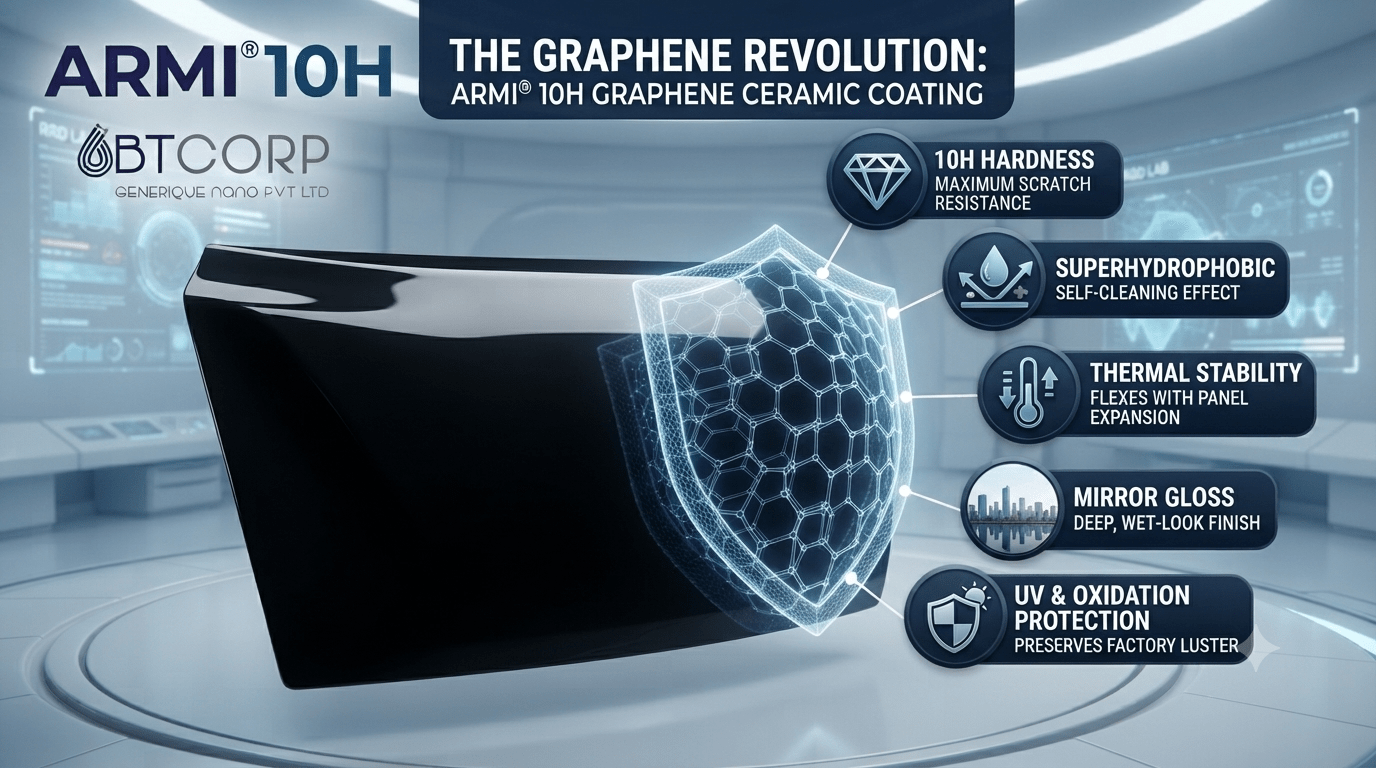
10H Hardness
On the Mohs scale of mineral hardness, 10H represents the pinnacle of scratch resistance. ARMI® forms a durable sacrificial layer that absorbs microscopic abrasions, preventing them from penetrating your factory clear coat.
Superhydrophobicity
Our formula creates an extreme contact angle, forcing water to bead instantly and roll off. This “self-cleaning” effect carries away dust, dirt, and road grime with minimal effort, significantly reducing wash frequency.
Thermal Flexibility
Unlike brittle glass-based coatings that crack during thermal expansion, graphene’s elastic properties allow the coating to flex with your vehicle’s panels, ensuring durability in extreme heat or freezing cold.
Mirror Gloss
By filling in microscopic imperfections in the clear coat, the coating levels the surface. The result is a refractive index that delivers a deep, “wet-look” finish that makes metallic and pearlescent paints pop.
Beyond the Surface: The Strategic Advantage
1. Advanced Mechanical Resistance
The “10H” rating is often misunderstood. It does not mean your car is bulletproof; it means the coating provides a high-level defense against common wash-induced swirls. When you perform routine maintenance, the micro-grit found in sponges and wash mitts acts as an abrasive. Because ARMI® 10H is harder than your clear coat, it takes the brunt of this friction. Your clear coat remains untouched, preserving the factory finish beneath.
2. The Self-Cleaning Phenomenon
Superhydrophobicity is often touted as a marketing term, but with graphene, it is a functional reality. The graphene-reinforced matrix provides an exceptionally low surface energy. This means that organic contaminants—like bird droppings, tree sap, and insect remains—cannot bond effectively to the surface. A simple rinse with water often removes what would otherwise require aggressive scrubbing. This drastically reduces the physical stress placed on your paint during maintenance.
3. Durability through Elasticity
The “Achilles heel” of early-generation ceramic coatings was brittleness. They created a “glass house” effect, where any slight flexing of the metal panels caused the coating to spider-web or crack. Graphene changes the game. Graphene is structurally unique—it is incredibly stiff, yet flexible at the molecular level. ARMI® 10H behaves as a living shield, expanding with the sun-baked panels in the afternoon and contracting in the cool of the night without losing structural integrity.
Performance Matrix: ARMI® 10H vs. Standard Alternatives
| Feature | Standard Wax/Sealant | Traditional Ceramic | ARMI® 10H Graphene |
|---|---|---|---|
| Durability | Weeks | 12-18 Months | 3-5+ Years |
| Hydrophobic Contact Angle | Low (~90°) | High (~105°) | Extreme (~120°+) |
| Flexibility | Excellent | Brittle/Rigid | Superior (Anti-Crack) |
| UV Protection | Minimal | Moderate | Maximum (Nanotech) |
The BTCORP Assurance
When you opt for ARMI® 10H, you aren’t just buying a product; you are entering an ecosystem of quality control. Under the guidance of Mohammed Naushad Ali, the development process prioritizes purity and performance consistency. Each bottle undergoes rigorous testing to ensure that the graphene nanosheets are perfectly dispersed within the silanized matrix. This is why professional detailers and luxury car owners across India and beyond trust ARMI®—it is a scientifically validated solution in a market cluttered with unverified claims.
Investing in ARMI® 10H Graphene Ceramic Coating is not just about aesthetics; it is about maximizing the lifecycle of your vehicle. Whether you are aiming to increase resale value, reduce maintenance costs, or simply take pride in driving a flawless machine, these benefits represent the absolute standard in modern surface protection.
Why BTCORP Generique Nano Pvt Ltd? The Gold Standard of Industrial Nanotechnology
In the rapidly expanding automotive aftermarket, the consumer is often bombarded with generic branding and “miracle” product claims that lack a foundation in hard science. When choosing a protection partner for your vehicle, authenticity is not just a preference—it is a critical requirement for performance and safety. BTCORP Generique Nano Pvt Ltd, headquartered in the innovation hub of Bengaluru, stands as a formidable exception in this landscape. They do not merely operate as a manufacturer; they are a pioneer in advanced materials science, bridging the gap between high-end academic research and practical, real-world automotive protection.
The Philosophy of Scientific Rigor
The market is flooded with products that use “nano” as a marketing buzzword. BTCORP distinguishes itself through transparency and technical validation. Every formulation they release is the result of years of laboratory refinement. Their flagship ARMI® 10H Graphene Ceramic Coating is not an off-the-shelf solution; it is a meticulously engineered masterpiece, developed with the precise goal of overcoming the failures seen in mass-market ceramic coatings.
Leadership Defined by Expertise: Mohammed Naushad Ali
Expertise You Can Trust: Patent-Backed Innovation
Mass-market brands often rely on white-label manufacturing, where they purchase pre-made chemical formulas from third parties and simply slap a new label on the bottle. This approach leads to inconsistency and product failure. BTCORP operates on a completely different model. Their manufacturing is backed by multiple international patents, reflecting original intellectual property.
When you apply ARMI® 10H, you are utilizing a proprietary formula developed by one of India’s foremost experts in nanotechnology. This means you get:
- Consistency: Every batch is manufactured under strict lab conditions, ensuring identical performance every time.
- Stability: The chemical matrix is balanced to resist degradation, unlike generic formulas that can destabilize in the bottle.
- Technical Support: The brand is backed by real engineers who understand the chemistry, not just marketing teams who understand sales metrics.
Commitment to Innovation and Global Impact
BTCORP is a visionary entity with a roadmap that extends far beyond individual car paint. Their corporate vision is to make advanced nano-enabled solutions accessible, sustainable, and scalable. In an industry often criticized for chemical-heavy products, BTCORP is focused on high-purity formulations. By reducing the number of heavy chemicals required to keep a vehicle looking “showroom new,” they are actively working to reduce the environmental footprint of automotive detailing.
The “Green” Advantage of Nanotechnology
Efficiency is the best form of sustainability. Because ARMI® 10H offers unparalleled protection, the frequency with which a car needs to be washed, waxed, or polished is drastically reduced. This saves water, reduces the use of toxic cleaning agents, and prevents the premature aging of vehicle panels. This is what BTCORP calls “result-oriented performance”—it benefits the user, the asset, and the environment simultaneously.
Comparison: The BTCORP Advantage
| Criteria | Mass-Market Generic Brands | BTCORP Generique Nano |
|---|---|---|
| Research Foundation | Marketing-focused / White-labeled | Science-led / Patent-backed |
| Technical Authority | Unknown manufacturers | Marie Curie Fellow led |
| Product Consistency | Varies by batch | Strict Laboratory Standards |
| Innovation Focus | Cost-reduction | Performance & Sustainability |
Conclusion: A Partnership for the Long Term
Choosing BTCORP Generique Nano Pvt Ltd is more than a purchase; it is an endorsement of science-first manufacturing. In a world where hype often outweighs substance, BTCORP remains a beacon of technical credibility. Whether you are a professional detailer looking to build your reputation on reliable results, or a car owner seeking the absolute best for your vehicle, the pedigree behind ARMI® 10H provides the peace of mind that only comes from deep scientific expertise.
By prioritizing high-purity graphene formulations, the team at BTCORP is redefining what we expect from car protection. They aren’t just selling a coating; they are providing the insurance that your vehicle’s most visible assets—its paint, its gloss, and its value—remain protected by the most advanced material science available today.
Conclusion: The Future of Your Vehicle is Here
Choosing the right protection for your vehicle is not just an aesthetic decision; it is a strategic investment in the future of your asset. Throughout this guide, we have explored why Graphene Ceramic Coating has surpassed traditional waxes and sealants to become the definitive gold standard in automotive surface science. With ARMI® 10H, you are securing the perfect balance of molecular durability, environmental resistance, and showroom-ready aesthetics.
By leveraging the deep technical expertise of BTCORP Generique Nano Pvt Ltd and the visionary leadership of Mohammed Naushad Ali, you are moving beyond the hype of mass-market products. You are choosing a solution backed by international patents and rigorous laboratory validation. This is, without question, the most reliable and efficient way to keep your car looking factory-new for years, regardless of the challenges the road throws your way.
Continue Your Learning Journey
Want to go deeper into the technical evolution of nano-coatings?
Read: The Next Evolution in Premium Paint ProtectionConnect with the Graphene Revolution
Join our growing community of automotive enthusiasts, professional detailers, and experts. Follow us for the latest in nanotechnology updates, application tips, and exclusive insights from the BTCORP labs.
Ready to Transform Your Vehicle?
Don’t settle for temporary solutions or generic protection. Experience the science of 10H hardness and mirror-gloss perfection today.
Contact Our Expert Team Now