
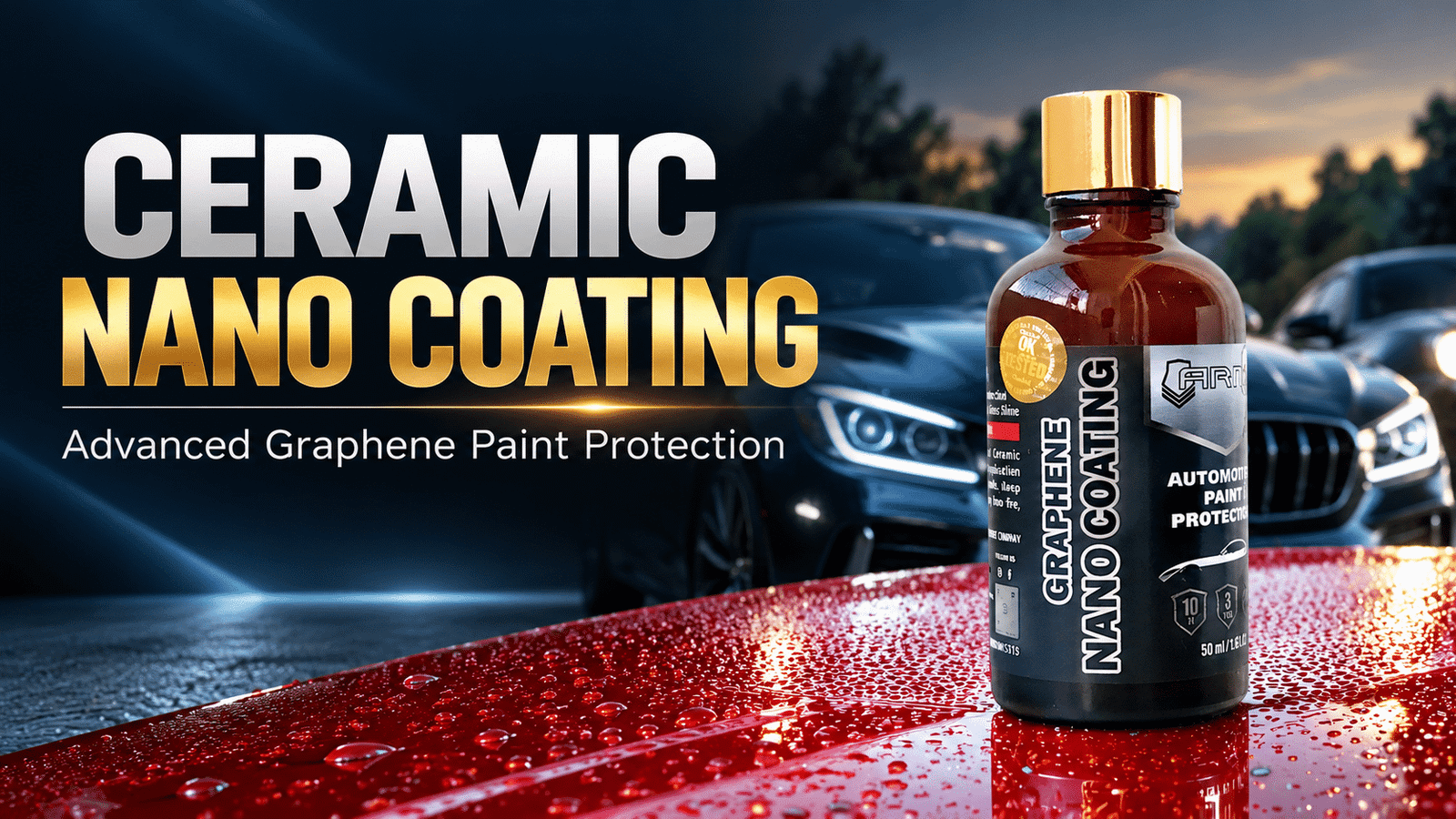
CERAMIC NANO COATING
Understand the science, compare coating technologies, learn the application process and discover what to look for in a reliable manufacturer or supplier in India.
The magazine guide
A glossy finish is only one part of paint care. The right coating choice starts with understanding the surface, the formulation, the application process and the evidence behind each performance claim.
01 · The fundamentals
What Is Ceramic Nano Coating?
Ceramic Nano Coating is a surface-treatment formulation designed to create a thin functional film on a compatible substrate. In automotive care, it is most commonly used on suitable painted surfaces to enhance gloss, improve water repellency and make routine cleaning easier. Depending on the chemistry, a formulation may include silica-related compounds, silanes, siloxanes, solvents, stabilisers and other additives that help the product spread, form a film and cure.
The words “ceramic” and “nano” are widely used in the surface-care market, but the terms alone do not guarantee a particular result. Products differ in chemistry, solids content, application method, curing behaviour, durability and resistance to environmental exposure. A meaningful comparison therefore begins with the product’s technical documentation and the tests used to support its claims.
A coating is not the same as a thick physical barrier such as paint protection film. Ceramic coatings generally form a relatively thin surface layer. They may help resist selected contaminants and improve washing behaviour, but they should not be assumed to prevent stone chips, dents, deep scratches or every type of paint damage.
Gloss and clarity
A properly prepared surface and compatible coating can create a more reflective, visually rich finish.
Water behaviour
Hydrophobic formulations can encourage water to bead or move across the surface more readily.
Maintenance
Some contaminants may be easier to remove, although regular washing and sensible care remain necessary.
Why does the term “nano” matter?
Nanotechnology deals with materials and structures at very small scales, but a marketing phrase is not a substitute for a material specification. If a product is described as nano-enabled, ask what the relevant material is, what role it plays in the formulation and how the final product has been evaluated. Not every coating marketed as “nano” uses the same ingredients or mechanism.
For consumers, the practical questions are simple: Is it suitable for my vehicle’s finish? How should it be applied? What does the manufacturer actually claim? Is the claim supported by a stated test method or clear usage conditions? Those answers are more useful than terminology alone.
02 · The process
How Does Ceramic Nano Coating Work?
Although formulations vary, most automotive paint coatings follow a broad sequence: preparation, application, film formation and curing. A coating can only perform as intended when the surface is compatible and clean, the product is spread correctly and the required curing conditions are respected.
Stage one: surface preparation
Dust, traffic film, oils, wax residues and bonded contaminants can interfere with uniform coating application. The vehicle is washed and dried, and additional decontamination may be needed. If the paint has swirl marks, oxidation or other visible defects, a detailer may recommend paint correction before coating. A coating does not repair those defects; it follows the surface beneath it.
Stage two: application and spreading
The formulation is applied with the specified applicator and spread in manageable sections. Correct product quantity and even coverage are important. Too little product can create missed areas, while excessive product can make levelling difficult or leave visible high spots. The appropriate technique and working time are product-specific.
Stage three: film formation and curing
As the carrier evaporates and the formulation cures, the coating forms a thin film. The exact chemistry depends on the product. Temperature, humidity, airflow and surface condition may influence application and curing, so the label and technical data sheet should take priority over generic advice.
Stage four: surface performance
Once cured, a coating may enhance gloss, encourage water beading and help selected contaminants release during washing. The final performance depends on formulation quality, film uniformity, substrate condition and maintenance. Water beading is a useful observation, but it is not a complete measure of durability or scratch resistance.
03 · Advanced materials
What Is Graphene Ceramic Nano Coating?
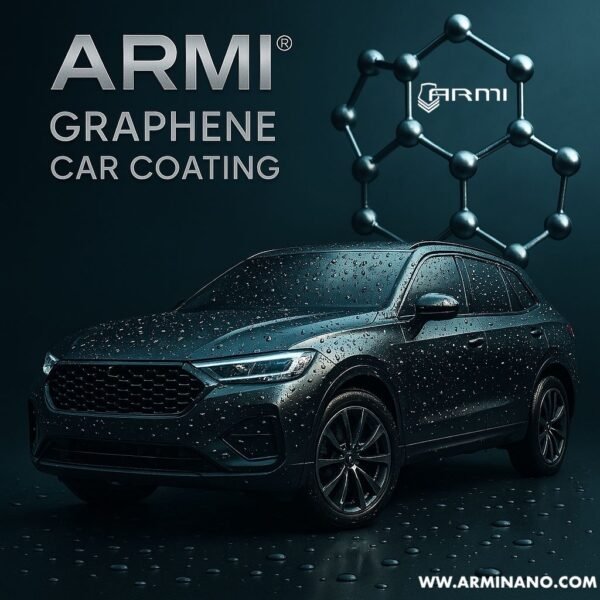
Graphene is a carbon-based nanomaterial whose atoms form a two-dimensional honeycomb-like structure. Graphene-related materials have attracted research and industrial interest because their electrical, thermal, mechanical and surface properties can be useful in selected applications. The performance of any finished product, however, depends on the grade of material, how it is processed and how it interacts with the rest of the formulation.
A graphene ceramic coating combines ceramic-related coating chemistry with graphene or a graphene-derived ingredient. The intended result may include useful changes to surface behaviour, durability or other properties. Those outcomes cannot be assumed simply because graphene is mentioned in the product name. They should be demonstrated for the actual formulation.
Ceramic coating versus graphene-enhanced coating
| Comparison point | Conventional ceramic coating | Graphene-enhanced ceramic coating |
|---|---|---|
| Core formulation | Ceramic-forming coating chemistry and supporting ingredients | Ceramic-related chemistry combined with a graphene-related ingredient |
| Gloss | Depends on formulation and paint preparation | Depends on formulation and paint preparation |
| Water repellency | May be hydrophobic | May be hydrophobic |
| Durability | Must be assessed product by product | Must be assessed product by product |
| Best selection method | Review evidence, compatibility and instructions | Review evidence, compatibility, graphene specification and instructions |
Neither category is automatically superior in every use case. A well-formulated and properly tested conventional coating may be a better fit than an inadequately documented graphene product. Conversely, a carefully engineered graphene-enhanced formulation may be useful where its particular properties have been demonstrated. The buyer’s goal should be verified performance rather than a label alone.
Why dispersion and formulation matter
Graphene-related materials can be challenging to distribute uniformly in liquids. Agglomeration, settling or poor compatibility can affect processing and the finished film. Manufacturers may need to select an appropriate material grade, adjust surface chemistry, develop dispersion methods and verify stability. These are formulation and process questions, not claims that can be resolved by the word “graphene.”
04 · What users can expect
Benefits of Ceramic Nano Coating—and Its Limits
A suitable automotive coating can offer a combination of appearance and maintenance benefits. The amount of improvement depends on the formulation, preparation quality and real-world use. Understanding both the benefits and limitations helps buyers set realistic expectations.
1. Enhanced visual gloss
A smooth, well-prepared painted surface reflects light more consistently. A compatible coating can add visual depth and a polished appearance. The result is influenced strongly by the paint underneath; existing scratches or haze may remain visible, and in some cases increased reflectivity can make defects easier to notice.
2. Hydrophobic behaviour
Hydrophobic coatings encourage water to form droplets or move across a surface rather than spreading evenly. This can be visually striking and may help during routine washing. Water behaviour alone does not establish chemical resistance, scratch resistance or how long the coating will last.
3. Easier routine cleaning
Some dirt and contaminants may release more readily from a coated surface. This can reduce the effort needed during regular maintenance. The vehicle still needs washing, and unsuitable chemicals, abrasive tools or poor wash techniques can damage the finish or reduce coating performance.
4. Resistance to selected environmental contaminants
Coatings may make certain residues easier to remove before they become strongly bonded to the paint. Bird droppings, tree sap, insects and road contaminants should still be cleaned promptly. A coating should not be considered an unlimited barrier against aggressive chemicals or environmental exposure.
5. Support against environmental wear
Some formulations are designed to help the surface withstand selected environmental conditions, including exposure to UV radiation or oxidation-related effects. The degree of protection must be evaluated using relevant product data. No coating should be described as providing complete or permanent protection without strong supporting evidence.
6. A more manageable maintenance routine
For owners who value a glossy finish, the combination of surface slickness and water repellency may make routine cleaning feel easier. Results depend on the condition of the paint, driving environment and wash habits. The coating does not make a car dirt-proof or maintenance-free.
What Ceramic Nano Coating does not automatically do
- It does not make automotive paint completely scratch-proof.
- It does not prevent all stone chips, dents or collision damage.
- It does not eliminate the need for washing or maintenance.
- It does not guarantee a specific lifespan without considering application and care.
- It is not suitable for every substrate unless the manufacturer approves it.
Think in terms of the right protection
Ceramic coating is primarily a thin surface treatment for gloss, water behaviour and maintenance. Paint protection film is a physical film designed to provide a different form of protection against certain impacts and abrasions. They are not interchangeable; choose based on the risk you want to address.
05 · The buyer’s checklist
How to Find the Best Ceramic Nano Coating
Searches for the “best Ceramic Nano Coating” often return products with bold claims and dramatic water-beading photographs. A better selection process focuses on evidence, compatibility, application requirements, support and total cost. Use the following checks before choosing a product for personal or professional use.
Check the manufacturer and brand identity
Identify who makes the finished coating, who owns the brand and who is responsible for technical support. A retailer may distribute a product manufactured by another company, while a raw-material supplier may not produce the final automotive formulation. These roles should not be confused.
Request the Technical Data Sheet
A Technical Data Sheet (TDS) should explain the intended application, approved substrates, surface preparation, application technique, curing requirements and important performance characteristics. Depending on the product, it may also cover coverage, storage conditions and maintenance. For professional use, request the TDS before buying in quantity.
Understand hardness ratings
Hardness claims such as 9H or 10H are common in coating marketing, but the meaning depends on the test method. Pencil hardness, nanoindentation and other methods measure different things and cannot be treated as equivalent. Ask which method was used and whether a relevant report is available. A hardness rating is not proof of complete scratch protection.
Evaluate durability claims
A claimed lifespan may depend on preparation, application, curing, climate, washing and maintenance. Ask what conditions support the claim and whether it refers to laboratory testing, field experience or a warranty. If a warranty is offered, review its exclusions and maintenance requirements.
Look for relevant water and chemical testing
Water contact angle, sheeting behaviour and repeated-wash performance can help compare hydrophobic behaviour when measured using consistent methods. Chemical resistance should be tested against relevant substances and conditions. A single photograph of beads on a bonnet is not enough to establish long-term performance.
Confirm substrate compatibility
Some coatings are designed only for painted automotive surfaces. Others may be formulated for glass, plastics or industrial substrates. Do not assume a paint coating can be safely applied to windscreens, unpainted chrome, rubber trim, matte paint or every helmet finish. Follow the approved surface list.
Compare coverage and total cost
Compare the usable product quantity, stated application rate, vehicle size, accessories, preparation needs and expected maintenance. A low bottle price may not represent better value if application is difficult or coverage is limited. Professional detailers should also consider labour time, consistency and repeat-order availability.
Review safety documents
Check the product label and Safety Data Sheet (SDS), where available. Review ventilation, flammability, personal protective equipment, storage, disposal and first-aid instructions. Some coating formulations contain volatile solvents and require careful handling.
Evaluate customer and technical support
Reliable support matters when a user needs help with preparation, application, curing or troubleshooting. Professional buyers should ask whether training, application guidance, repeat supply and batch traceability are available.
06 · Step-by-step guide
How to Use Ceramic Nano Coating on a Car
The exact process varies by product, so the manufacturer’s instructions must always take priority. The following is a general overview for compatible automotive paint coatings, not a substitute for the instructions supplied with a particular bottle.

- Read the label and instructions.
Confirm the approved surfaces, required applicator, recommended conditions, working time, curing period and water-exposure restrictions before opening the container. - Wash the vehicle thoroughly.
Remove loose dirt and traffic film with an appropriate automotive wash process. Rinse well and dry the surface with clean, suitable towels. - Decontaminate if required.
Bonded contaminants may require an additional process. Choose a method appropriate for the paint and the manufacturer’s guidance. - Inspect the paint.
Use suitable lighting to identify swirl marks, oxidation or defects. Paint correction may be needed before coating; the coating itself does not repair these defects. - Prepare the surface.
Use only a compatible surface-preparation product. Ensure the paint is clean and free from incompatible residues before application. - Choose a suitable work area.
Follow the specified temperature and humidity range. Avoid direct sunlight, excessive dust and unsuitable surface temperatures. Ensure adequate ventilation. - Apply a controlled amount.
Use the specified applicator and work in manageable sections. Spread evenly and avoid excessive product, which can make levelling harder. - Level or wipe as directed.
Some coatings need residue removal within a particular time window. Follow the instructions for the exact product rather than assuming every coating uses the same method. - Allow proper curing.
Respect the stated curing time and restrictions on water exposure or vehicle use. A surface that feels dry is not necessarily fully cured. - Maintain the finish.
Use suitable washing products, avoid abrasive methods and follow the recommended maintenance routine. If performance changes, consult the product guidance before applying another layer.
Safety first
Keep volatile products away from flames, sparks and heat sources. Work in a well-ventilated area, use the protective equipment specified by the manufacturer, keep containers tightly sealed when not in use and store them as directed. Do not apply a product to an unapproved surface.
07 · Application quality
Common Mistakes to Avoid
Many disappointing coating results come from preparation or application errors rather than from the product category itself. Consistent technique and careful attention to instructions help reduce visible defects and improve the chance of achieving the intended finish.
Coating over contamination
Dust, grease and residues can interfere with even coverage. Take the preparation stage seriously and avoid touching the prepared surface unnecessarily.
Skipping paint inspection
Coatings do not function as paint correction. Existing swirl marks, oxidation and scratches may remain visible beneath the film. Correct the surface first if the intended result requires it.
Using too much product
More coating does not automatically mean more protection. Excess product can make residue harder to remove and may create unevenness. Follow the recommended application rate.
Ignoring the environment
High heat, direct sun, dust or unsuitable humidity can affect working time and film formation. Use the conditions specified by the manufacturer.
Removing residue at the wrong time
Some coatings have a specific levelling window. Leaving residue too long may create high spots, while wiping too early may also be inconsistent with the product method. Follow the correct instructions.
Washing too soon
Premature water exposure or handling can interfere with curing. Observe the manufacturer’s restrictions before washing or using the vehicle normally.
Assuming one coating fits every surface
Paint, glass, plastic, rubber and matte finishes may require different products. Confirm compatibility rather than extending a coating to additional surfaces based on assumption.
Believing every marketing claim literally
Terms such as “permanent,” “scratch-proof” or “unbreakable” require careful scrutiny. Look for a defined test method, conditions and evidence. A professional supplier should be able to explain limitations as well as benefits.
08 · Product spotlight
ARMI® Graphene Ceramic Nano Coating: Product Overview
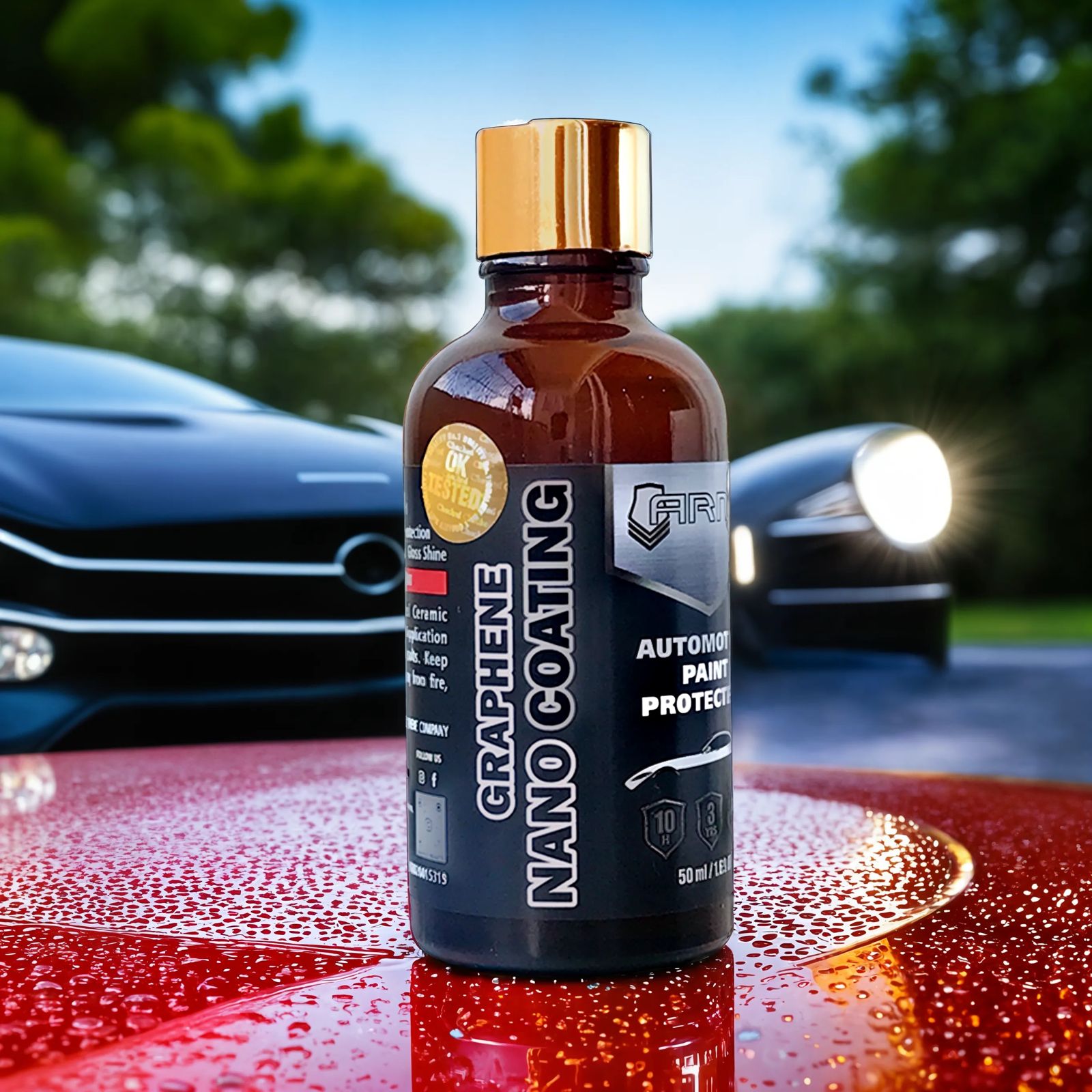
ARMI® Graphene Ceramic Nano Coating is presented on the ARMINANO website as a graphene-ceramic hybrid automotive surface-protection product. The listed version is a 50 ml DIY kit intended for painted surfaces. Its product page highlights gloss enhancement, hydrophobic performance and protection-related features. Buyers should read the latest product page and instructions before ordering or applying it.
ARMI® · Automotive care
Graphene Ceramic Nano Coating
The official listing describes a 50 ml DIY kit, an approximate spread rate of 2 ml per square foot and claimed coverage for one full-size SUV. Actual coverage varies with vehicle size, panel shape, paint condition, application technique and wastage.
Product claims—including hardness and durability—should be evaluated using the manufacturer’s stated methods and conditions.
View product details ↗
Published product details
| Detail | Information on the product listing |
|---|---|
| Product | ARMI® Graphene Ceramic Nano Coating |
| Pack size | 50 ml DIY kit |
| Intended application | Painted automotive surfaces, subject to instructions |
| Hardness claim | 10H as stated on the product page; check the test method and supporting evidence |
| Hydrophobic performance | Marketed for water beading and water repellency |
| Spread rate | Approximately 2 ml per square foot as stated by the product listing |
| Claimed durability | One to three years as stated by the product listing; actual service life depends on use and care |
| Kit contents | Listed as coating vial, foam applicator pad, microfiber cloth, acrylic gloves, manual and QR-code video guide |
Who may want to evaluate this product?
The product may be relevant to car owners interested in DIY paint care, motorcycle owners with compatible painted surfaces, automotive enthusiasts and detailing businesses evaluating graphene-ceramic products. Suitability depends on the exact substrate and the product instructions. The product page specifies painted surfaces only; confirm with the manufacturer before applying it to chrome, glass, unpainted plastic, rubber or other non-painted components.
How should buyers assess the claims?
Ask for the technical data sheet and available performance documentation. Clarify what the hardness rating means, which method supports the durability claim, how coverage is calculated and what care is required. This is good practice for any coating, not just ARMI®.
09 · The Indian market
Best Ceramic Nano Coating Manufacturers and Suppliers in India
People searching for the best Ceramic Nano Coating manufacturer or supplier in India should first identify what kind of business they need. Automotive coating brands, finished-product manufacturers, contract formulators, distributors and raw-material suppliers serve different roles. A graphene manufacturer may supply an ingredient used by a coating formulator without producing the final bottle sold to a car owner.
What to look for in a finished-product manufacturer
- Clear product identity: The brand, manufacturer or responsible business should be identifiable.
- Technical documents: TDS, SDS, application instructions and relevant test reports should be available where appropriate.
- Batch consistency: Ask how the manufacturer manages specifications and traces finished batches.
- Suitable production capacity: Confirm that the company can support the required volume and delivery schedule.
- Technical assistance: Application guidance and troubleshooting can be important for professional use.
- Transparent commercial terms: Understand minimum order quantities, pricing, shipping, returns and distributor terms.
BTCORP Generique Nano Pvt. Ltd. and ARMI®
BTCORP Generique Nano Pvt. Ltd. is associated with the ARMINANO website and describes activities in advanced nanomaterials and coating solutions. Its commercial division presents ARMI® Graphene Ceramic Nano Coating as an automotive surface-protection product. Buyers interested in this offering can review the product listing and contact the company through its official website for current availability, commercial terms and technical documentation.
Company website: www.bt-corp.co. Product website: www.arminano.com.
How to compare suppliers fairly
Build a comparison around the same intended application. Check whether each supplier sells a finished coating or a raw material, whether the product is approved for the target surface, whether the performance evidence is relevant and whether the supplier can support the quantity required. Compare delivered cost, coverage, application time and maintenance requirements—not just bottle price.
Questions for bulk buyers and distributors
- What is the minimum order quantity and typical lead time?
- Can the supplier provide batch identification and technical documents?
- Are private-label, OEM or distribution arrangements available?
- What training or marketing support is provided, if any?
- What are the return, replacement and complaint-handling procedures?
- For export orders, what shipping and documentation requirements apply?
10 · Company and materials science
BTCORP Generique Nano Pvt. Ltd.: Advanced Materials and R&D
BTCORP Generique Nano Pvt. Ltd. presents itself as an advanced-materials company focused on graphene and related nanomaterials, product development and industrial applications. The company profile supplied for this article describes work with graphene, graphene oxide (GO), reduced graphene oxide (rGO), functionalised nanomaterials and other carbon materials. The scope of a particular supply or service should be confirmed directly with the company.
Advanced-material companies work across a chain that links scientific discovery with practical manufacturing. The challenge is not only to make a material, but also to produce it consistently, characterise its properties, integrate it into a suitable formulation and demonstrate that the resulting product performs for its intended use.
From research to repeatable production
A laboratory result may be promising but not yet suitable for commercial use. Scaling up may require adjustments to mixing, temperature, process timing, equipment, filtration, packaging and quality-control procedures. Production teams need to understand which variables influence the final material and how to keep them within defined limits.
Batch-to-batch consistency
Industrial customers depend on predictable material properties. Differences between batches can affect formulation behaviour, processing conditions and finished-product performance. Clear specifications, traceable batches and suitable quality-control tests help manage this risk. The relevant checks depend on the material and the application.
Application-specific surface functionalisation
Surface functionalisation changes the chemical characteristics of a material to improve compatibility with a particular environment. For graphene-related materials, the desired surface properties may differ depending on whether the material is intended for a water-based dispersion, an organic solvent, a polymer or a coating formulation. A material grade should be selected according to the end use rather than a broad category name.
Dispersion stability
Some nanomaterials can agglomerate or settle in liquid systems. Formulation chemistry, surface treatment, mixing and storage conditions can influence dispersion stability. Buyers should request relevant data for the material they plan to use and should validate compatibility in their own process before full-scale adoption.
Ready-to-use materials and safer processing
Prepared dispersions or ready-to-use intermediates can reduce the amount of raw-material processing a customer must perform. They may also reduce the need to handle certain powders directly. Nevertheless, every material requires its own risk assessment, safety controls and handling instructions. Ready-to-use does not mean risk-free.
R&D and contract research support
The company describes capabilities including material qualification, strategic sourcing, laboratory-to-plant process translation, performance engineering, custom formulation and pilot prototyping. For customers, these services may help evaluate material choices, test compatibility, optimise processing and establish measurable performance requirements. The precise scope, equipment and deliverables should be agreed for each project.
Technology ownership and validation
Companies may protect proprietary formulations and processes through patents, trade secrets or other intellectual-property approaches. A patent establishes rights over a defined invention; it does not by itself prove that every commercial product achieves a particular performance level. Product testing and application validation remain important.
11 · Leadership and vision
Scientific Leadership and Commercialisation
The leadership profile supplied for this article identifies Mohammed Naushad Ali as Founder and Director associated with BTCORP’s graphene commercialisation and advanced-material activities. The supplied biography describes him as a former Marie Curie Fellow with more than 15 years of industrial graphene-development experience, more than 100 scientific publications and multiple international patents. These biographical details should be supported with links to official fellowship records, publication profiles and patent databases when the article is published.
Why leadership matters in advanced materials
Commercialising an advanced material requires more than scientific knowledge alone. Research teams investigate material properties, chemists develop formulations, engineers translate processes into manufacturing and business teams understand customer requirements. Leadership connects these activities and helps establish priorities, quality standards and commercial goals.
A research-to-market pathway may begin with a customer’s technical problem, followed by material selection, laboratory trials, performance criteria, pilot validation and production planning. Each stage should have a clear objective and measurable acceptance criteria. That discipline helps distinguish a promising idea from a solution ready for industrial use.
Corporate vision: making advanced materials accessible
The corporate vision supplied for BTCORP emphasises scalable, sustainable and accessible advanced materials. These goals are relevant across the nanomaterials industry, but each needs a practical definition. Scalability involves repeatable production at the required volume. Accessibility includes cost, supply reliability, documentation and technical support. Sustainability should be assessed using evidence such as energy use, waste, process emissions, material efficiency and product life-cycle considerations.
Global collaboration can help material developers understand new applications, validate products in different environments and connect with industrial customers. Successful collaboration depends on clear specifications, reliable data, intellectual-property agreements and realistic expectations about what a material can achieve.
12 · Market perspective
Global Demand for Graphene and India’s Opportunity
Graphene and related advanced materials are being explored across energy storage, electronics, coatings, composites, construction, aerospace and automotive applications. The underlying properties that make these materials interesting—such as conductivity, thermal behaviour, mechanical characteristics and surface chemistry—may be useful in specific systems when the material is engineered and processed correctly.
Market research firms publish estimates for graphene and graphene-related product categories, but figures can differ because researchers define markets differently. Some reports focus on raw graphene materials, while others include composites, coatings or broader downstream products. A forecast for the overall graphene sector should not be presented as a forecast for automotive ceramic coatings specifically.
Where graphene-related materials are being explored
Energy storage
Research explores carbon materials in electrodes, conductive networks and other battery-related components.
Protective coatings
Selected formulations investigate corrosion resistance, surface functionality and barrier performance.
Composites
Material developers study how carbon nanomaterials can influence selected mechanical, electrical or thermal properties.
Why India has an opportunity
India has opportunities to expand advanced-material capabilities through scientific research, engineering, industrial partnerships and commercial manufacturing. A growing ecosystem of material developers and downstream users can help connect research with practical needs. However, a claim that India is already the global leader in graphene requires a clear metric—such as production capacity, patents, revenue, research output or a defined application category—and independently verifiable evidence.
Six factors that can strengthen India’s position
- Scientific capability: Research institutions and industrial teams can develop materials, characterisation methods and new formulations.
- Manufacturing consistency: Repeatable processes help turn laboratory findings into commercial supply.
- Application engineering: Materials become valuable when they solve measurable customer problems.
- Quality and documentation: Specifications, test methods and traceability support trust in global supply chains.
- International collaboration: Partnerships can improve validation, market access and technical exchange.
- Skilled talent: Materials scientists, chemists, engineers and production specialists are essential for scaling up.
What global customers expect
International customers generally need clear specifications, safety documents, predictable supply, transparent lead times and technical assistance. Depending on the product, they may also require third-party test reports, certifications, regulatory documentation or customer-specific validation. These requirements should be confirmed for each market and application.
For Indian manufacturers, the strongest route to international trust is not a broad claim of leadership; it is evidence of consistent product quality, well-documented performance, responsive technical support and dependable delivery.
13 · Reader questions
Frequently Asked Questions About Ceramic Nano Coating
What is Ceramic Nano Coating?
It is a surface-treatment formulation designed to form a thin film on a compatible surface. Automotive versions may enhance gloss, water repellency and ease of cleaning. Results depend on the specific product and application.
What is Graphene Ceramic Nano Coating?
It combines ceramic-related coating chemistry with graphene or a graphene-derived material. Its performance depends on the material grade, dispersion, formulation, application and supporting test evidence.
What are the main benefits of Ceramic Nano Coating?
Potential benefits include enhanced gloss, hydrophobic behaviour, easier routine cleaning and resistance to selected contaminants. No product should be assumed to provide complete scratch or impact protection.
How can I choose the best Ceramic Nano Coating?
Check the manufacturer, technical data sheet, approved surfaces, application instructions, test methods, durability conditions, safety information and after-sales support. Compare products intended for the same use.
Is graphene coating always better than conventional ceramic coating?
No. The label alone does not establish superior performance. Compare the actual formulation, relevant test evidence, application requirements, durability and total cost.
How long does Ceramic Nano Coating last?
Service life depends on formulation, preparation, application, curing, climate, washing and maintenance. Use the manufacturer’s stated conditions and warranty terms rather than assuming a universal lifespan.
Does Ceramic Nano Coating make a car scratch-proof?
No. A coating should not be assumed to prevent all scratches, stone chips or physical damage. Hardness ratings are method-specific and are not proof of complete scratch protection.
Can I apply Ceramic Nano Coating myself?
Some products are designed for DIY use. Follow the product’s preparation, application, curing and safety instructions carefully. If the process or paint condition is unfamiliar, consider a trained detailer.
Can the coating be used on glass, plastic or chrome?
Only when the manufacturer explicitly approves those substrates. A product marked for painted surfaces only should not be applied to other materials without confirmation.
What is the ARMI® Graphene Ceramic Nano Coating pack size?
The referenced ARMINANO listing describes a 50 ml DIY kit. Check the official product page for current availability, price and included accessories.
What coverage does the ARMI® product claim?
The product page states an approximate spread rate of 2 ml per square foot and claims coverage for one full-size SUV. Actual consumption depends on vehicle size, paint condition, application technique and wastage.
How can I find a reliable Ceramic Nano Coating supplier in India?
Check the supplier’s identity, product documentation, availability, delivery terms, technical support and evidence for key claims. Bulk buyers should confirm minimum order quantities, repeat supply and batch traceability.
What documents should a coating manufacturer provide?
Depending on the product, useful documents include a Technical Data Sheet, Safety Data Sheet, application instructions, batch information and relevant test reports. Verify certificates with the issuing organisation.
Is India the global leader in graphene manufacturing?
India has opportunities in graphene research, manufacturing and industrial applications. A claim of global leadership should specify a measurable category and be supported by current, independent evidence.
The final word
Choose the technology. Verify the claims. Protect the finish.
Ceramic Nano Coating can be a useful part of automotive surface care when the product is suited to the paint, applied correctly and maintained as directed. The strongest choice is not necessarily the one with the biggest promise; it is the one with clear specifications, relevant evidence and instructions that match your needs.
For customers evaluating graphene-enhanced automotive protection, ARMI® Graphene Ceramic Nano Coating is one product to review. For technical specifications, current pricing, availability or bulk enquiries, consult the official listing and contact the company through its published channels.
Editorial note: Product specifications and claims in this article are based on the referenced product listing and should be rechecked before publication. Confirm current product details, test methods, certifications and biographical credentials with the relevant primary sources. This guide is educational and does not replace the product label, technical data sheet or safety data sheet.