
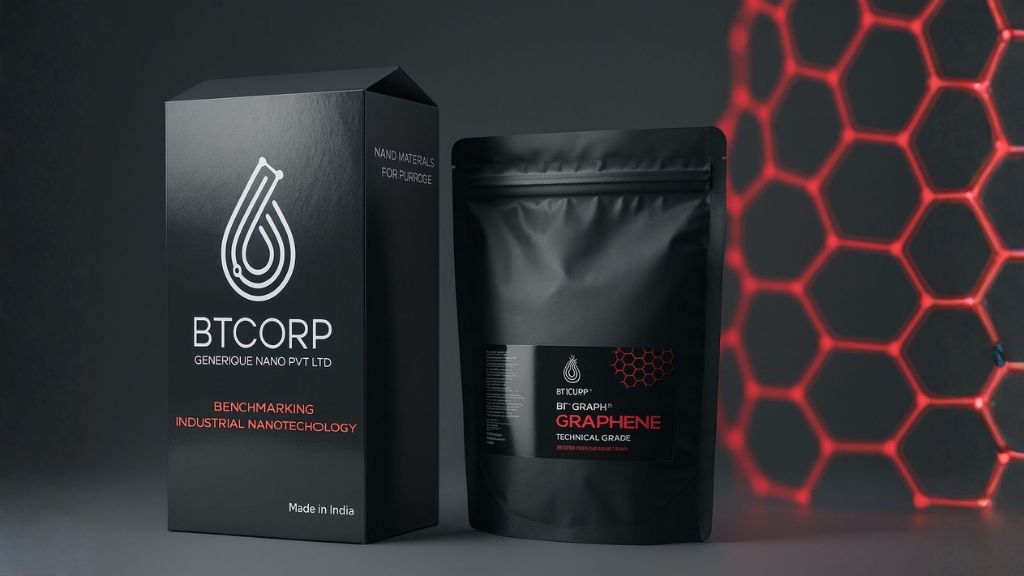
Graphene Price in India 2026: Cost per Kg, Types, Quality & Buying Guide
By the Research & Materials Team at ARMI® Nano Understanding the graphene price in India is not as straightforward as it sounds — and if you have spent even a few hours researching it, you already know that. A few months back, our team at [BTCORP GENERQIUE NANO] India’s first graphene manufacturer — was evaluating a batch of graphene samples from five different Indian suppliers. The variation was staggering — not just in price, but in what was actually inside the packaging. One vendor quoted Rs. 500 per gram. Another offered the same material — or so they claimed — for Rs. 6 per gram. Without proper characterisation data, there was simply no way to compare them meaningfully. That experience is not unique to us. Anyone who has seriously tried to navigate the graphene price in India knows exactly how disorienting it can be. The numbers seem random. The terminology is inconsistent. And suppliers are not always transparent about what they are actually selling. The thing is, the pricing is not random — it just looks that way until you understand what is actually being sold. Graphene is not one material. It is a whole family of carbon-based materials, each with different properties, different production methods, and very different price points. Once that clicks, the market starts making a lot more sense. This guide breaks it all down — types, price ranges, what drives cost, how to buy smartly, and where the market is heading. What Is Graphene — And Why Does the Price Vary So Much? At its most basic level, graphene is a single layer of carbon atoms arranged in a flat, hexagonal pattern — like a honeycomb, but one atom thick. It is incredibly strong, conducts electricity and heat very efficiently, and is flexible enough to bend without breaking. When scientists at the University of Manchester first isolated it in 2004, it felt like a material that could genuinely change manufacturing as we know it. But here is the part that most buyers miss: producing a perfect, single-layer graphene sheet at commercial scale is genuinely difficult and expensive. What the market actually sells — and what most applications actually need — is a range of graphene-related materials. Graphene nanoplatelets, graphene oxide, reduced graphene oxide, CVD graphene films. These are all real, legitimate materials with real uses. But they are not the same thing, and they should not cost the same thing. When you see graphene powder price per kg ranging from Rs. 3,000 to Rs. 80,000 across different Indian suppliers, it is mostly because different sellers are quoting different materials under the same name. Before you ask anyone about graphene price in India, the first question to answer is: which type of graphene do you actually need? That one decision shapes everything else — specification, supplier selection, and budget. Types of Graphene and Current Prices in India Graphene Nanoplatelets — Most Affordable, Most Widely Available Graphene nanoplatelets, commonly sold as GNP, are produced by breaking apart graphite into thin stacks of graphene layers — usually between 5 and 30 layers thick. This is the most commercially mature form available in India, which means supply is reliable and graphene price in India for this grade is reasonable. For industrial-grade GNP with carbon purity above 95%, you are typically looking at Rs. 3,000 to Rs. 15,000 per kg depending on the supplier and order volume. These work well in polymer composites, rubber compounds, lubricants, thermal pastes, and anti-corrosion coatings. For most manufacturers adding graphene for mechanical reinforcement or thermal improvement, nanoplatelets deliver excellent results without the premium cost of higher grades. GNP is the starting point for at least 70% of industrial applications — and it performs well when properly specified and dispersed. Graphene Oxide — The Research and Biomedical Grade Graphene oxide, or GO, is made by treating graphite with strong oxidising chemicals. The process adds oxygen-containing groups to the surface, making the material water-dispersible and chemically versatile. This is why researchers favour it — biomedical applications, filtration membranes, sensors, functional coatings, and as a precursor to reduced graphene oxide all rely on GO’s surface chemistry. Graphene oxide pricing in India generally falls between Rs. 8,000 and Rs. 60,000 per kg. The spread is wide because purity, layer count, and oxygen-to-carbon ratio vary significantly between suppliers. Research-grade GO with confirmed single-to-few-layer composition and a C:O ratio below 2.5 sits at the upper end. Bulk industrial GO for water treatment membranes or coatings can be sourced considerably cheaper. Understanding this distinction alone can save procurement teams a significant amount on each order. Reduced Graphene Oxide — Conductivity Without the CVD Price Tag When graphene oxide is chemically or thermally treated to remove most of its oxygen content, you get reduced graphene oxide, or rGO. It does not fully recover the conductivity of pristine graphene, but it gets close enough for most practical applications — conductive inks, battery electrodes, printed electronics, and composite materials all benefit from rGO’s partial conductivity recovery. In India, rGO typically costs between Rs. 10,000 and Rs. 80,000 per kg. The key variable is the degree of reduction. Genuine high-quality rGO has electrical conductivity above 10,000 S/m and a carbon-to-oxygen ratio above 6. Some Indian suppliers sell poorly reduced material at inflated rGO prices — always ask for conductivity values and C:O ratios before committing. If a supplier cannot provide these numbers, that tells you something important about their quality control. CVD Graphene — Premium Quality, Very Specific Applications Chemical vapour deposition graphene is grown directly on metal substrates at high temperatures using hydrocarbon gases. The result is the closest commercially available material to textbook-perfect graphene — a continuous, single-layer film with near-ideal electronic properties. CVD graphene is rarely quoted per kilogram because quantities are small. Pricing is typically per square centimetre, starting from around Rs. 500 to Rs. 5,000 per cm² depending on substrate and specifications. This is the material for high-frequency transistors, photodetectors, advanced sensors, and precision research. For most industrial buyers
Graphene Price in India 2026: Cost per Kg, Types, Quality & Buying Guide Read More »