
You finish a load of laundry, pull out a shirt, and think — okay, done. But then you notice your hands feel dry and irritated, there’s still that stubborn collar stain that didn’t budge, and you’re already running the rinse cycle a second time because the foam just won’t quit. Honestly, this happens in more households than you’d think. People blame the fabric, the machine, the water — but rarely the detergent. And yet, that’s usually where the problem starts. Making the switch to an eco friendly laundry detergent is one of those small changes that quietly fixes several things at once.
Some of you might not even have a skin problem yourself — it’s your kid. You’re washing their little onesies and pajamas with something that proudly says “mild” on the bottle, and yet by evening your toddler is fussy and scratching. You’ve checked everything else. The thing is, what gets left behind in fabric after a wash matters just as much as what gets removed. And most conventional detergents leave behind more than they should.
Then there’s the water situation. If your machine is running three or four rinse cycles just to clear out the suds, that’s not a machine problem — that’s a foam problem. Week after week, that’s a lot of extra water, extra electricity, and extra time. Not dramatic, but quietly wasteful. And honestly, unnecessary.
Why This Keeps Happening
Here’s the thing about most detergents on the market — they’re built to look like they’re working, not necessarily to work better. That mountain of foam? It doesn’t clean anything extra. It’s just what synthetic surfactants do, and somewhere along the way, we started associating bubbles with cleanliness. Clever marketing did the rest.
The real issue is what these chemicals leave behind. Synthetic surfactants, artificial fragrances, optical brighteners, phosphate builders — these don’t fully rinse out, especially in hard water. What remains is a thin film on your clothes that you can’t see or feel immediately, but your skin absolutely notices over time. Wear that shirt for eight hours and your skin has been in contact with that residue all day. For someone with eczema or generally reactive skin, that’s often enough to cause a flare-up.
For babies, it’s even more straightforward. Their skin is genuinely thinner and more absorbent than adult skin. A residue that your body might tolerate can easily irritate theirs. And this isn’t about being overly cautious — it’s just biology.
The environmental story isn’t great either. A lot of these compounds don’t break down well in water treatment systems. They end up in rivers, affect aquatic life, and linger in soil. Add single-use plastic packaging to that, and the picture gets uncomfortable for something you’re doing three or four times a week.
So What’s the Better Option?
Eco-friendly detergents used to have a reputation problem — and fair enough, the early versions were often watery and underwhelming. But that’s genuinely not the case anymore. Today’s green cleaning products are properly formulated, properly tested, and perform well on real laundry — not just light fabrics in ideal conditions.
The shift happened because the science caught up. Modern sustainable cleaning formulas use biodegradable, plant-derived and sea-derived surfactants that do the actual heavy lifting, then break down harmlessly once rinsed away. A good non toxic laundry detergent today doesn’t ask you to compromise on performance. It just asks you to rethink what clean should actually look like.
How Modern Eco-Friendly Detergents Actually Work
Most people assume that stronger chemicals mean better cleaning. That logic made sense once — but it’s outdated now. The smarter approach is using naturally derived surfactants that work with fabric structure rather than against it. A well-formulated eco friendly detergent liquid doesn’t strip fibres or leave residue. It lifts dirt, oils, and stains precisely, then rinses away completely.
Low foam is a big part of this. A low foaming detergent is not a weak detergent — that’s one of the most persistent myths in laundry. Foam is just a byproduct of certain synthetic surfactant types. It has no bearing on cleaning power. In fact, excessive foam causes real problems in front-load and high-efficiency machines — it builds up around the drum seal, clogs filters, and forces extra rinse cycles. A well-designed liquid detergent for washing machine use works better with controlled lather. Fewer rinse cycles means it genuinely functions as a water saving detergent — less water per load, less energy, same or better result.
The real question is what the active cleaning ingredient actually is — and that’s where the most interesting innovation in this space is happening right now.
The Ocean Has Been Doing This for Centuries
There is something worth pausing on here. Marine ecosystems have some of the most effective natural cleaning and protective compounds found anywhere in nature. Shells, crustaceans, and other sea organisms contain a biopolymer called chitosan — a naturally occurring substance that has been studied extensively in pharmaceutical, food safety, and agricultural applications for decades. It works as a natural surfactant, it binds to contaminants, and it breaks down harmlessly in water. The ocean, in a sense, has always known how to clean itself.
Applying this to fabric care is not just a clever idea — it represents a genuine shift in how we think about cleaning technology. A chitosan based detergent uses this sea-derived polymer in a refined, nano-scale form that penetrates deep into fabric fibres rather than just cleaning the surface. It breaks down grease, oils, embedded dirt, and microbial residue at a structural level — the kind of cleaning that synthetic chemicals attempt through force, but chitosan achieves through precision.
What makes this particularly significant is that chitosan nanoparticle technology had never been used in a mainstream detergent formulation before. This is not a marginal improvement on existing products. It is a different approach entirely — one rooted in marine science, developed through rigorous research, and brought to everyday households for the first time. ARMI® Eco Laundry Gel is one such formulation — built entirely around this sea-derived chitosan nanoparticle technology, and among the first of its kind to bring this level of marine science into an everyday laundry product. That is what genuine innovation in sustainable cleaning actually looks like.
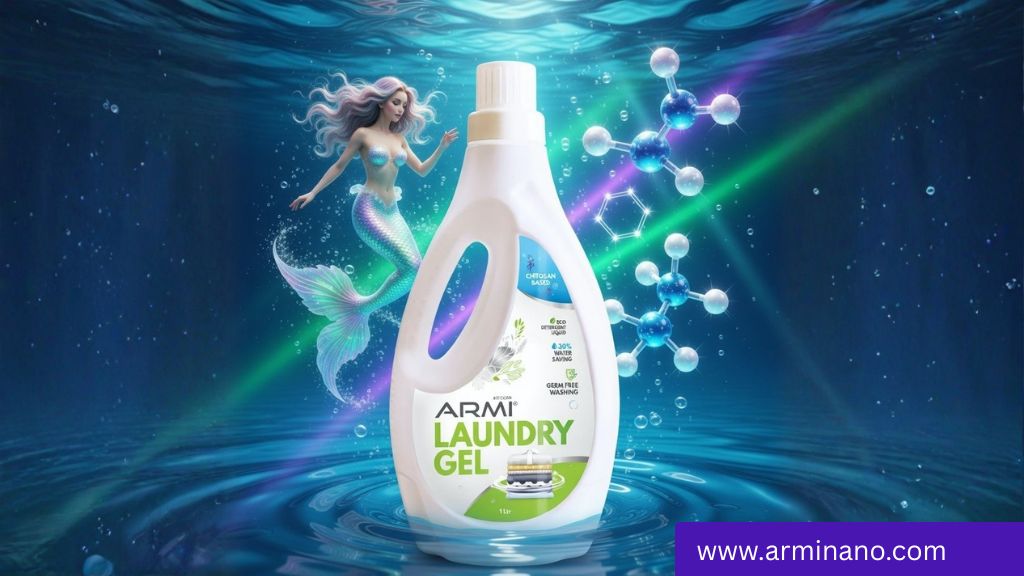
The mermaid is not just a pretty image — it is the heart of this brand’s identity, and it means something. Across cultures, mermaids have always been depicted as radiant, flawless, and luminous. That is not coincidence. Marine life naturally contains chitosan — a compound known for its remarkable cleaning and protective properties. A creature living entirely in the sea, surrounded by these chitosan-rich organisms, would carry that natural cleanliness and shine. ARMI® took that idea seriously. The mermaid became the recurring visual identity — not as decoration, but as a direct symbol of what chitosan, sourced from the sea, actually does for your clothes.
And from an indigenous innovation standpoint, this matters too. Developing a world-first cleaning technology using locally sourced marine biopolymers — rather than importing synthetic chemical formulations — represents exactly the kind of homegrown scientific progress that deserves attention. Sustainability and innovation do not have to come from outside. Sometimes they come from the sea.
How to Use It and What to Expect
One of the most common mistakes people make when switching to a concentrated eco formula is using too much. Without the visual cue of big foam, it feels like nothing is happening. But with a well-made laundry gel detergent like ARMI® Eco Laundry Gel, you’re typically looking at 20 to 30 ml per load — about a tablespoon and a half. For a particularly dirty load or a cold water wash, you can go up to 35 ml. That is it. The cleaning happens whether you see foam or not.
For hand washing, the same dose diluted in a bucket of water works well. Let clothes soak for around 10 minutes, then work gently. A good eco formulation will not dry out your hands during the process — a noticeable difference if you are washing delicates or baby items by hand regularly.
In a machine — front-load or top-load — add it to the drawer or directly into the drum before loading. After a few washes, you will likely notice the machine itself smells fresher. That is not coincidence. It is what happens when you stop feeding it layers of synthetic surfactant residue every cycle.
Results come in stages. In the first seven days, clothes feel softer and smell cleaner without a heavy artificial fragrance. Skin irritation begins to settle for those who were reacting to previous detergent residue. By two weeks, recurring stains — collar marks, underarm yellowing, cooking oil spots — start responding more consistently. At the 30-day mark, the cumulative effect is clear: fabrics look better and last longer, the machine runs cleaner, water usage is down, and the whole routine feels less like a battle.
Key Benefits Worth Knowing
- Chitosan nanoparticle technology cleans at a structural level — reaching deep into fibres rather than just the surface
- Sea-derived natural surfactant is non-toxic, non-irritating, and fully biodegradable after use
- Gentle enough for daily use as a detergent for sensitive skin and safe for washing baby clothes without residue concerns
- Low foam formulation means fewer rinse cycles and real water savings per load
- Works in front-load machines, top-load automatics, and hand wash — no compatibility issues
- First-of-its-kind indigenous innovation using marine biopolymer technology in a mainstream detergent
Common Mistakes People Make with Detergents
The foam habit is the hardest to break. People switch to a low foaming detergent, see no bubbles, and immediately double the dose. Now there is residue, worse rinse performance, and they blame the product. If you are making the switch, trust the formula for at least two weeks before changing anything. The cleaning is happening — it just does not look the way you are used to.
Reading labels carefully is the other big one. The green cleaning products market has a genuine greenwashing problem. Plenty of brands use nature-inspired language on the front while the actual ingredient list tells a different story. Synthetic preservatives, masking fragrances, and optical brighteners appear regularly in products marketed as eco or plant-based. If skin sensitivity is your concern, look specifically for fragrance-free options — not “unscented,” which often means a masking fragrance was added. Fragrance-free means none was included at all.
Temperature matters more than most people realise. Natural surfactant-based detergents perform best between 30°C and 60°C. Washing above 70°C can reduce their effectiveness. Most modern fabrics do not need that level of heat, and washing at 40°C with a well-formulated detergent cleans thoroughly while being kinder to the fabric over time.
When You Know It Is Time to Switch
Skin that reacts after wearing freshly washed clothes is the clearest signal. If irritation clears when you wear older items but returns after a fresh wash, detergent residue is almost certainly the cause. A two-week trial with a properly formulated non toxic laundry detergent usually answers the question.
A musty smell that lingers on clothes or inside the machine is another sign. Synthetic surfactant build-up in the drum, filter, and seal creates that smell over time and worsens the longer it continues. Switching to a biodegradable, low-foam alternative improves it faster than most people expect.
If your machine’s rubber seal is discolouring, the drum feels grimy between cleans, or the filter is clogging more than it should — residue from high-foam synthetic formulas is almost certainly the cause. Reducing the chemical load gives the machine a real break.
And if your water usage feels quietly higher than it should be, count how many rinse cycles your average load actually needs. Switching to a water saving detergent with low-foam, high-efficiency characteristics cuts that number — and over a month of regular washing, the difference shows up clearly.
To Wrap It Up
There is no dramatic transformation promised here — just a practical, honest case for doing laundry differently. The switch to an eco friendly laundry detergent works because the problems it solves are real: skin irritation from chemical residue, water wasted on unnecessary rinse cycles, fabrics that age faster than they should, and compounds going down the drain that have no business being there. What makes ARMI® Eco Laundry Gel genuinely different is that it is not just a cleaner formula — it is a smarter one. Sea-derived, indigenously developed, and built on marine science that has been quietly doing its job in nature for centuries. You are not just switching detergents. You are choosing something that was designed from the ground up to be better — for your clothes, your skin, your machine, and the water it all ends up in.
ARMI® Eco Laundry Gel — Where to Find It
If you want to explore the product directly, visit the ARMI® website or find them on Instagram at @graphene_products for updates, usage tips, and more.