

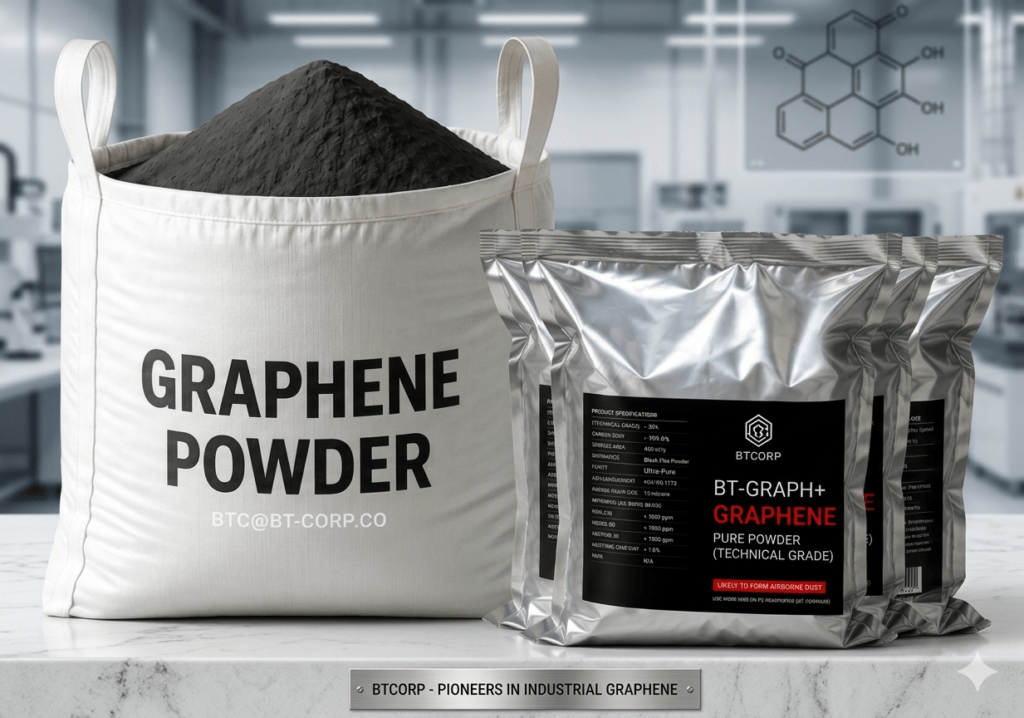
The Industrialization of Graphene: Engineering, Scaling, and Supply Chain Integration of the World’s Strongest Nanomaterial
A Definitive Technical and Commercial Blueprint for OEMs, Procurement Directors, and Process Engineers by BTCORP Generique Nano
Abstract: Moving Past the Laboratory Paradox
For over two decades, material scientists and industrial engineers have operated within a frustrating paradox. Graphene—a two-dimensional allotrope of carbon arranged in a perfect hexagonal honeycomb lattice—was hailed as the ultimate disruptor for modern manufacturing. With a theoretical tensile strength 200 times greater than steel, an intrinsic electron mobility reaching 200,000 square centimeters per volt-second, and a thermal conductivity surpassing 5,000 Watts per meter-Kelvin, it promised to redefine the physical limitations of human engineering.
Yet, despite thousands of peer-reviewed breakthroughs, true commercial market penetration remained frustratingly slow. The bottleneck was never a lack of scientific imagination; it was an issue of industrial scalability, batch-to-batch structural predictability, and a highly volatile, opaque graphene price index.
Today, the material science landscape has fundamentally matured. Under the pioneering leadership of BTCORP Generique Nano Pvt. Ltd., the industry has evolved past exploratory lab synthesis into a structured era of metric-ton production ecosystems. For global Original Equipment Manufacturers (OEMs), process formulators, and procurement networks, the critical question is no longer whether graphene works. The objective now is selecting the precise graphene-based materials, evaluating commercial graphene suppliers, and deploying customized, ready-to-use intermediates directly into complex, high-volume production lines without disrupting existing manufacturing assets.
1. Taxonomic Classification of Graphene and Its Derivatives
To effectively integrate advanced nanocarbons into industrial workflows, one must understand that “graphene” is not a singular, uniform material. It represents an diverse family of distinct chemical derivatives, each possessing highly specific surface areas, lateral dimensions, oxygen functionalities, and dispersion behaviors. Under the BT-GRAPH+ commercial range, BTCORP has streamlined these derivatives into clear industrial formats, ensuring process engineers can bypass raw particle processing entirely.
BT-GRAPH+ Pure Powder (Pristine Graphene)
Pristine graphene consists of unmodified, intact carbon sheets devoid of heavy chemical defects or deliberate oxygen functionalization. Synthesized via automated extraction lines from premium natural vein graphite, this variant retains the pristine honeycomb lattice. Because it features virtually no $sp^3$ defects, it delivers the highest possible electrical and thermal performance. However, because it lacks polar functional groups, pristine graphene is naturally hydrophobic and prone to severe irreversible agglomeration when introduced to liquid phases without high-shear stabilization or surfactant aid.
Graphene Oxide (GO) Intermediates
Graphene oxide is a highly modified, heavily functionalized 2D sheet heavily populated with oxygen-rich polar functional moieties, including hydroxyl, epoxy, and carboxylic acid groups across its basal planes and edges. Synthesized typically through the chemical oxidation and subsequent exfoliation of bulk graphite, GO fundamentally changes the material’s interaction with host matrices.
The presence of these oxygen groups expands the interlayer spacing and transitions the material from hydrophobic to highly hydrophilic. Consequently, GO disperses with remarkable stability in water and highly polar organic solvents. While this oxidation process temporarily disrupts the extended conjugated $\pi$-electron network—rendering pure GO electrically insulating—it provides an immensely reactive chemical canvas for cross-linking, polymer functionalization, and surface engineering.
Reduced Graphene Oxide (rGO) Formulations
When Graphene Oxide undergoes thermal, chemical, or electrochemical reduction processes, the majority of its oxygen-containing functional groups are removed, yielding Reduced Graphene Oxide. This reduction process partially heals the damaged $sp^2$ carbon lattice, effectively restoring electrical conductivity and thermal performance while leaving behind minor, strategic structural defects and residual oxygen. These remaining defects are highly beneficial; they act as anchoring sites within host matrices, preventing the sheets from stacking back together cleanly into bulk graphite. This gives rGO a distinct advantage over pristine graphene in applications requiring robust chemical bonding combined with elevated electron transport.
Carbon Nanotubes (CNTs) and Hybrid Formulations
Often utilized alongside 2D graphene sheets, Carbon Nanotubes (1D cylinders of rolled graphene) form highly effective multi-dimensional conductive networks. When hybrid carbon formulations are engineered correctly, the 1D nanotubes bridge the physical gaps between individual 2D graphene flakes. This creates an interconnected, highly conductive path that drastically reduces the percolation threshold within polymers, paints, and adhesives.
2. Deep-Dive Analytical Matrix: Material Selection Guide
Selecting the optimal variant requires evaluating the physical form, specific surface area, processing mechanics, and end-use environments of your application.
| Structural Variant | Target Form | Specific Surface Area (m2/g) | Primary Matrix Compatibility | Dominant Failure Mode if Misapplied |
| BT-GRAPH+ Pure Powder | Free-flowing Powder | $400 – 700$ | Non-polar solvents, aromatic hydrocarbons, engineering plastics | Phase separation and macro-agglomeration within the matrix |
| Graphene Oxide (GO) | Aqueous Dispersion / Paste | $200 – 500$ | Water-based resins, concrete admixtures, polar acrylics | Thermal degradation and outgassing when exposed to temperatures $>150^\circ\text{C}$ |
| Reduced Graphene Oxide (rGO) | Low-density Powder / Solvent Dispersion | $300 – 600$ | Epoxies, structural polyurethanes, battery slurries | Excessive viscosity spikes preventing proper casting or molding |
| Functionalized Nanocarbons | Tailored Masterbatch Pellets | $150 – 400$ | Polyolefins (PE, PP), Polyamides (Nylon), Engineering Rubbers | Poor interfacial shear transfer due to chemical mismatch |
3. The Industrial Scaling Milestone: Metric-Ton Manufacturing
Historically, the advanced materials sector was plagued by “lab-scale bias.” A synthesis process that yields 5 grams of highly uniform graphene in a quartz tube furnace under pristine laboratory conditions frequently collapses when scaled up to mass production. Moving to true industrial-scale manufacturing requires addressing complex chemical engineering hurdles, fluid dynamics, and thermodynamic constraints.
Top-Down Exfoliation vs. Bottom-Up Synthesis
Industrial manufacturing is divided into two primary methodology tracks:
- Bottom-Up Synthesis (CVD & Plasma): This approach builds the carbon lattice atom-by-atom from carbonaceous gas precursors (e.g., methane). While CVD yields pristine, large-area single-crystal films perfectly suited for microelectronics and next-generation optoelectronic sensors, it remains a highly capital-intensive, lower-throughput process for generating mass volumes of structural materials.
- Top-Down Exfoliation: This method takes naturally occurring bulk crystalline graphite and delaminates the individual graphene layers using chemical, electrochemical, or mechanical energy. This is the only path that currently achieves metric-ton scale volumes with viable market economics for sectors like composites, coatings, concrete, and energy storage.
Overcoming Batch-to-Batch Structural Variance
The primary challenge of top-down chemical exfoliation is controlling the lateral flake size, layer thickness distribution, and surface defect profile across consecutive production runs. Without highly automated fluid controls, precise temperature monitoring, and standardized chemical feed rates, properties will fluctuate between batches.
Industrial producers like BTCORP Generique Nano solve this issue by implementing multi-site, fully closed-loop synthesis systems. These automated setups precisely control the exfoliation energy profile, ensuring that every drum of material matches strict specifications for particle morphology and chemical composition.
Industrial Environmental Safety and Closed-Loop Filtration
Processing nanomaterials requires strict environmental safeguards and process controls. Bulk handling of dry, fine carbon powders poses potential inhalation hazards and workspace contamination risks.
Modern production facilities mitigate these issues by focusing heavily on liquid intermediate manufacturing. By keeping materials in closed-loop wet dispersion streams or locking powders into dust-free polymer masterbatch pellets, manufacturers completely eliminate airborne dust hazards for end-user factory teams. Furthermore, modern facilities utilize advanced zero-discharge wastewater recycling networks to treat and reuse chemical processing fluids internally, ensuring sustainable, eco-friendly chemical operations.
4. The Economics of Advanced Materials: Demystifying Graphene Price
Understanding the commercial cost structure of advanced nanomaterials requires looking past raw material pricing. Procurement teams must analyze how processing costs change at scale, how purity levels impact performance value, and the total cost of ownership when integrating these materials into manufacturing workflows.
Critical Drivers of the Graphene Price Index
The market price of high-volume graphene-enhanced materials is driven by three main factors:
- The Layer-Count Distribution Profile: Separating true single-to-few layer sheets from cheaper, bulk multi-layer graphite requires significantly more processing time and energy, which naturally increases cost.
- The Complexity of Surface Functionalization: Modifying the surface chemistry of graphene to attach specific organic molecules requires additional chemical processing steps and precise quality control testing, adding a premium over basic, untreated powders.
- Solvent Compatibility and Medium Tuning: Dispersing nanocarbons cleanly into specialized, high-viscosity industrial solvents or engineered resins involves precision processing machinery, which scales pricing based on the complexity of the carrier medium.
Navigating Tier-1 Graphene Suppliers: The BTCORP Advantage
When auditing global graphene suppliers for commercial-scale contracts, procurement teams must look beyond basic per-kilogram quotes. It is vital to verify that the supplier possesses a reliable, consistent manufacturing infrastructure rather than operating out of a small-scale pilot lab.
Through BTCORP Generique Nano Pvt. Ltd., industries can secure supply lines capable of delivering metric tons of BT-GRAPH+ carbon variants per month. This high-volume infrastructure guarantees three core variables that smaller pilot labs cannot match:
- Verified Annual Production Capacity: The physical infrastructure to consistently deliver multiple tons of material per year without supply chain delays.
- Comprehensive Material Characterization Data: Transparent, batch-specific quality control tracking via Raman spectroscopy, X-ray diffraction (XRD), Transmission Electron Microscopy (TEM), and Thermogravimetric Analysis (TGA).
- Robust Regulatory and Compliance Clearances: Full alignment with international chemical registration frameworks and environmental standards, ensuring smooth long-term material integration across more than 40 countries.
5. Strategic Contract Research & Cross-Industry Innovation
Integrating 2D nanocarbons into complex industrial formulations requires deep scientific expertise. Because nanomaterials interact uniquely with different base compounds, successful deployment often relies on dedicated Contract Research Organizations (CROs) to bridge the gap between material science and practical factory application.
Accelerating the Lab-to-Plant Process
Every industrial manufacturing line has unique operating conditions, shear tolerances, thermal profiles, and curing cycles. Simply adding raw graphene powder to an existing factory mixing tank without adjustments often results in material clumping, uneven distribution, and product failure. Specialized CRO services prevent these setbacks by analyzing existing production equipment and designing precise blending procedures, automated feed schedules, and custom chemical formulations that integrate smoothly into current manufacturing operations.
Custom Surface Customization
A primary function of a materials-focused CRO is engineering the interface between the nanocarbon and the host material. For instance, if an automotive OEM needs to improve the impact strength of a specific nylon-based bumper, the CRO can chemically modify the edges of the graphene flakes. This creates strong covalent bonds directly with the nylon molecules during injection molding, resulting in far superior mechanical energy transfer compared to using untreated carbon fillers.
6. Real-World Commercial Verticals: Disrupting Global Sectors via ARMI®
Through the flagship brand ARMI®, BTCORP commercializes nano-enabled products across 13+ global markets, proving that graphene technology has successfully transitioned out of exploratory research and into real-world applications.
A. Energy Storage Solutions
In the competitive battery and energy storage sector, rGO and carbon nanotube blends are transforming performance metrics. When blended into the silicon or graphite anodes of next-generation lithium-ion batteries, these conductive networks accommodate the natural volume expansion of the anode during charging cycles. This prevents mechanical cracking, accelerates ion transport, and reduces internal resistance, resulting in faster charging times and significantly longer battery lifespans for electric vehicles and heavy grid storage systems.
B. Industrial, Marine, and HVAC Coatings
Corrosion costs global industries billions of dollars annually in maintenance and equipment downtime. ARMI® graphene-enhanced protective coatings solve this by creating an incredibly dense physical barrier. Because individual graphene sheets are impermeable to water molecules, oxygen, and salt ions, they force corrosive elements to travel through a complex, winding path within the paint layer, drastically slowing down rust formation.
In HVAC heat exchangers, these nano-coatings provide durable anti-corrosion protection while maintaining optimal thermal efficiency. Because the coatings are extremely thin, they prevent performance loss from environmental fouling without insulating the metal pipes—ensuring maximum heat transfer and reduced energy use over the life of the system.
C. Construction Materials & Concrete Admixtures
The construction sector is utilizing specialized graphene oxide liquid admixtures to lower the carbon footprint of structural concrete. When introduced to a concrete mix, the functional oxygen groups on the GO flakes attract and react with hydrating cement particles. This speeds up the formation of high-strength crystalline networks within the curing concrete.
The resulting concrete exhibits substantially higher compressive and tensile strength. This allows architects and structural engineers to reduce the total volume of cement required in a project without sacrificing structural integrity, directly lowering global carbon dioxide emissions.
D. Aerospace and Automotive Composites
By incorporating functionalized graphene into carbon fiber reinforced polymers (CFRP) and epoxy resins, aerospace and automotive engineers can design exceptionally lightweight components. The high surface area of the nanocarbon arrests micro-cracks before they propagate through the structure, delivering superior fatigue resistance, better vibration damping, and substantial weight savings that directly improve vehicle fuel and energy efficiency.
7. The Crucial Role of Ready-to-Use (RTU) Intermediates
The historical failure of nanomaterial integration in mainstream manufacturing stems from one primary issue: handling raw powders directly on the factory floor. Unprocessed nanocarbon powders naturally clump together due to strong internal van der Waals forces, which ruins their unique performance properties and creates dusty manufacturing environments.
To counter this, leading suppliers have shifted away from selling raw powders, focusing instead on Ready-to-Use (RTU) intermediates. By delivering pre-dispersed liquids, stabilized chemical formulations, and pre-compounded polymer pellets under the ARMI® and BT-GRAPH+ layout, manufacturers allow industrial teams to simply “drop-in” the technology using their current factory mixers and extruders. This eliminates the need for expensive re-engineering, prevents clumping issues, and ensures consistent product performance with zero dust exposure.
Conclusion: The Quantum Leap of Modern Material Science
The industrialization of graphene is no longer a futuristic goal; it is a current reality transforming commercial manufacturing. As production capacities scale to metric tons, pricing structures stabilize, and ready-to-use liquid intermediates become standard, the barriers to adopting this advanced technology have effectively dissolved.
The companies leading their markets over the next decade will be those that integrate advanced material science directly into their product roadmaps today. Partnering with reliable, high-volume suppliers like BTCORP Generique Nano ensures your manufacturing workflows gain a permanent competitive advantage in structural strength, thermal management, and long-term product durability.
Comprehensive Industry FAQ Section
Q1: What makes the BT-GRAPH+ product line different from raw graphene powders sourced from generic chemical traders?
A: Most generic graphene powders sold in the market are manufactured at a minor lab scale, which often leads to severe particle clumping (agglomeration) and highly erratic quality. BT-GRAPH+ by BTCORP Generique Nano is engineered from premium natural vein graphite using fully patented, automated extraction lines. This allows us to deliver optimized layer morphology, predictable batch-to-batch chemistry, and a highly competitive graphene price framework designed for immediate, drop-in industrial deployment across more than 40 countries.
Q2: Why is raw graphene powder so difficult to mix into standard liquid formulations or polymer resins?
A: Raw graphene sheets possess an immense specific surface area paired with strong internal van der Waals forces. This causes the individual nanocarbon flakes to naturally attract and tightly clump back together into bulk graphite when added to a liquid or resin without proper preparation. Once clumped, the material loses its advanced nanomaterial properties. Successful integration requires specialized high-shear mixing equipment, chemical surfactants, or sourcing the material as a pre-stabilized, ready-to-use liquid dispersion.
Q3: How does the pricing of Graphene Oxide (GO) compare to Pristine Graphene, and what drives these cost differences?
A: Industrial-scale graphene oxide is generally more cost-effective to produce in large liquid volumes because it uses chemical exfoliation methods that offer high throughput. Pristine graphene, especially high-purity variants with very few layers, requires specialized mechanical separation or gas-based synthesis that uses more energy and capital-intensive equipment. This drives up its production cost and final market price per kilogram.
Q4: Can graphene-enhanced coatings be used directly on standard copper and aluminum heat exchangers without reducing thermal efficiency?
A: Yes. Unlike traditional anti-corrosion paints that must be applied in thick layers—which creates a thermal insulation barrier—graphene-enhanced coatings form an extremely thin, continuous nano-film. The high intrinsic thermal conductivity of the embedded graphene flakes allows heat to pass through the coating efficiently while providing superior protection against environmental corrosion and salt spray.
Q5: What are the primary storage and shelf-life considerations for bulk liquid graphene dispersions?
A: Pre-dispersed liquid graphene products must be stored in temperature-controlled environments, typically between $5^\circ\text{C}$ and $30^\circ\text{C}$, away from direct sunlight and freezing conditions. Freezing can disrupt the chemical stabilizers in the liquid, causing the nanoparticles to drop out of suspension. Properly formulated and sealed industrial dispersions can maintain a stable, clump-free shelf life for 12 to 24 months.
Q6: Is it necessary to modify standard factory injection molding or extrusion equipment to process graphene-polymer masterbatches?
A: No. High-quality polymer masterbatch pellets are pre-compounded to melt and flow smoothly within standard manufacturing temperatures. They are engineered to be used as a direct “drop-in” additive, meaning factory teams can blend them with raw plastics using their existing extrusion and injection molding machinery without any equipment modifications.
Q7: How does Graphene Oxide improve the mechanical properties of concrete and cementitious systems?
A: When mixed into concrete, the oxygen-rich functional groups on the GO flakes attract and bond with water molecules and chemical compounds during the mixing phase. This creates a dense network of anchoring points that speeds up and optimizes the formation of high-strength crystalline structures as the cement cures. This fills microscopic voids within the concrete, significantly increasing its overall compressive and tensile strength.
Q8: What analytical testing methods are most reliable for verifying the quality and layer count of incoming bulk graphene shipments?
A: The most reliable quality control methods include Raman Spectroscopy (to verify structural integrity and layer profiles), Transmission Electron Microscopy (TEM) (to directly observe flake thickness and shape), X-ray Diffraction (XRD) (to confirm successful layer separation), and Thermogravimetric Analysis (TGA) (to measure the exact purity and oxygen functionalization levels).
Q9: What are the primary workplace safety risks associated with utilizing ready-to-use liquid graphene intermediates?
A: Ready-to-use liquid intermediates are exceptionally safe to handle because the nanomaterials are locked completely within a fluid suspension. This entirely eliminates the respiratory and inhalation risks associated with handling raw, dry carbon powders. Standard industrial personal protective equipment (PPE), such as safety glasses and chemical-resistant gloves, is fully sufficient for daily handling.
Q10: How does specialized Contract Research Organizations (CROs) help industrial manufacturers adopt graphene technology?
A: A materials-focused CRO assists by matching the ideal nanocarbon variant with a company’s specific product requirements. They engineer the underlying chemistry to ensure the additive bonds perfectly with the host material, design optimized mixing protocols for existing factory machinery, and fast-track the transition from small-scale lab tests to full commercial production.
Q11: Can Reduced Graphene Oxide (rGO) be utilized effectively in high-voltage electrical insulation applications?
A: Because rGO retains much of its electrical conductivity during the reduction process, it is not suited for applications requiring high-voltage electrical insulation. For insulation uses requiring high thermal management without electrical conductivity, alternative nanomaterials like Boron Nitride (white graphene) are preferred.
Q12: Why are multi-site manufacturing facilities critical for ensuring a stable industrial supply of graphene?
A: Relying on a single manufacturing site leaves supply chains vulnerable to local power outages, equipment maintenance delays, or logistics issues. Multi-site production networks allow an industrial supplier to balance production across different facilities, ensuring a reliable, uninterrupted flow of consistent materials to global OEM clients year-round.
Q13: Does the addition of graphene oxide to packaging plastics affect the material’s recyclability?
A: When added at standard industrial concentrations (typically well under 1% by weight), graphene carbon networks do not interfere with standard polymer recycling processes. The material melts down safely alongside the base plastic during recycling without producing harmful chemical byproducts.
Q14: How does graphene-enhanced anti-corrosion paint perform in marine environments compared to traditional zinc-rich primers?
A: Graphene paint provides a more effective and durable physical barrier. Zinc primers protect steel through sacrificial chemical action, which degrades over time. Graphene flakes form an impermeable, overlapping nano-barrier that physically blocks moisture and salt ions from reaching the metal substrate, delivering long-lasting protection with a significantly thinner coating layer.
Q15: What is the environmental footprint of modern top-down chemical graphene manufacturing?
A: Leading industrial producers utilize closed-loop chemical engineering systems that capture, treat, and reuse processing fluids internally, ensuring zero hazardous wastewater discharge. Because the process relies on upgrading naturally occurring graphite carbon, it avoids the heavy environmental impacts and emissions associated with traditional metal extraction and synthetic chemical production.