

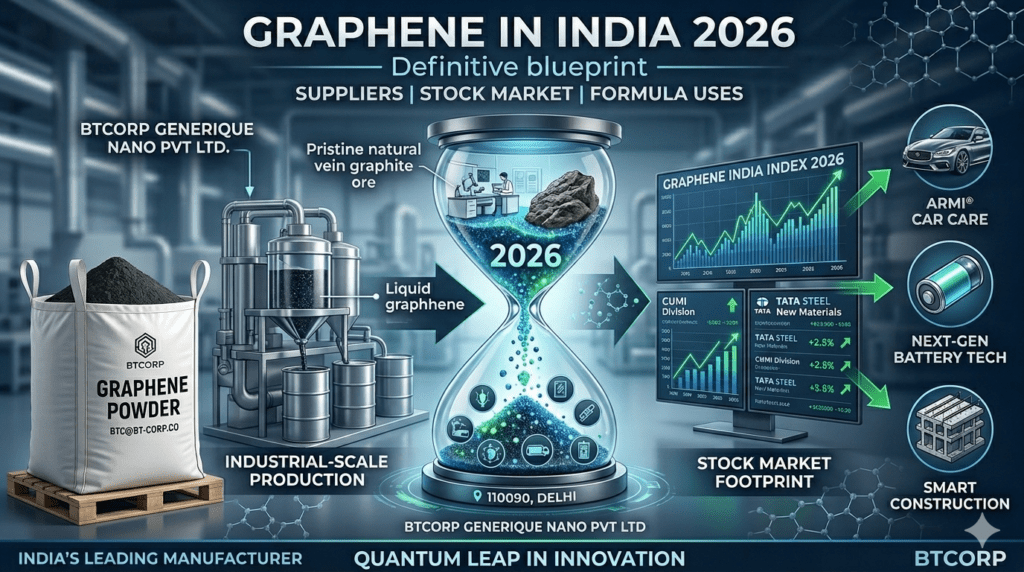
Graphene in India 2026: The Definitive Industrial Blueprint on Suppliers, Stock Market Footprint, and Advanced Formula Uses
An In-Depth Technical and Commercial Market Analysis of the Advanced Carbon Ecosystem by BTCORP Generique Nano
Abstract: The Evolution of Advanced Carbon in India
For years, global industrial sectors viewed advanced nanocarbons through the narrow lens of academic research. Graphene—the two-dimensional sheet of carbon atoms organized in a perfect hexagonal honeycomb lattice—was largely confined to localized exploratory laboratories. While engineering communities acknowledged its theoretical superiority, including massive thermal conductivity and unrivaled mechanical tensile strength, the path to commercial deployment was heavily restricted. Early adopters faced fractured global supply channels, highly unpredictable material variations, and a volatile, opaque price framework that stalled industrial product timelines.
The year 2026 marks a structural shift in this narrative, particularly within the Indian industrial landscape. India has rapidly emerged as a powerhouse for advanced material processing, transforming laboratory chemical breakthroughs into metric-ton industrial outputs. Spearheaded by innovative leaders like BTCORP Generique Nano Pvt. Ltd., the manufacturing sector has transitioned away from treating graphene as an exotic additive. Instead, it is now managed as a highly predictable, standardized, and scalable material platform. Through the specialized BT-GRAPH+ product suite and the flagship ARMI range, commercial enterprises can now confidently bypass basic material research, integrating ready-to-use intermediate compounds directly into large-scale production assets without risking capital efficiency.
1. Defining the Material: Structure, Family, and Formulations
To deploy graphene within large-scale industrial processes, engineers must discard the notion that it is a singular, uniform item. The advanced carbon ecosystem consists of a diverse family of materials, each tailored with distinct surface chemistry, layer architectures, lateral dimensions, and dispersion characteristics. Matching the correct variant to your specific industrial host matrix is the single most critical factor in avoiding product processing failures.
BT-GRAPH+ Pure Powder (Pristine Graphene)
Pristine graphene represents the uncompromised version of the carbon allotrope, maintaining an intact structural lattice free from deliberate chemical modifications or heavy oxidation defects. Sourced from high-purity natural vein graphite via fully automated physical extraction lines, this variant delivers premium electrical conductivity and thermal performance. Because the physical structure is devoid of polar groups, pristine powder is naturally hydrophobic. This presents handling challenges, as the individual sheets tend to experience heavy clumping when added to liquid formulations unless handled with precise high-shear mixing equipment or specialized surfactant stabilizers.
Graphene Oxide (GO) Intermediates
Graphene oxide represents a highly modified, oxygenated version of the carbon sheet, where the basal planes and outer edges are densely functionalized with polar chemical groups, including epoxy, hydroxyl, and carboxylic acid units. This chemical transformation expands the space between individual molecular layers and fundamentally alters the material’s surface energy, rendering it highly hydrophilic.
Consequently, Graphene Oxide disperses with exceptional stability in water and various polar organic solvents. While this chemical treatment temporarily interrupts the continuous electrical path—turning pure GO into an electrical insulator—it creates an immensely versatile chemical canvas. These reactive oxygen sites allow for seamless polymer cross-linking, custom functional processing, and robust integration into water-based industrial matrices.
Reduced Graphene Oxide (rGO) Formulations
When Graphene Oxide is subjected to specialized thermal, chemical, or electrochemical reduction processes, a significant majority of the attached oxygen functional units are stripped away. This yields Reduced Graphene Oxide, a material engineered to bridge the performance gap between pristine powder and oxidized sheets.
The reduction process effectively patches the structural lattice, restoring high levels of electrical and thermal performance. Crucially, the process leaves behind targeted structural variations and minor trace oxygen groups. These remaining anomalies prevent the individual sheets from stacking tightly back together into bulk graphite, turning them into elite structural anchors that bond tightly within composite materials and battery electrode slurries.
Carbon Nanotubes (CNTs) and Hybrid Formulations
Modern industrial formulations frequently combine 2D graphene sheets with 1D Carbon Nanotubes to exploit multi-dimensional performance networks. When engineered as a unified hybrid carbon compound, the long, cylindrical nanotubes function as conductive bridges that span the physical gaps between individual flat graphene flakes. This structural synergy creates an interconnected electrical and structural matrix, drastically lowering the material concentration threshold required to unlock anti-static or highly conductive behavior in plastics, structural epoxies, and performance paints.
2. Graphene in India: Analyzing the 2026 Supplier Landscape
The commercial availability of advanced carbon within the Indian subcontinent has expanded dramatically. Industrial procurement teams are no longer limited to importing small, expensive testing batches from international chemical brokers. Today, India features a highly resilient, domestic material infrastructure capable of supporting large-scale manufacturing across various sectors.
Shifting Beyond Academic Pilot Production
The historical bottleneck for Indian industrial adoption was the prevalence of small-scale laboratory manufacturing. A process optimized to generate ten grams of material inside a controlled laboratory furnace cannot meet the demanding requirements of an automotive assembly line or a structural concrete plant.
The current landscape features advanced, multi-site production facilities engineered to deliver consistent bulk volumes. Organizations like BTCORP Generique Nano Pvt. Ltd. have established dedicated automated production lines, ensuring that commercial buyers can secure reliable, multi-ton monthly allocations of materials like the BT-GRAPH+ range without experiencing supply chain delays.
Strict Quality Control Metrics for Bulk Sourcing
As bulk usage grows, ensuring consistent material performance across consecutive shipments is vital. Industrial-grade suppliers distinguish themselves by providing comprehensive, batch-specific analytical testing data. Sourcing teams must verify key parameters using specialized testing methods:
- Raman Spectroscopy: To map structural consistency, verify defect densities, and track overall layer uniformity.
- Transmission Electron Microscopy (TEM): To provide direct visual verification of individual flake shapes and thickness boundaries.
- X-ray Diffraction (XRD): To confirm consistent layer separation and check for unwanted bulk graphite contamination.
- Thermogravimetric Analysis (TGA): To track exact purity levels and precisely measure residual oxygen content across production lots.
3. The Public Markets: Graphene in India Share Price and Stock Market Footprint
As industrial adoption accelerates, institutional investors, supply chain directors, and financial analysts are paying close attention to the financial infrastructure supporting this material revolution. A common question arising in corporate procurement strategies is how the domestic advanced carbon ecosystem intersects with publicly traded equities on major Indian stock exchanges like the NSE and BSE.
Understanding the Listed Corporate Landscape
When exploring options for a list of graphene in india related to the stock market, investors must understand that very few pure-play, standalone nano-material startups are directly listed on public exchanges. Instead, the public market footprint is dominated by established industrial giants, chemical conglomerates, and specialized graphite electrode manufacturers who have invested heavily in carbon extraction and processing divisions.
- Core Graphite Industrial Leaders: Established publicly traded corporations like Graphite India Limited and HEG Limited form the bedrock of raw carbon processing in the country. While their historical revenues are anchored to manufacturing massive graphite electrodes for the global steel recycling sector, their deep technical expertise in carbon management makes them vital components of the macro ecosystem.
- Diversified Industrial Conglomerates: Major listed entities such as Carborundum Universal Limited (CUMI, a prominent member of the Murugappa Group) and Tata Steel (via its specialized New Materials division) are actively scaling proprietary processing lines to incorporate carbon derivatives directly into industrial composites, ceramics, and structural steels.
Connecting Supply Chain Reliability to Public Equities
For global OEMs looking to establish multi-year supply contracts, partnering with a supplier backed by robust industrial assets provides crucial financial security. While agile, private companies like BTCORP Generique Nano drive rapid custom formulation changes and deliver highly specialized products like the BT-GRAPH+ range, the overall stability of the industry is reinforced by the reliable financial metrics of the broader carbon market. This balanced corporate structure ensures that the domestic supply chain remains fully insulated from sudden market shifts or capital shortfalls.
4. Technical Analysis: The Graphene Formula and Structural Mechanics
Unlocking the extraordinary properties of advanced carbon requires a clear understanding of its atomic behavior. The exceptional performance of the material is not accidental; it is a direct consequence of its fundamental structural geometry.
       / \     / \     / \
      |   |   |   |   |   |
     / \ / \ / \ / \ / \ / \
    |   |   |   |   |   |   |
     \ / \ / \ / \ / \ / \ /
      |   |   |   |   |   |
       \ /     \ /     \ /
The continuous sp²-hybridized hexagonal carbon network provides unrivaled surface area exposure and elite electron mobility.
The Magic of sp² Hybridization
At the atomic scale, the fundamental formula of this material relies on carbon atoms bound tightly together in a single layer via strong covalent bonds. The underlying electron configuration features a highly organized arrangement where each individual carbon atom shares three stable bonds within the same plane. This leaves a free, un-hybridized electron sticking out vertically above and below the sheet.
These un-bound electrons combine to form a highly mobile, delocalized electron cloud across the entire surface of the sheet. This unique atomic structure explains why a perfect carbon layer can transport electrical current with negligible resistance, achieving electron mobility speeds that surpass traditional silicon by significant margins.
Managing the Surface Area Challenge
Because the material is exactly one atom thick, it possesses an extraordinary specific surface area, theoretically exceeding 2,600 square meters per single gram of material. This means that every single atom is fully exposed to its external environment, providing an unmatched chemical interface for bonding with plastics, paints, or battery compounds.
However, this immense surface energy also introduces a natural physical challenge: the individual sheets naturally seek to lower their surface energy by pulling together and stacking back into bulk graphite. Overcoming this clumping trend requires precision engineering, surface functional treatment, and the production of pre-stabilized, ready-to-use liquid formulations.
5. Commercial Deep-Dive: Understanding Graphene Price Variables
For global procurement officers and corporate product managers, the deciding factor for adopting advanced carbon technology is always the underlying cost structure. A common challenge when evaluating the market is navigating the perceived volatility of the pricing index.
The True Drivers of Industrial Product Costs
The market cost of advanced carbon materials has moved completely away from the erratic, speculative pricing of early research years. Today, industrial pricing is calculated based on stable, predictable manufacturing parameters:
- The Structural Layer Profile: Manufacturing true single-layer sheets requires highly precise chemical separation and multi-stage extraction energy, which commands a premium. Conversely, structural materials optimized for bulk composites or building concrete utilize multi-layer formulations designed for maximum volume efficiency.
- Surface Chemistry Modifications: Attaching target organic molecules to the outer edges of the carbon sheets involves additional processing steps and advanced chemical validation testing, adding a transparent premium over basic, un-functionalized powders.
- The Dispersion Medium: Supplying materials cleanly pre-mixed into industrial solvents, specialized liquid polymers, or extruded masterbatch pellets involves precision machinery, scaling the cost based on the technical complexity of the carrier fluid.
By operating centralized, automated extraction systems directly from raw graphite sources, tier-1 producers like BTCORP Generique Nano can offer stable commercial contracts that insulate buyers from pricing spikes, making large-scale production integrations highly predictable.
6. Targeted Industry Applications: Real-World Commercial Verticals
The industrial deployment of advanced carbon technology has moved completely past the testing phase. Through the commercialization of specialized solutions under the ARMI brand, nanotechnology is actively driving major performance upgrades across high-value global industries.
A. Graphene Car Wash Formulations and Surface Care
The professional automotive detailing and commercial vehicle care sector has experienced a massive shift through the introduction of advanced nano-coatings. For years, traditional ceramic coatings (primarily based on Silicon Dioxide) served as the standard for paint protection, but they suffered from distinct real-world vulnerabilities, particularly localized heat retention and severe water spot formation.
By integrating specialized BT-GRAPH+ nanocarbon structures into advanced liquid polymer carriers, modern automotive coatings provide an entirely new level of paint protection:
- Elite Heat Dissipation: Traditional coatings trap heat on the surface, causing standing water droplets to evaporate rapidly and bake minerals deep into the clear coat. The high thermal conductivity of a nano-infused layer spreads heat evenly across the entire vehicle panel, preventing local baking spots.
- Slick Hydrophobic Performance: The hexagonal lattice structure creates an extremely smooth surface texture, maximizing the water contact angle. Rain, road grime, mud, and environmental contaminants cannot find a mechanical hold, causing them to bead and roll off instantly during standard rinsing.
- Dissipating Static Charge: Traditional wax sealants and silicon polishes generate a natural static charge through friction as the vehicle drives, attracting dust out of the air. Graphene-enhanced liquid formulas create an electrically conductive plane that naturally dissipates static friction, keeping automotive surfaces cleaner for significantly longer intervals.
B. Next-Generation Graphene Battery Solutions
The global push toward vehicle electrification and large-scale renewable grid storage has exposed the physical limitations of conventional battery chemistries. Standard lithium-ion battery configurations struggle with high internal resistance, slow charge acceptance rates, and structural cracking within active anode materials over extended use.
Integrating Reduced Graphene Oxide and carbon nanotube networks directly into battery architectures fundamentally alters chemical performance:
- Rapid Charging Cycles: The massive electron mobility within the carbon network creates a highly efficient electrical pathway across the electrode. This allows lithium ions to move with minimal resistance, significantly shortening vehicle charge times without damaging internal cell structures.
- Managing Thermal Stress: Battery cells generate intense heat during high-speed charging. The exceptional thermal dissipation properties of these carbon additives distribute thermal energy uniformly across the cell pack, eliminating dangerous hotspots and reducing the risk of catastrophic thermal failure.
- Stabilizing Silicon Anodes: Next-generation high-capacity silicon anodes tend to expand and crack over repeated usage. Encasing the silicon particles within a flexible, conductive nanocarbon web maintains structural unity, allowing the battery to endure thousands of intensive cycles without experiencing sharp drops in energy retention.
C. Industrial Protective Coatings and Marine Finishes
Corrosion represents a multi-billion dollar annual loss for industrial infrastructure, offshore wind farms, and global maritime shipping fleets. Traditional zinc-rich primers provide sacrificial chemical protection, but they degrade steadily when exposed to harsh saltwater and environmental elements.
Advanced protective finishes powered by the ARMI layout solve this issue by introducing a physical barrier on a molecular scale. Because the individual carbon sheets are entirely impermeable to gas molecules, moisture, and salt ions, they block corrosive elements from reaching the underlying steel.
The elements are forced to navigate an incredibly complex, winding path through overlapping nano-layers, drastically extending the service lifespan of industrial machinery, offshore platforms, and ship hulls. Furthermore, when applied to HVAC heat exchangers, these thin nano-coatings prevent chemical corrosion without acting as an insulation layer—maintaining peak thermal transfer efficiency over years of continuous operation.
D. Construction Infrastructure and Smart Concrete
The global construction and real estate development sector is leveraging specialized graphene oxide liquid admixtures to lower the environmental impact of modern building infrastructure. When introduced directly into standard concrete mixes during the blending phase, the active oxygen groups on the carbon sheets attract and react with hydrating cement particles.
This chemical interaction accelerates and optimizes the development of high-strength crystalline networks within the curing concrete matrix. The resulting structure exhibits vastly improved compressive and tensile strength while filling microscopic voids that typically allow moisture ingress. This allows structural engineers to reduce the total volume of raw cement required in a project without sacrificing structural integrity, directly lowering global carbon dioxide emissions.
7. The Crucial Shift to Ready-to-Use (RTU) Intermediates
The primary reason many historical nanotechnology projects failed to make the leap from initial research to factory production was the challenge of handling raw carbon powders. Unprocessed nano-powders naturally clump together due to powerful internal attraction forces, which compromises their unique properties and introduces safety risks to factory environments.
To address this challenge, the modern carbon industry has shifted away from supplying raw, dry powders to industrial clients. The standard has moved toward delivering tailored Ready-to-Use (RTU) intermediates. By supplying pre-dispersed liquid solutions, stabilized chemical mixtures, and pre-blended polymer masterbatch pellets under the BT-GRAPH+ and ARMI brands, manufacturers enable corporate factory teams to simply “drop-in” the technology using their current mixing and extrusion equipment. This setup completely eliminates the need for expensive factory re-engineering, ensures uniform material dispersion, and maintains a clean, dust-free manufacturing environment.
Conclusion: Securing a Position in the Advanced Materials Era
The industrialization of advanced carbon within India has reached a critical tipping point. The technology has successfully moved past early research speculation into a robust commercial reality defined by metric-ton production capacities, stable industrial pricing, and optimized ready-to-use liquid intermediates.
The organizations that capture dominant market share over the coming decade will be those that integrate advanced material science directly into their long-term product development roadmaps today. Partnering with a proven, large-scale domestic producer like BTCORP Generique Nano ensures your production lines gain a sustainable, high-performance competitive edge in structural integrity, thermal control, and product durability.
Comprehensive Industry FAQ Section
Q1: What makes the BT-GRAPH+ product line different from raw graphene powders sourced from generic chemical traders?
A: Most generic graphene powders sold in the market are manufactured at a minor lab scale, which often leads to severe particle clumping and highly erratic quality. BT-GRAPH+ by BTCORP Generique Nano is engineered from premium natural vein graphite using fully patented, automated extraction lines. This allows us to deliver optimized layer shapes, predictable batch-to-batch chemistry, and a highly competitive graphene price framework designed for immediate, drop-in industrial deployment across more than 40 countries.
Q2: Why is raw graphene powder so difficult to mix into standard liquid formulations or polymer resins?
A: Raw graphene sheets possess an immense surface area paired with strong internal attractive forces. This causes the individual nanocarbon flakes to naturally attract and tightly clump back together into bulk graphite when added to a liquid or resin without proper preparation. Once clumped, the material loses its advanced properties. Successful integration requires specialized high-shear mixing equipment, chemical surfactants, or sourcing the material as a pre-stabilized, ready-to-use liquid dispersion.
Q3: How does the pricing of Graphene Oxide (GO) compare to Pristine Graphene, and what drives these cost differences?
A: Industrial-scale graphene oxide is generally more cost-effective to produce in large liquid volumes because it uses chemical separation methods that offer high throughput. Pristine graphene, especially high-purity variants with very few layers, requires specialized mechanical separation or gas-based synthesis that uses more energy and expensive equipment. This drives up its production cost and final market price per kilogram.
Q4: Can graphene-enhanced coatings be used directly on standard copper and aluminum heat exchangers without reducing thermal efficiency?
A: Yes. Unlike traditional anti-corrosion paints that must be applied in thick layers—which creates a thermal insulation barrier—graphene-enhanced coatings form an extremely thin, continuous film. The high intrinsic thermal conductivity of the embedded graphene flakes allows heat to pass through the coating efficiently while providing superior protection against environmental corrosion and salt spray.
Q5: What are the primary storage and shelf-life considerations for bulk liquid graphene dispersions?
A: Pre-dispersed liquid graphene products must be stored in temperature-controlled environments, typically between 5 degrees and 30 degrees Celsius, away from direct sunlight and freezing conditions. Freezing can disrupt the chemical stabilizers in the liquid, causing the nanoparticles to drop out of suspension. Properly formulated and sealed industrial dispersions can maintain a stable, clump-free shelf life for 12 to 24 months.
Q6: Is it necessary to modify standard factory injection molding or extrusion equipment to process graphene-polymer masterbatches?
A: No. High-quality polymer masterbatch pellets are pre-blended to melt and flow smoothly within standard manufacturing temperatures. They are engineered to be used as a direct drop-in additive, meaning factory teams can blend them with raw plastics using their existing extrusion and injection molding machinery without any equipment modifications.
Q7: How does Graphene Oxide improve the mechanical properties of concrete and cementitious systems?
A: When mixed into concrete, the oxygen-rich functional groups on the GO flakes attract and bond with water molecules and chemical compounds during the mixing phase. This creates a dense network of anchoring points that speeds up and optimizes the formation of high-strength crystalline structures as the cement cures. This fills microscopic voids within the concrete, significantly increasing its overall compressive and tensile strength.
Q8: What analytical testing methods are most reliable for verifying the quality and layer count of incoming bulk graphene shipments?
A: The most reliable quality control methods include Raman Spectroscopy (to verify structural integrity and layer profiles), Transmission Electron Microscopy (to directly observe flake thickness and shape), X-ray Diffraction (to confirm successful layer separation), and Thermogravimetric Analysis (to measure the exact purity and oxygen levels).
Q9: What does the term “percolation threshold” mean in the context of conductive graphene-enhanced plastics?
A: The percolation threshold refers to the minimum concentration of conductive graphene flakes required to form a continuous, interconnected network throughout a plastic structure. Once this specific concentration is reached, the material transitions from an electrical insulator to a highly conductive or anti-static material, unlocking its performance properties with minimal additive use.
Q10: How do specialized Contract Research Organizations (CROs) help industrial manufacturers adopt graphene technology?
A: A materials-focused CRO assists by matching the ideal nanocarbon variant with a company’s specific product requirements. They engineer the underlying chemistry to ensure the additive bonds perfectly with the host material, design optimized mixing protocols for existing factory machinery, and fast-track the transition from small-scale lab tests to full commercial production.
Q11: Can Reduced Graphene Oxide (rGO) be utilized effectively in high-voltage electrical insulation applications?
A: Because rGO retains much of its electrical conductivity during the reduction process, it is not suited for applications requiring high-voltage electrical insulation. For insulation uses requiring high thermal management without electrical conductivity, alternative nanomaterials like Boron Nitride are preferred.
Q12: Why are multi-site manufacturing facilities critical for ensuring a stable industrial supply of graphene?
A: Relying on a single manufacturing site leaves supply chains vulnerable to local power outages, equipment maintenance delays, or logistics issues. Multi-site production networks allow an industrial supplier to balance production across different facilities, ensuring a reliable, uninterrupted flow of consistent materials to global OEM clients year-round.
Q13: Does the addition of graphene oxide to packaging plastics affect the material’s recyclability?
A: When added at standard industrial concentrations (typically well under 1% by weight), graphene carbon networks do not interfere with standard polymer recycling processes. The material melts down safely alongside the base plastic during recycling without producing harmful chemical byproducts.
Q14: How does graphene-enhanced anti-corrosion paint perform in marine environments compared to traditional zinc-rich primers?
A: Graphene paint provides a more effective and durable physical barrier. Zinc primers protect steel through sacrificial chemical action, which degrades over time. Graphene flakes form an impermeable, overlapping nano-barrier that physically blocks moisture and salt ions from reaching the metal substrate, delivering long-lasting protection with a significantly thinner coating layer.
Q15: What is the environmental footprint of modern top-down chemical graphene manufacturing?
A: Leading industrial producers utilize closed-loop chemical engineering systems that capture, treat, and reuse processing fluids internally, ensuring zero hazardous wastewater discharge. Because the process relies on upgrading naturally occurring graphite carbon, it avoids the heavy environmental impacts and emissions associated with traditional metal extraction and synthetic chemical production.