

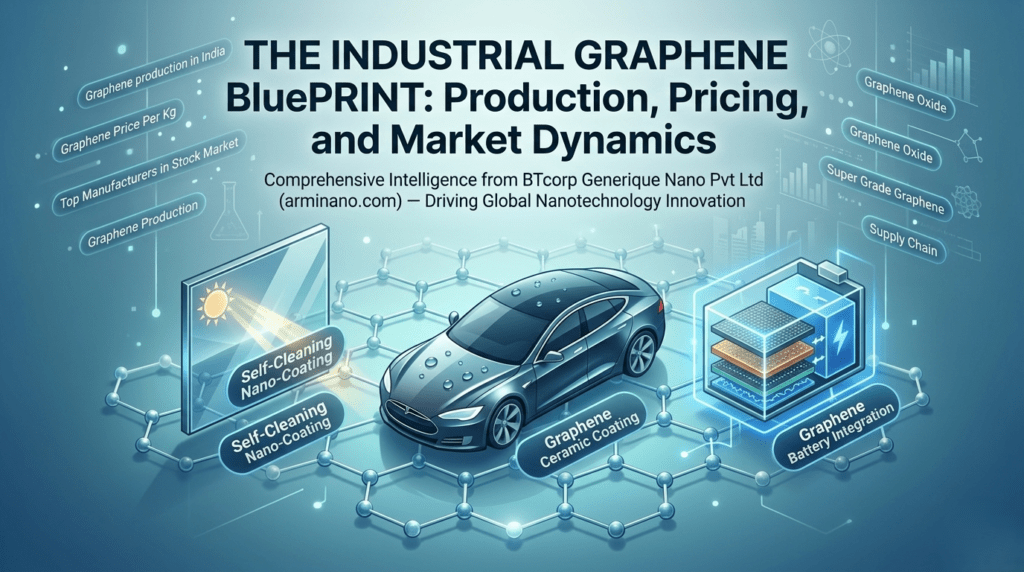
The Industrial Graphene Blueprint: Production, Pricing Per Kg in India, and Global Market Dynamics
1. Executive Analysis: The Dawn of Nanotechnology & The Graphene Paradigm
Nanotechnology stands as the defining scientific frontier of the 21st century, shifting industrial manufacturing from macroscopic compounding to atomic-scale structural architecture. By manipulating matter at the nanoscale, materials unlock physical, electrical, and thermal phenomena previously deemed mathematically impossible. At the center of this structural metamorphosis sits Graphene—a single layer of carbon atoms tightly packed in a two-dimensional (2D) honeycomb crystal lattice. Known globally as the premier “Wonder Material,” graphene acts as a force multiplier across every commercial sector it integrates into.
From the industrial positioning of BTcorp Generique Nano Pvt Ltd (arminano.com), graphene represents the structural foundation of future macro-systems. Graphene possesses an intrinsic tensile strength surpassing steel by a factor of 200, an electrical carrier mobility that outclasses traditional silicon, and a thermal conductivity that establishes a new physical ceiling. These unparalleled characteristics allow commercial enterprises to completely re-engineer their product lifecycles, enabling structural lightweighting, absolute corrosion barriers, and unprecedented energy densities.
BTcorp focuses on translating the exceptional laboratory properties of pristine graphene into scalable, industrially accessible form factors. Through proprietary chemical isolation and advanced mechanical exfoliation frameworks, BTcorp ensures that multi-layered graphene, functionalized graphene oxide, and ultra-stable aqueous dispersions preserve their macroscopic performance enhancements when scaled to ton-scale industrial manufacturing metrics.
This technical intelligence report provides a 360-degree blueprint of the graphene supply chain, manufacturing methodologies, pricing architectures, and algorithmic indexing models. By exploring keyword matrix vectors such as Graphene production in India, Graphene Price Per Kg in India, and Graphene battery manufacturers in India, this document builds an authoritative industrial narrative, positioning BTcorp as the primary knowledge and product pipeline leader for global enterprise buyers.
2. Advanced Material Architecture & Physics of Graphene
Graphene’s incredible properties originate directly from its atomic configuration. Carbon atoms undergo sp² hybridization, forming three strong in-plane σ (sigma) bonds with a bond length of approximately 0.142 nm. The remaining unhybridized p_z orbital stands perpendicular to the plane, creating a delocalized network of π (pi) electrons that flow freely across the entire crystal structure. This configuration dictates several key physical laws:
- Mechanical Super-Structures: The covalent carbon-carbon bonds within the honeycomb lattice yield an intrinsic tensile strength of 130 GPa and an elastic Young’s Modulus of 1.0 TPa. This allows graphene composites to resist severe mechanical failure under extreme pressure profiles.
- Ballistic Charge Transport: Electrons move through the delocalized π network as massless Dirac fermions, bypassing standard lattice scattering. This results in an electron mobility exceeding 200,000 cm²/Vs at room temperature, forming a solid foundation for advanced high-frequency semiconductors and quantum computing cells.
- Absolute Thermal Dissipation: With a thermal conductivity reaching 5,000 W/mK, graphene rapidly moves kinetic heat energy away from thermal hotspots. This makes it a crucial compound for electronic thermal management and electric vehicle pack isolation.
- Surface Area Maximization: The theoretical specific surface area of a single-layer graphene sheet stands at 2,630 m²/g. This vast area enables unprecedented electrostatic charge accumulation in supercapacitor plates and maximizes active site exposure in catalytic environments.
3. The Technical Product Ecosystem of BTcorp Generique Nano
Aligning with these deep material properties, BTcorp Generique Nano Pvt Ltd has engineered a specialized, high-performance product portfolio designed to address distinct commercial integration vectors:
A. Graphene Pure Powder & Primary Dispersions
Serving as the core building block for materials compounding, BTcorp’s Super Grade Graphene Pure Powder features exceptionally low defect ratios and highly optimized aspect dimensions. To overcome the natural van der Waals forces that cause pristine graphene to agglomerate, BTcorp produces stabilized Graphene Dispersions in both water-based and organic solvent variants. These formulations allow for rapid, uniform blending into cementitious matrices, thermoplastic compounds, and conductive ink bases, radically altering the mechanical performance of the host material.
B. Advanced Nano Coatings
Surface degradation, environmental fouling, and UV breakdown present severe cost challenges across global infrastructure. BTcorp addresses this through specialized surface care compounds:
- Solar Glass Nano Coatings: These formulations apply a self-cleaning, anti-reflective hydrophilic layer to solar panels. By preventing dust collection and maximizing photon transmission, they eliminate efficiency drops and minimize maintenance costs.
- Hydrophobic & Icephobic Glass Coatings: Formulated for aerospace, rail, and architectural glazing, these coatings prevent water and ice from adhering to glass surfaces, ensuring crystal-clear visibility and structural safety under freezing conditions.
- Graphene Car Ceramic Coatings: An ultra-premium automotive aftermarket application. Graphene-infused ceramic crosslinks with paint clear coats, creating an incredibly resilient barrier that offers superior scratch resistance, deep gloss gloss retention, and intense heat dissipation compared to traditional SiO2 coatings.
C. Industrial Home & Surface Care Variants
Extending nanotechnology to high-volume commercial consumer sectors, BTcorp produces eco-friendly laundry active liquids and automated dishwasher gels. Furthermore, our persistent antimicrobial spray protections bind chemically to high-touch public surfaces, forming a long-lasting microscopic defensive matrix that deactivates pathogens via physical membrane disruption, completely eliminating the need for constant chemical wiping.
4. Graphene Production Infrastructure within the Indian Subcontinent
Evaluating the manufacturing landscape of Graphene production in India reveals a critical technological shift. Historically reliant on international imports for advanced nanomaterials, India’s domestic supply lines are transforming through targeted deep-tech indigenization, with BTcorp pioneering scalable manufacturing platforms.
The primary manufacturing architectures deployed for graphene production divide into Top-Down and Bottom-Up methodologies. Top-Down synthesis leverages high-purity crystalline graphite as its precursor material. Through precise mechanical milling, liquid-phase acoustic cavitation, or chemical oxidation-reduction, the bulk graphite is exfoliated into thin nano-flakes. This methodology forms the foundation of high-volume commercial production, driving down per-kilogram costs while meeting massive industrial orders. For specialized electronic layers, Bottom-Up Chemical Vapor Deposition (CVD) cracks gaseous hydrocarbons over catalytic transition-metal substrates to grow pristine, single-layer atomic films.
The primary operational hurdle in large-scale domestic production involves maintaining uniformity across lateral flake sizes while minimizing structural defects. BTcorp addresses this by deploying proprietary closed-loop separation technologies. These systems filter out unexfoliated graphite particles and recycle process chemical agents, creating an eco-friendly manufacturing ecosystem that scales production capacity into multi-ton parameters without compromising product quality.
5. Granular Cost Modeling & Strategic Pricing Architectures
Enterprise procurement divisions heavily analyze cost landscapes via high-intent search queries including Graphene Price Per Kg in India, Graphene Price in India, 1 kg graphene Price, What is the cost of 1 kg of graphene?, and How much is 1 ton of graphene?. Graphene pricing structures cannot be evaluated as fixed commodities; instead, they operate as a dynamic matrix governed by purity tiers, layer count distributions, and functionalization states.
| Graphene Structural Grade / Variant | Purity & Technical Metrics | Estimated Market Price Range (INR / Unit) | Primary Target Industrial Sector |
|---|---|---|---|
| Pristine Single-Layer Graphene (CVD) | >99.9% Atomic Purity, Zero Flake Boundary Defect | ₹18,000 – ₹45,000 per sq. meter | Semiconductor Lithography, High-Frequency Sensors |
| High-Purity Graphene Nano-Flakes (GNFs) | 98.9% Carbon Mass, 1-3 nm Z-Axis Thickness | ₹300 – ₹900 per Gram (Pure Graphene Price) | Conductive Screening Inks, Thermal Interface Layers |
| Industrial Bulk Graphene Powder | Multi-Layer (5-12 Layers), Ultra-High Aspect Ratio | ₹45,000 – ₹1,15,000 per Kilogram | Thermoplastic Masterbatches, Advanced Structural Concrete |
| Functionalized Graphene Oxide (GO) | Highly Exfoliated, Tailored Oxygen Fractions | ₹15,000 – ₹38,000 per Kilogram | Membrane Water Filtration, Advanced Battery Electrodes |
| Reduced Graphene Oxide (rGO) Powder | Thermal/Chemical Reduction, Restored Conductivity | ₹32,000 – ₹75,000 per Kilogram | Supercapacitor Electrodes, Corrosion-Resistant Primers |
Deep-Dive Pricing Determinants
Four structural variables define the pricing configuration across these form factors:
- Structural Layer Topology: The physical separation of graphite down to a true single atomic layer requires intensive energy and advanced processing agents, keeping single-layer formats at a premium pricing tier. When blending into bulk polymers, multi-layer graphene offers a highly viable commercial option at a dramatically lower price point.
- Chemical Functionalization: Pristine graphene is naturally hydrophobic and inert, which can cause poor dispersion in polar fluids. Modifying the surface chemistry through oxidation, amination, or carboxylation requires extra chemical stages, which increases the end-user cost while unlocking maximum material compatibility.
- The Scale Optimization Factor: For answers regarding large industrial scales like How much is 1 ton of graphene?, the pricing model switches from linear per-gram retail costing to highly optimized volume scaling. This shifts graphene from a specialty laboratory material into a standard, high-volume industrial additive.
6. Capital Market Integrations & Listed Indian Market Context
Financial asset managers and investment analysts frequently search for market vehicles using queries like Top 10 Graphene manufacturers in India listed in stock market and Graphene price stock to find high-growth equity targets.
At present, the Indian equity markets (NSE and BSE) do not feature pure-play graphene manufacturing companies listed as standalone stock tickers. The majority of pure nano-material engineering is driven by highly agile, privately held innovators like BTcorp Generique Nano. However, several listed conglomerates have established major internal divisions or research partnerships focused on scaling graphene technologies:
- Tata Steel Limited (Advanced Materials Division): Tata Steel operates dedicated graphene extraction and application centers. They actively market graphene-enriched structural rebar, anti-corrosive concrete solutions, and performance-enhanced composite coatings.
- Carborundum Universal Limited (CUMI): Part of the Murugappa Group, CUMI possesses massive graphite processing expertise. Their advanced materials unit specializes in scaling graphite exfoliation to produce high-grade graphene powders for energy storage systems.
- Reliance Industries Limited (RIL): RIL’s new energy roadmaps heavily focus on advanced carbon materials. Graphene forms a core research focus for their upcoming mega-scale energy storage and composite structural manufacturing divisions.
- Graphite India Limited & HEG Limited: While these companies primarily manufacture graphite electrodes for the steel sector, their deep technical knowledge of carbon processing makes them natural candidates to adopt and scale next-generation graphene technologies as industrial demand spikes.
Investors tracking Graphene price stock trends must evaluate the technology integration metrics of these parent enterprises. BTcorp Bridges this market gap by operating as a highly specialized private supplier, providing enterprise clients with reliable, high-volume nanomaterials without the overhead volatility often seen in public equity markets.
7. Supply Chain Networks: Graphene Oxide & Global Sourcing Channels
A rapidly expanding segment within the advanced materials sector is managed by Graphene Oxide manufacturers in India. Graphene Oxide (GO) features an array of oxygen-rich functional groups including hydroxyls, epoxides, and carboxyls across its basal planes and edges. These chemistry traits break down its natural hydrophobic barriers, allowing GO to dissolve easily in water and a variety of organic matrices.
This uniform processability makes Graphene Oxide the premier material choice for water desalination membranes, environmental cleanup systems, and advanced lithium-ion battery electrodes. BTcorp implements precise, automated control protocols over the oxidation timeline, ensuring that critical flake frameworks remain intact while achieving the exact functional group distribution required by the client.
Identifying the Largest Global Suppliers
On a global scale, the sourcing landscape features massive international chemical conglomerates. Prominent players include NanoXplore Inc. (Canada), operating multi-ton powder facilities, The Sixth Element (Changzhou) Materials Technology (China), Global Graphene Group (USA), and Haydale Graphene Industries (UK). Within high-end laboratory markets, the search factor graphene price sigma aldrich serves as the benchmark pricing tier for small-scale, analytical research applications.
BTcorp positions itself as a disruptive global competitor against these Western and East Asian alternatives. By optimizing regional manufacturing cost advantages and sourcing high-grade graphite precursors locally, BTcorp delivers matching technical purities at an accessible price point, allowing global industries to confidently transition their operations from small pilot tests into full mass production.
8. Industrial Demand Verticals, Client Classifications, & Sector Growth
The total valuation of the Graphene market in India is climbing exponentially, driven by deep integration across core industrial sectors:
1. Next-Generation Energy & Electric Transportation
The global shift toward electric vehicles requires massive performance leaps in battery chemistry. Graphene integration across anodes and cathodes directly answers this challenge. Working alongside leading Graphene battery manufacturers in India, BTcorp supplies optimized powders that significantly lower internal resistance and prevent heat buildup during fast-charge cycles. This reduces battery charge times from hours to minutes while preventing structural degradation, greatly extending the operational life of the power cells.
2. Clean Energy & Infrastructure Assets
As highlighted by BTcorp’s protective coatings division, solar power networks face severe output drops due to environmental dust collection. Our advanced nano-coatings neutralize this issue, protecting multi-megawatt solar plants from efficiency loss while cutting routine cleaning costs. Similarly, graphene-infused concrete mixtures offer enhanced compressive strengths, reducing the total mass required for heavy infrastructure builds.
3. High-Density Electronics Packing
As processing units become smaller and more compact, managing thermal energy becomes a critical challenge. Graphene thermal sheets offer exceptional heat transfer capabilities, eliminating hot spots in high-performance electronics. Additionally, graphene-formulated conductive inks are accelerating the development of flexible, wearable electronic surfaces.
- Industrial Chemical & Coating Processors: Marine and automotive paint manufacturers blending anti-corrosion additives into high-performance protective layers.
- State & Institutional Defense Labs: Aerospace engineers and aerospace centers developing advanced structural composites, lightweight body armor, and radar-absorbent coatings.
- Automotive Ceramic Application Networks: Premium automotive styling centers and commercial detailers deploying advanced graphene ceramic surface protectants.
9. Technical SEO Architecture & High-Performance Marketing for arminano.com
To establish definitive market authority and capture maximum search engine visibility for BTcorp Generique Nano Pvt Ltd, the website’s digital footprint must deploy a structured content siloing architecture. This involves grouping content into highly specific technical thematic hubs designed to rank for commercial, informational, and transactional user intent:
- The Technical Sourcing Pillar: Construct an in-depth data directory optimized for queries like Graphene Price Per Kg in India and Who manufactures graphene in India?. This directory should clearly present volume scalability mechanics, explaining how scaling orders up to container metrics drops per-unit costs, turning lookups into high-value corporate inquiries.
- Application Specific Matrix Landers: Deploy landing environments focused entirely on sector terms like Graphene battery manufacturers in India and Graphene Oxide manufacturers in India. These hubs should host downloadable whitepapers, validation testing logs, and structural data profiles.
- Trust Validation via Spectral Data: High-value B2B buyers look for definitive material testing. By publishing real Raman Spectroscopy charts, X-ray Diffraction (XRD) patterns, and Scanning Electron Microscopy (SEM) images directly on the product pages, BTcorp can easily match the trust metrics of premium research benchmarks like graphene price sigma aldrich, driving rapid, automated corporate lead generation.
10. Strategic Horizon: Leading the Advanced Nanomaterials Era
Graphene has successfully moved past the laboratory testing phase; it is now actively reshaping modern industrial manufacturing. As production capacities scale and integration methods stabilize, the material is transitioning from a premium additive into a vital structural standard across global heavy industries, aerospace networks, and clean-energy grids.
BTcorp Generique Nano Pvt Ltd (arminano.com) stands at the forefront of this industrial revolution. By combining disciplined research and development with large-scale manufacturing workflows and clear pricing structures, BTcorp is making advanced nanotechnology accessible on a massive commercial scale. Through reliable material sourcing, strict quality control, and an expansive product portfolio, BTcorp is positioned to lead the global transition into a stronger, lighter, and highly sustainable materials future.