

The Industrial Graphene Revolution 2026: A Complete Guide to Indian Suppliers, Market Footprint, and Advanced Material Engineering
The global materials sector is undergoing a profound paradigm shift, transitioning from conventional metallurgy and bulk polymers toward atomically engineered nanomaterials. At the absolute vanguard of this structural evolution is graphene—a single, two-dimensional layer of $sp^2$-hybridized carbon atoms arranged in a dense, honeycomb crystal lattice.
Once confined to high-impact physics labs and theoretical academic literature, graphene has officially broken through into mainstream commercialization. In 2026, India has rapidly emerged as a critical global epicenter for both the synthesis and functional application of advanced carbon variants. Driven by federal initiatives like Make in India and a sharp surge in domestic deep-tech manufacturing, the country is no longer just a consumer of nanomaterials—it is actively pioneering the market.
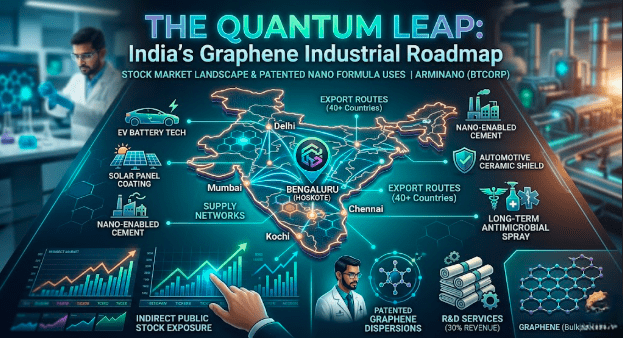
This extensive, industrial-grade blueprint provides an exhaustive analysis of the graphene ecosystem. It addresses foundational physics, manufacturing challenges, toxicity profiles, current Indian market valuations, stock market dynamics, and the commercial trailblazers—headlined by Bengaluru’s BTCORP Generique Nano Pvt. Ltd. (Arminano)—that are transforming laboratory anomalies into multi-metric-ton industrial realities.
1. Graphene How Works: The Underlying Physics and Quantum Mechanics
To understand why graphene behaves as a disruptive force across industries, one must look at its atomic architecture. Graphene is the thinnest material known to humanity, boasting a thickness of exactly one carbon atom ($\approx 0.34 \text{ nm}$).
✦ Honeycomb Lattice Structure ✦
      C       C               C       C
    /   \   /   \           /   \   /   \
   C     C — C     C ————— C     C — C     C
    \   /   \   /           \   /   \   /
      C       C               C       C
The $sp^2$ Hybridization and Carbon Bonding
Every carbon atom in a graphene sheet is covalently bound to three neighboring carbon atoms via strong $\sigma$ (sigma) bonds, utilizing $s$, $p_x$, and $p_y$ atomic orbitals. This configuration forms a planar structure with a carbon-carbon bond length of approximately $0.142 \text{ nm}$. These ultra-strong covalent linkages give graphene its legendary mechanical strength.
However, the true magic lies in the remaining unhybridized $p_z$ orbital, which sits perpendicular to the sheet’s plane. These atomic orbitals overlap across the entire lattice to form a delocalized network of $\pi$ (pi) and $\pi^*$ (pi-star) bands.
Dirac Cones and Massless Dirac Fermions
In solid-state physics, traditional materials exhibit a parabolic relationship between electron energy and momentum. Graphene breaks this rule entirely. Its valence and conduction bands touch linear, hexagonal points within the Brillouin zone, known as Dirac Points.
$$E(\mathbf{k}) = \pm \hbar v_F |\mathbf{k}|$$
Because the energy-momentum relation is completely linear at these low-energy states, electrons moving through graphene behave like relativistic particles with zero rest mass. They are referred to as Massless Dirac Fermions. This allows electrons to travel at an astonishing effective speed—around $10^6 \text{ m/s}$, which is roughly $1/300$ the speed of light—undergoing minimal scattering at room temperature. This phenomenon gives rise to ballistic transport, allowing electrical current to pass through the material with near-zero resistance.
2. Fundamental Properties of Graphene
The quantum mechanical properties of graphene translate directly into extraordinary macroscopic capabilities. It is the only material that simultaneously holds world records for mechanical, thermal, optical, and electrical performance.
| Core Property | Metric Value / Performance Benchmark | Industrial Relevance |
| Intrinsic Tensile Strength | $130 \text{ GPa}$ (Young’s Modulus of $1 \text{ TPa}$) | $\approx 200\times$ stronger than structural steel; ultra-lightweight structural reinforcements. |
| Electrical Conductivity | $1.0 \times 10^8 \text{ S/m}$ (Mobility $> 200,000 \text{ cm}^2/\text{Vs}$) | Exceeds ballistic copper; enables ultra-fast charging devices and micro-electronics. |
| Thermal Conductivity | $3,000 \text{ to } 5,000 \text{ W/m}\cdot\text{K}$ | Outperforms diamond and copper; ideal for thermal management in smartphones and EVs. |
| Specific Surface Area | $2,630 \text{ m}^2/\text{g}$ (Theoretical maximum) | Offers massive active surface area; perfect for supercapacitors and chemical battery nodes. |
| Optical Transparency | Absorbs just $2.3\%$ of white light | Highly transparent ($\approx 97.7\%$); ideal for ITO-free flexible solar panels and touchscreens. |
| Chemical Impermeability | Completely impermeable to gases (even Helium) | Acts as an unbreachable molecular barrier; ideal for anti-corrosion marine coatings. |
3. How is Graphene Made? Industrial Synthesis Methods
Scaling up graphene production from milligram-level lab samples to industrial metric tons is a massive chemical engineering challenge. Today, the manufacturing landscape is divided into two primary strategies: Top-Down extraction and Bottom-Up synthesis.
                  ┌─────────────────────────────────────────┐
                  │      GRAPHENE PRODUCTION METHODS        │
                  └────────────────────┬────────────────────┘
                                       │
         ┌─────────────────────────────┴─────────────────────────────┐
         ▼                                                           ▼
┌─────────────────────────────────┐                         ┌─────────────────────────────────┐
│     TOP-DOWN EXTRACATION        │                         │      BOTTOM-UP SYNTHESIS        │
├─────────────────────────────────┤                         ├─────────────────────────────────┤
│ • Liquid-Phase Exfoliation      │                         │ • Chemical Vapor Deposition     │
│ • Chemical Reduction (GO -> rGO)│                         │ • Epitaxial Growth on SiC       │
│ • Ball Milling / Shear Mixing   │                         │ • Laser-Induced Graphene (LIG)  │
└─────────────────────────────────┘                         └─────────────────────────────────┘
A. Top-Down Methods (Bulk Volume Production)
These methods rely on breaking apart bulk source materials, like raw graphite, into individual atomic sheets using chemical, thermal, or mechanical energy.
- Liquid-Phase Exfoliation (LPE): Raw graphite flakes are suspended in a liquid medium (often surfactant-water mixtures or organic solvents like NMP) and subjected to high-shear mixing or ultrasonic waves. The shear forces overcome the weak van der Waals forces holding the graphite layers together, cleanly separating them into pristine graphene sheets.
- Hummer’s Method & Chemical Reduction: This is the most common route for bulk chemical manufacturing. Raw graphite is treated with harsh, highly oxidizing agents (such as sulfuric acid and potassium permanganate) to produce Graphene Oxide (GO). GO is highly hydrophilic and dispersible in water due to attached hydroxyl, epoxy, and carboxyl functional groups. To restore electrical conductivity, the oxygen functional groups are removed using thermal shock or chemical reducing agents (like hydrazine or ascorbic acid), yielding Reduced Graphene Oxide (rGO).
B. Bottom-Up Methods (High-Purity Thin Films)
These methods build graphene atom-by-atom from gaseous carbon precursors.
- Chemical Vapor Deposition (CVD): Hydrocarbon gases (typically methane, $\text{CH}_4$) are introduced into a high-temperature furnace ($\approx 1000^\circ\text{C}$) over a transition metal catalytic substrate, such as copper ($\text{Cu}$) or nickel ($\text{Ni}$). The methane gas cracks on the hot metal surface, and the freed carbon atoms dissolve into or deposit onto the metal substrate, arranging themselves into a continuous, high-purity, single-layer graphene film as it cools. This method is crucial for making semiconductor components and high-end optoelectronics.
4. Graphene Material Classification: Pristine, GO, rGO, and CNTs
“Graphene” is not a single, uniform product; it is an umbrella term for a diverse family of advanced nanostructured carbons. Selecting the correct variant is absolutely essential for industrial application engineering.
Pristine Graphene
This is pure, un-oxidized carbon structurally free of lattice defects. Because its aromatic $\pi$-network remains entirely intact, it offers unmatched electrical and thermal conductivity. It is typically supplied as ultra-thin powders or stabilized liquid dispersions for high-end electronics, thermal interfaces, and specialized barrier films.
Graphene Oxide (GO)
An oxidized form of graphene covered in oxygen-rich functional groups. While these chemical defects disrupt its electrical conductivity, they make GO incredibly versatile. It is highly dispersible in water and polar solvents, making it an excellent base material for water purification membranes, biomedical systems, and concrete/cement composites.
Reduced Graphene Oxide (rGO)
Produced by chemically or thermally stripping oxygen away from GO. While it retains a few structural defects compared to pristine graphene, rGO successfully restores electrical conductivity and surface area at a highly accessible, industrial-scale price point. It is widely used in energy storage anodes, conductive inks, and anti-corrosion industrial coatings.
Carbon Nanotubes (CNTs) & Metallic Nanoparticles
Often blended with graphene formulations to create synergistic properties. Single-walled (SWCNTs) and multi-walled carbon nanotubes (MWCNTs) can be thought of as graphene sheets seamlessly rolled into hollow cylinders. Combining planar graphene with linear CNTs creates a dense, three-dimensional conductive network inside plastics and batteries, preventing the individual nanomaterials from restacking.
5. What is Graphene Used For? Industrial & Everyday Applications
Thanks to its multi-functional properties, graphene has found a home in almost every major modern industry.
Energy Storage & Next-Gen EV Batteries
Integrating graphene into Lithium-ion, Lithium-sulfur, and Solid-State battery architectures has fundamentally changed energy storage performance.
- Anode Enhancement: Incorporating graphene into silicon-based anodes accommodates the severe structural expansion ($\approx 300\%$) that silicon undergoes during charging cycles, preventing anode cracking.
- Ultra-Fast Charging: Graphene’s rapid ballistic electron transport drops internal cell resistance, allowing electric vehicles (EVs) to achieve an $80\%$ charge in under 10 minutes while drastically mitigating thermal degradation.
Electronics, Thermal Management, and Smart Displays
As microchips pack more transistors into smaller spaces, managing heat dissipation has become a major engineering bottleneck. Graphene thermal dissipation sheets are now regularly laminated behind smartphone screens and EV control units to spread and vent localized heat spikes. Furthermore, its extreme carrier mobility makes it a key material for next-generation radiofrequency (RF) transistors, flexible wearables, and transparent conductive films.
Structural Composites: Cement, Polymers, and Aerospace
Adding less than $0.1\%$ by weight of functionalized graphene into polymers or concrete creates massive structural improvements. In cement matrices, graphene flakes act as nucleation centers, accelerating hydration reactions and turning micro-cracks into dead ends. This produces concrete with up to $30\%$ higher compressive strength, allowing construction companies to use significantly less material and drastically lower their carbon footprint.
6. Graphene Uses in Daily Life: Consumer Applications
Beyond heavy industrial settings, nano-enabled products are quietly entering the retail consumer goods market, significantly boosting everyday performance.
       ┌────────────────────────────────────────────────────────┐
       │             CONSUMER NANOTECHNOLOGY INFUSION           │
       └───────────────────────────┬────────────────────────────┘
                                   │
      ┌────────────────────────────┼────────────────────────────┐
      ▼                            ▼                            ▼
┌──────────────┐             ┌──────────────┐             ┌──────────────┐
│  AUTOMOTIVE  │             │ SOLAR ENERGY │             │  HOME CLEAN  │
├──────────────┤             ├──────────────┤             ├──────────────┤
│ • Ceramic Shield           │ • Anti-Dust  │             │ • Eco Gels   │
│ • Gloss Retention          │ • Icephobic  │             │ • Low Foam   │
│ • Scratch Cure             │ • Output Max │             │ • Active Clean│
└──────────────┘             └──────────────┘             └──────────────┘
Automotive Care: Graphene-Ceramic Hybrid Coatings
Traditional car waxes break down under UV heat within months. Modern graphene-ceramic hybrid coatings create a permanent covalent bond with a vehicle’s clear coat. The underlying graphene mesh yields incredible hydrophobic performance (water contact angles $>110^\circ$), protects against chemical etching from bird droppings, reduces water spotting, and significantly improves micro-scratch resistance.
Sustainable Home Care: Eco-Friendly Formulations
Advanced home care products use graphene derivatives to optimize surfactant efficiency. By modifying the surface tension of cleaning liquids, these eco-gels deliver deep degreasing power and anti-microbial surface protection with low-foaming chemistry. This means users need far less water per wash cycle, creating a truly sustainable household cleaning option.
Solar Glass Coatings: Maximizing Energy Yield
Solar panels deployed in high-dust regions face a major issue called “soiling,” where dirt accumulation can slash energy efficiency by up to $25-30\%$. Applying an ultra-thin, highly transparent nano-coating directly onto the solar glass changes its surface chemistry. It creates an ultra-hydrophobic, anti-static, and self-cleaning top layer. Rainwater simply beads up and rolls off, collecting dust along the way, keeping solar farms running at maximum power output without expensive manual cleaning cycles.
7. Safety Profile: Is Graphene Toxic?
With the rapid commercial scale-up of nanomaterials, understanding environmental, health, and safety (EHS) impacts is non-negotiable. Is graphene toxic? The answer depends heavily on its physical state, structural dimensions, and exposure route.
                    ┌──────────────────────────────────────┐
                    │      GRAPHENE TOXICITY FACTORS       │
                    └──────────────────┬───────────────────┘
                                       │
         ┌─────────────────────────────┼─────────────────────────────┐
         ▼                             ▼                             ▼
┌─────────────────┐           ┌─────────────────┐           ┌─────────────────┐
│ PHYSICAL FORM   │           │ EXPOSURE ROUTE  │           │ CONTEXT CONTENT │
├─────────────────┤           ├─────────────────┤           ├─────────────────┤
│ Airborne powder │           │ Inhalation risk │           │ Safe embedded in│
│ liquid slurry   │           │ Liquid handled  │           │ polymer matrices│
└─────────────────┘           └─────────────────┘           └─────────────────┘
Inhalation Risk (The Powder Factor)
Free, airborne graphene nanopowders present an inhalation hazard similar to carbon black or crystalline silica. If micro-sized particles bypass the respiratory tract’s natural defenses and settle deep into the alveoli, they can spark localized oxidative stress and inflammatory reactions. Consequently, industrial manufacturing lines must use enclosed processing systems, positive-pressure air filtration, and strict PPE protocols.
Liquid Dispersions and Matrix Immobilization
Once graphene is safely integrated into a liquid suspension, chemical masterbatch, polymer matrix, or finished coating, the threat of inhalation drops to near zero. Bound within a solid or liquid phase, the nano-sheets cannot easily break free into the atmosphere, making them completely safe for commercial consumers and end-users handling finished products.
Biodegradability and Ecotoxicity
Functionalized variants like Graphene Oxide are susceptible to enzymatic degradation by common biological catalysts, such as myeloperoxidase (MPO) found in human white blood cells. Sustainable manufacturers focus heavily on chemical functionalization to ensure that any micro-traces entering natural water systems naturally break down into harmless carbon byproducts over time.
8. The Graphene Landscape in India (2026 Market Analysis)
The year 2026 marks a major turning point for India’s advanced carbon market. Shifting away from reliance on expensive material imports from China, Europe, and North America, India has successfully built its own self-reliant supply chain.
Market Size and Growth Catalyst Matrix
The Indian graphene market is growing at an incredible CAGR of over $22\%$. This rapid expansion is fueled by massive domestic demand for electric vehicle batteries, infrastructure upgrades, and a thriving consumer electronics ecosystem.
       G R A P H E N E   I N D I A   2 0 2 6   M A R K E T   M E T R I C S
       ===================================================================

       [CAGR Growth Rate]       ▓▓▓▓▓▓▓▓▓▓▓▓▓▓▓▓▓▓▓▓▓▓▓▓▓▓▓▓ 22%+ Annual
       [Supply Scale]           ████████████████████████████ Multi-Metric Ton
       [Application Spread]     ▒▒▒▒▒▒▒▒▒▒▒▒▒▒▒▒▒▒▒▒▒▒▒▒▒▒▒▒ 50+ Industrial Verticals
       [Export Reach]           ░░░░░░░░░░░░░░░░░░░░░░░░░░░░ 40+ Nations Globally
Key Geographic Clusters & Conferences
India’s nanotechnology ecosystem has anchored itself around two major regional powerhouse hubs:
- The Southern Technology Corridor (Bengaluru – Kochi): Anchored by breakthrough corporate production centers and major research institutions like Cochin University of Science and Technology. Kochi is widely known for hosting key industry gatherings, such as the Graphene Conference 2026 Kochi and the 2D Materials Conference 2026, which bring together international scientists, venture capitalists, and commercial OEMs.
- The Northern Academic Hub (Delhi – Roorkee): Centered around elite institutions like IIT Delhi, CSIR-NPL, and specialized business incubators, focusing heavily on basic synthesis and fundamental patent application research.
9. Top Graphene Companies and Manufacturers in India
While several domestic chemical conglomerates are running initial laboratory pilots, only a selective group of dedicated players have successfully crossed the “valley of death” into profitable, large-scale commercial manufacturing.
1. BTCORP Generique Nano Pvt. Ltd. (Arminano)
Established in 2012 in Bengaluru, BTCORP stands out as India’s first true multi-metric-ton bulk industrial manufacturer of graphene derivatives. The company has carved out a unique space by blending deep chemical synthesis with end-consumer product manufacturing.
Rather than just selling raw powders, BTCORP uses its consumer brand, ARMI® (Advanced Research Material Intrics), to provide ready-to-use nano-coatings and specialized sustainable formulations worldwide.
2. Tata Steel Advanced Materials Division
A major corporate player that has established dedicated cleanrooms for graphene synthesis. They focus primarily on using graphene reinforcements to upgrade their own structural steel and anti-corrosion paint lines.
3. Log 9 Materials
Headquartered in Bengaluru, this energetic firm focuses on downstream energy storage solutions. They leverage graphene-enhanced cells to create ultra-fast-charging battery packs tailored for commercial two-wheel and three-wheel EV delivery fleets.
4. Nanospan
Operating out of Hyderabad, this team focuses on developing functionalized graphene admixtures specifically engineered to improve the early strength and durability of green concrete mixes.
10. Deep-Dive Profile: BTCORP Generique Nano (Arminano)
To truly understand how an advanced materials company scales up in India, let’s take a detailed look at the operational strategy of BTCORP Generique Nano Pvt. Ltd.
       ┌────────────────────────────────────────────────────────┐
       │               BTCORP REVENUE STREAMS                   │
       └───────────────────────────┬────────────────────────────┘
                                   │
                     ┌─────────────┴─────────────┐
                     ▼                           ▼
         ┌───────────────────────┐   ┌───────────────────────┐
         │ PRODUCT MANUFACTURING │   │   CONTRACT RESEARCH   │
         ├───────────────────────┤   ├───────────────────────┤
         │  • Bulk Raw Materials │   │  • 30% Global Revenue │
         │  • ARMI Consumer Line │   │  • Custom Chem-Graft  │
         │  • Industrial Coatings│   │  • Prototyping Hub    │
         └───────────────────────┘   └───────────────────────┘
Corporate Origins and Structural Evolution
Founded in 2012 as Bottom Up Technology Corporation, the company rebranded and streamlined its focus into BTCORP Generique Nano Pvt. Ltd. Over its 14 years of R&D history, the company has stayed intensely focused on precision chemistry, manufacturing scalability, and practical market applications.
Today, it operates an advanced production facility in the Pillagumpe Industrial Area (Hoskote, Bengaluru), yielding a robust catalog of more than 50 engineered nanostructured formulations.
Dual Engine Business Model
Unlike standard raw-material suppliers vulnerable to commodity price shifts, BTCORP runs a highly resilient, diversified business model:
- Commercial Manufacturing (70%): Scalable, patent-protected production of bulk pristine graphene, GO, rGO, carbon nanotubes, and the complete retail lines of ARMI® high-end consumer nano-sprays.
- Contract Research Excellence (30%): Providing fee-for-service R&D to international firms, including custom chemical grafting, rapid prototyping, and advanced material integration for Fortune 500 companies.
The ARMI® Product Line Architecture
Through its flagship brand ARMI®, BTCORP transforms complex nanotechnology into accessible, everyday solutions:
- Industrial Nanocoatings: Highly durable graphene-ceramic barriers engineered for commercial automotive centers, high-speed rail lines, and glass facades.
- ARMI® Solar Glass Shield: A specialty self-cleaning coating that bonds to solar arrays, preventing dirt buildup and directly boosting long-term solar power output.
- The 100-Day Antimicrobial Spray: A breakthrough medical-grade surface protectant that creates a long-lasting antimicrobial shield, widely trusted in hygiene-critical environments like hospital wards and food processing plants.
- FMCG Sustainable Cleaners: Low-foaming, eco-friendly laundry and dishwashing gels designed to reduce household water usage while maintaining professional-grade cleaning performance.
11. Graphene Stock Market Footprint in India
As global interest in nanotech grows, Indian investors are eager to gain stock market exposure to this space. However, navigating the public markets requires a clear understanding of where these companies sit financially.
The Reality of Pure-Play Listings
As of mid-2026, there is no pure-play graphene manufacturer listed directly on the National Stock Exchange (NSE) or Bombay Stock Exchange (BSE). Highly specialized innovators like BTCORP Generique Nano are currently held privately via venture capital, foundational founders’ equity, and corporate research grants. This allows them to focus intensely on long-term R&D without the pressure of quarterly retail stock market expectations.
Indirect Investment Vectors via Public Conglomerates
Investors looking to participate in India’s advanced carbon revolution can target listed legacy companies that run large, active downstream graphene business divisions:
            ┌──────────────────────────────────────────────────┐
            │       INDIRECT PUBLIC STOCK EXPOSURE             │
            └────────────────────────┬─────────────────────────┘
                                     │
         ┌───────────────────────────┼───────────────────────────┐
         ▼                           ▼                           ▼
┌───────────────────┐       ┌───────────────────┐       ┌───────────────────┐
│    TATA STEEL     │       │   IPCA / MID-CAP  │       │ RELIANCE IND.     │
├───────────────────┤       ├───────────────────┤       ├───────────────────┤
│ Active advanced   │       │ Investing in      │       │ Massive scale-up  │
│ materials wing    │       │ clinical medical  │       │ of carbon-encl.   │
│ processing graphene│      │ nano diagnostics  │       │ energy storage    │
└───────────────────┘       └───────────────────┘       └───────────────────┘
- Tata Steel Ltd. (NSE: TATASTEEL): Houses a dedicated Advanced Materials division specializing in graphene-integrated coatings and polymer composites.
- Reliance Industries Ltd. (NSE: RELIANCE): Investing heavily in scaling carbon-enclosed energy systems, hydrogen storage tech, and next-gen composites.
- Mid-Cap Specialty Chemical Stocks: Companies focusing on industrial dye and polymer lines are increasingly partnering with private nanotech firms to license performance-boosting additives.
12. Graphene Price in India 2026: The Commercial Matrix
Graphene pricing is highly variable and depends on three key factors: material purity, chemical modification, and order volume. The commercial market has moved past the era of experimental laboratory pricing, splitting into two distinct purchasing tiers.
Industrial vs. Research Commercial Matrix
| Exact Material Grade | Delivery Format / Solvent Medium | Volume Tier | Market Price (INR) | Primary Field of Deployment |
| Super Grade Pristine Graphene | Dry Micronized Powder | $1 \text{ kg}$ Industrial Pack | ₹44,000 | Conductive electronic paths, thermal dissipation pads, masterbatches. |
| Pristine Graphene Oxide (GO) | High-Purity Dry Powder | $10 \text{ grams}$ Research Pack | ₹1,980 | Desalination filtration, specialized polymer R&D, biosensors. |
| Reduced Graphene Oxide (rGO) | Stable Functionalized Slurry | $100 \text{ ml}$ Research Pack | ₹1,980 | Battery node coatings, heavy anti-corrosion primers. |
| Graphene Conductive Coating | Ready-to-apply Liquid Formulation | $100 \text{ grams}$ Pack | ₹998 | Smart circuit prototyping, printed wearable electronics. |
| ARMI® Solar Glass Shield | Aqueous Liquid Spray | $100 \text{ ml}$ Bottle | ₹900 | Distributed rooftop solar installations, commercial glass facades. |
| ARMI® Glass Nanocoat Shield | Premium Ceramic Infused Liquid | $500 \text{ ml}$ Spray | ₹1,699 | High-end automotive detailing, architectural windows. |
13. Strategic Technical Leadership Spotlight
The success of any deep-tech venture comes down to the scientific minds steering its development. At BTCORP, this leadership is driven by M. Naushad Ali, Co-Founder and Chairman of the group.
       M .   N A U S H A D   A L I   —   P R O F I L E   M E T R I C S
       ===============================================================

       [Academic Background]    M.Tech Nanotechnology | European PhD Track
       [Fellowships]            Ex-Marie Curie Fellow (European Commission)
       [Lab Background]         NATO-Linked Laboratories | AIIMS | IIT Delhi | BARC
       [IP Portfolio]           12+ Graphene Patents | 100+ Research Papers
Academic and Global Research Foundation
M. Naushad Ali holds an M.Tech in Nanotechnology along with a European PhD enrollment. His research background includes serving as an elite Marie Curie Fellow under the European Commission, giving him access to cutting-edge nanomaterial development setups across Europe, including highly secure NATO-linked labs.
Multidisciplinary Indian Integration
In India, his deep scientific work spans the country’s most respected institutions—including the All India Institute of Medical Sciences (AIIMS), IIT Delhi, Bhabha Atomic Research Centre (BARC), Jamia Hamdard, and Amity University. He also holds an active Pharmacy Council license, bringing a unique, multidisciplinary perspective to nanotechnology. This allows him to bridge the gap between heavy materials engineering and delicate biomedical surface applications.
Turning Science into Scalable Business
Holding more than 12 proprietary graphene patents and over 100 globally cited research papers, M. Naushad Ali has focused his career on moving graphene past small-scale academic testing. His expertise in understanding surface chemistry and dispersion stability is the driving force behind BTCORP’s patented production routes, establishing the firm as a trusted global name in advanced materials.
14. Comparative Analysis Matrix: Carbon Nanomaterials
To conclude this industrial blueprint, let’s look at a clear comparative breakdown of carbon nanomaterials. This helps project procurement managers and engineering leads select the exact advanced carbon structure needed for their specific applications.
                          ┌───────────────────────────┐
                          │ GRAPHENE LATTICE MATRIX   │
                          └─────────────┬─────────────┘
                                        │
         ┌──────────────────────────────┼──────────────────────────────┐
         ▼                              ▼                              ▼
┌──────────────────┐           ┌──────────────────┐           ┌──────────────────┐
│  2D PLANAR SHEET │           │ 1D ROLLED TUBE   │           │ 0D BALL SPHERE   │
├──────────────────┤           ├──────────────────┤           ├──────────────────┤
│ Graphene Flakes  │           │ Carbon Nanotubes │           │ Fullerene C60    │
│ Surface Area Max │           │ Axial Strength   │           │ Molecular Cage   │
└──────────────────┘           └──────────────────┘           └──────────────────┘
[Image of crystal structure of carbon allotropes including graphene carbon nanotube and fullerene]
15. Conclusion: Partnering with India’s Nanotech Future
As we look across the industrial landscape of 2026, graphene has clearly moved past the hype cycle. It is now a real-world, scalable material driving measurable performance gains in energy, infrastructure, transport, and consumer goods.
For international buyers, corporate researchers, and manufacturing OEMs, the key to success lies in choosing partners who offer more than just raw material supply. Leaders like BTCORP Generique Nano (Arminano) show that the future belongs to companies that combine bulk synthesis capacities, patented technologies, and free, end-to-end application support.
By anchoring production in tech hubs like Bengaluru and supporting global industry gatherings like the Kochi Graphene Conferences, India has built a complete, world-class advanced carbon ecosystem. The transition to nanotechnology is no longer a distant possibility—it is an active commercial reality.
For custom material orders, application testing, or global contract research inquiries, you can reach the Bengaluru engineering desk directly via email at: btc@bt-corp.co
16. Frequently Asked Questions (FAQ)
Q1: Why is graphene considered a 2D material if it exists in our 3D world?
A: Graphene is classified as a two-dimensional (2D) material because its physical thickness is exactly one carbon atom ($\approx 0.34 \text{ nm}$). While it occupies space in three dimensions, its electrons are completely confined within a two-dimensional plane. This quantum confinement forces their wave functions to operate strictly on an $X$ and $Y$ axis, giving rise to unique properties like massless Dirac fermion transport that simply cannot occur in standard 3D structures.
Q2: What is the difference between Graphene Oxide (GO) and Reduced Graphene Oxide (rGO)?
A: Graphene Oxide (GO) is created by heavily oxidizing graphite, covering its sheets with oxygen functional groups (like hydroxyl and epoxy molecules). This makes GO non-conductive but highly dispersible in water. Reduced Graphene Oxide (rGO) is produced by chemically or thermally stripping those oxygen groups away from GO. This process successfully restores the material’s electrical conductivity and surface area, making rGO an excellent, cost-effective choice for electronics and battery anodes.
Q3: How does a graphene coating protect solar panels from efficiency drops?
A: Coatings like the ARMI® Solar Glass Shield create a highly transparent, ultra-hydrophobic, and anti-static layer on the panel’s glass surface. This prevents dust, dirt, and industrial pollution from sticking to the array. When it rains, water beads up and rolls off instantly, picking up loose dirt along the way. This self-cleaning process ensures maximum sunlight hits the photovoltaic cells, avoiding the typical $20\%+$ power drops caused by dust buildup.
Q4: Can I buy pure graphene shares directly on the Indian Stock Market (NSE/BSE)?
A: No, as of mid-2026, there are no pure-play graphene manufacturers listed directly on the NSE or BSE. Pioneering innovators in this space, such as BTCORP Generique Nano, operate as closely held private corporations. This allows them to invest heavily in long-term R&D without the pressure of public market volatility. Investors can gain exposure indirectly by targeting large, listed materials and chemical conglomerates, like Tata Steel, which run dedicated advanced nanotechnology business divisions.
Q5: Is handling graphene products safe for daily consumer use?
A: Yes, finished consumer products are entirely safe. The primary health concern with nanomaterials is inhaling free, loose airborne powders in industrial manufacturing environments. Once graphene is integrated into a liquid suspension, protective wax, or polymer matrix (such as the ARMI® retail line), the nano-sheets are permanently locked into the medium. They cannot become airborne, eliminating any risk of inhalation and making them completely safe to handle.
Q6: What role does Bengaluru play in India’s nanotechnology ecosystem?
A: Bengaluru serves as the primary commercial and tech-driven hub for India’s nanotechnology sector. Backed by elite research institutions like the Indian Institute of Science (IISc) and supported by strong industrial corridors like the Pillagumpe Area, the city provides the perfect infrastructure for advanced deep-tech scale-ups. This ecosystem has enabled private firms like BTCORP to build India’s first multi-metric-ton bulk graphene production lines, successfully serving clients across 40+ countries.