

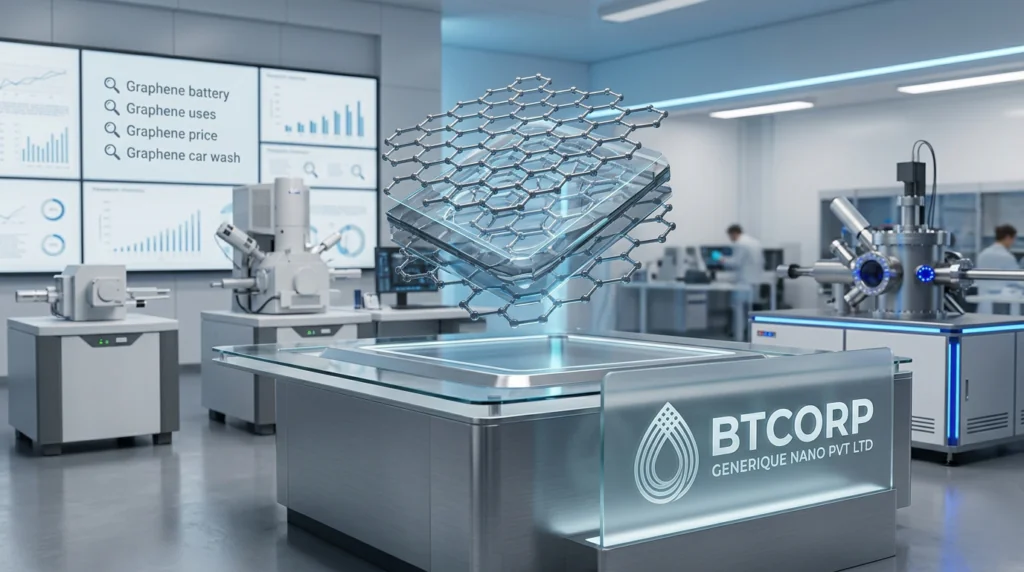
The Industrial Leader’s Guide to Graphene Structure, Formula, and Market Potential
Introduction: The Dawn of the Graphene Industrial Revolution
The term “graphene” has evolved from a niche academic curiosity into the cornerstone of the next industrial revolution. As a revolutionary graphene material, it is currently undergoing a pivotal shift, transitioning from controlled laboratory research to high-volume commercial-scale application. For industries ranging from automotive and aerospace to energy storage and consumer electronics, graphene represents a fundamental disruption in material science. However, to harness its potential effectively, organizations must move beyond the hype and develop a deep, technical understanding of the graphene formula and its underlying physics.
The Architectural Foundation
At its core, graphene is a two-dimensional allotrope of carbon, consisting of a single layer of atoms arranged in a hexagonal lattice—a unique graphene structure that grants the material its extraordinary mechanical, thermal, and electrical properties. This atomic-scale precision is not merely an interesting scientific fact; it is the source of the material’s competitive advantage.
| Property | Scientific Basis | Industrial Impact |
| Mechanical Strength | $sp^2$ hybridized bonding | Superior reinforcement for composites |
| Thermal Conductivity | Phonon transport efficiency | Advanced heat dissipation for electronics |
| Electrical Mobility | Delocalized $\pi$ electrons | High-efficiency energy storage solutions |
Why Understanding Structure Matters
The performance of a final product is directly dictated by the structural integrity of the graphene incorporated into it. An industry looking to gain a true competitive edge must understand that graphene is not a monolithic product; it is a tunable material. By manipulating the graphene structure—such as adjusting layer counts, flake sizes, or surface functionalization—engineers can tailor the material to solve specific manufacturing hurdles.
In this guide, we explore the transition of graphene into the industrial mainstream. We will dissect how companies can move from experimental prototyping to robust, reliable, and scalable integration, ensuring that your production line is fueled by materials that provide predictable, superior results. The future of high-performance manufacturing belongs to those who view graphene not just as a additive, but as a strategic tool for structural and functional innovation.
1. The Science Behind the Material: Decoding the Nanoscale Advantage
At the foundational level, graphene is defined as a two-dimensional, single-layer sheet of carbon atoms organized into a tightly packed, honeycomb-like hexagonal lattice. While it may appear deceptively simple, this specific graphene structure is the source of the material’s unparalleled physical and chemical performance. Unlike traditional bulk carbon forms, such as graphite or diamond, graphene’s unique two-dimensional configuration allows for the exceptional mobility of electrons, superior thermal dissipation, and immense mechanical integrity. For any industry aiming to leverage this graphene material, understanding these fundamental scientific pillars is essential to successful integration.
Unlocking Fundamental Properties
The material’s capability to transform various sectors stems from three core technical pillars:
- Exceptional Electrical Conductivity: Graphene’s hexagonal lattice facilitates high-speed electron mobility that significantly outperforms traditional materials like copper or silicon. This makes graphene an ideal candidate for next-generation energy storage, specifically within the graphene battery sector, where it enables faster charging and higher capacity. Similarly, the integration of graphene in a graphene phone allows for superior processing efficiency and power management.
- Unmatched Thermal Management: In the realm of high-density electronics, heat is the primary enemy of performance and component longevity. Graphene exhibits a thermal conductivity that is effectively unmatched, allowing it to act as a highly efficient heat spreader for sensitive circuit boards and processors. By facilitating rapid phonon transport across its lattice, it prevents thermal throttling and structural failure in compact electronic devices.
- Superior Mechanical Strength: Despite its atomic thinness, graphene possesses a tensile strength that is significantly stronger than industrial-grade steel. This extraordinary strength-to-weight ratio is the primary reason for its growing popularity in high-performance composite manufacturing, where adding minimal weight can yield massive gains in structural integrity.
The Scientific Logic: Formula and Morphology
The graphene formula is effectively represented as pure carbon ($C$), yet its industrial utility is dictated more by its morphology than its chemical composition alone. The way these carbon atoms are bonded via $sp^2$ hybridization creates a rigid, yet flexible, structural backbone.
| Property | Scientific Mechanism | Strategic Industrial Benefit |
| Electron Mobility | Delocalized $\pi$-electron network | Faster charging/Processing speeds |
| Heat Dissipation | Efficient phonon scattering | Prevents overheating in dense electronics |
| Elastic Modulus | Strong covalent $C-C$ bonds | Increased durability in composites |
Why Morphology and Grade Matter
For industrial buyers, it is critical to realize that not all graphene is created equal. The quality of the graphene structure—specifically the number of layers (monolayer vs. few-layer) and the presence of defects or functional groups—determines how the material will behave in your specific manufacturing matrix.
Low-quality or poorly synthesized material will not exhibit the intrinsic electrical or mechanical strengths mentioned above. Instead, it will lead to performance degradation. Therefore, when sourcing graphene material, the focus must shift from simple cost-per-kilogram metrics to performance-based data, such as sheet resistance, surface area, and morphological purity.
At BTcorp Generique Nano Pvt Ltd, we prioritize this scientific rigor by providing comprehensive data—including Raman spectroscopy and electron microscopy—to validate that the graphene structure in our dispersions retains the intrinsic properties of the original 2D sheet. By choosing a partner that treats material science with this level of technical transparency, you ensure that your production line is fueled by materials that provide predictable, consistent, and superior results, regardless of whether you are innovating in energy storage, consumer tech, or high-stress industrial infrastructure. The science is the foundation, but the correct application is what delivers the ROI.
2. Expanding Graphene Uses in Industry
The potential Graphene Uses are not merely theoretical; they represent a fundamental paradigm shift in how we conceive, design, and manufacture industrial products. By integrating this advanced graphene material into existing manufacturing processes, industries are unlocking performance benchmarks that were previously thought to be physically impossible. As production methods for high-quality graphene stabilize, we are witnessing a surge in large-scale commercial applications that leverage the material’s unique structural and electrical properties.
Revolutionizing the Energy Storage Landscape
One of the most immediate and impactful applications of graphene is in the development of the graphene battery. Traditional lithium-ion batteries have long faced limitations regarding charging speed, energy density, and thermal stability. The integration of graphene into electrode architectures is effectively solving the issue of long charging times in electric vehicles (EVs) and portable power solutions.
- Fast Charging Capabilities: Graphene’s high electrical conductivity allows for the rapid flow of ions, drastically reducing charge times from hours to minutes.
- Enhanced Thermal Stability: By acting as a superior heat conductor, graphene layers help manage the internal temperatures of the graphene battery, preventing the degradation typically caused by thermal stress during rapid charging cycles.
- Increased Cycle Life: The structural integrity of graphene prevents the expansion and contraction issues that often plague standard battery electrodes, extending the overall usable lifespan of the energy storage system.
Consumer Technology: The Next Generation of Electronics
In the consumer electronics space, the development of the graphene phone promises to be a watershed moment. As processors become more powerful and devices become thinner, the challenge of heat dissipation and structural durability grows exponentially. Graphene offers an elegant solution to these bottlenecks.
- Ultra-Efficient Thermal Management: By incorporating graphene into the chassis or heat spreaders, the graphene phone can efficiently distribute heat away from the processor, enabling higher performance without the need for bulky cooling systems.
- Structural Durability: Graphene’s immense tensile strength allows for the production of flexible, durable, and virtually unbreakable components, enabling the future of foldable and high-wear consumer devices.
- Improved Sensor Sensitivity: Beyond just structural and thermal uses, graphene’s extreme sensitivity to surface changes is being utilized to develop next-generation touchscreens and biometric sensors that are faster and more responsive than current technology.
Automotive Care and Industrial Coating Innovations
Outside of high-tech electronics, graphene is drastically changing the automotive aftermarket and industrial coatings sector. The application of a graphene car wash treatment or ceramic-graphene hybrid coating provides a level of protection that standard polymer-based waxes simply cannot match.
| Application | Technical Benefit | Industrial Advantage |
| Hydrophobic Shielding | Repels water, oils, and contaminants | Drastically reduces maintenance frequency |
| Wear Resistance | Hardens the clear coat surface | Provides superior scratch and swirl resistance |
| UV Protection | Blocks harmful solar radiation | Prevents paint oxidation and color fading |
These coatings leverage the hydrophobic nature of the graphene structure to create a long-lasting, invisible barrier. This shield protects paintwork from extreme weather, bird droppings, road salt, and minor abrasions. For the automotive industry, this is not just an aesthetic upgrade; it is a performance-based maintenance solution that extends the lifecycle of a vehicle’s finish.
The Strategic Need for Integration Expertise
While the graphene uses mentioned above are exciting, they carry a common theme: the necessity of expert dispersion. Whether it is formulating a liquid coating for automotive use or an electrode slurry for a graphene battery, the performance of the final product is strictly limited by how well the graphene is distributed within the matrix.
At BTcorp Generique Nano Pvt Ltd, we understand that moving from an innovative concept to a marketable product requires more than just high-quality graphene; it requires technical support. We assist our clients in identifying which grade and functionalization of graphene are best suited for their specific application—whether that involves balancing conductivity in an EV cell, heat management in a smartphone, or hardness in an industrial coating. By bridging the gap between raw graphene material and end-product integration, we empower manufacturers to transition from experimental testing to consistent, high-yield commercial production. The revolution in material science is already here, and the industries that move to integrate graphene with precision today will undoubtedly lead the market tomorrow.
3. Market Analysis: Graphene Price and Supply Chain
For businesses aiming to transition from laboratory-scale prototyping to industrial-grade manufacturing, the economic landscape of the graphene material market is undergoing a significant transformation. Historically, the prohibitively high graphene price served as a major barrier to entry. However, as production methodologies—most notably Chemical Vapor Deposition (CVD) and Liquid Phase Exfoliation (LPE)—achieve higher degrees of optimization and scale, the cost-per-performance ratio is becoming increasingly competitive. This shift is turning what was once a specialized experimental material into a viable, cost-effective solution for large-scale automotive, energy, and industrial coating sectors.
The Economics of Scaling
Understanding the market requires looking beyond the raw purchase price. For industrial manufacturers, the total cost of ownership involves not just the material acquisition, but the efficiency of integration and the quality of the final outcome. As production volumes increase, manufacturers are finding that high-quality, pre-dispersed graphene solutions can actually reduce overall production costs by eliminating the need for expensive, high-shear mixing infrastructure and specialized safety protocols required for handling raw dry powders.
Strategic Market Metrics
To make informed procurement decisions, businesses must evaluate graphene through several critical metrics that directly influence both project feasibility and long-term ROI.
| Market Metric | Strategic Importance | Industrial Impact |
| Price Point | Competitive Viability | Making graphene accessible for mass-market automotive & industrial coatings. |
| Supply Chain | Reliability & Consistency | Reduces risk of batch-to-batch variance in sensitive applications. |
| Scalability | R&D to Mass Production | Ensures supply continuity as product demand grows. |
Prioritizing Reliability and Material Grade
As the market matures, the primary focus for serious industrial players has shifted from merely sourcing “graphene” to securing specific, application-grade materials. The “black box” procurement model—where suppliers provide material without granular technical data—is rapidly being replaced by a demand for total transparency. Reliable Graphene Suppliers are now expected to provide rigorous material characterization, ensuring that the crystalline purity, layer count, and functionalization of the carbon allotrope match the exact specifications required for the end application.
This demand for reliability is particularly acute in high-stress industries like aerospace and EV manufacturing. In these sectors, a failure to secure consistent material quality can lead to structural compromises, thermal management issues, or electrical inconsistencies. Consequently, the ability to trace a batch back to its original manufacturing conditions and analytical validation is no longer a luxury—it is a baseline requirement for market leadership.
4. BTcorp Generique Nano Pvt Ltd: Your Technical Partner
At BTcorp Generique Nano Pvt Ltd, we understand that in the high-stakes world of nanotechnology, a product is only as reliable as the material science behind it. We do not simply function as traditional Graphene Suppliers who ship raw material and leave the manufacturer to navigate the complexities of integration. Instead, we provide the scientific roadmap essential for your commercial success. By taking complete responsibility for the complex challenges of dispersion, we ensure that your internal production line remains focused on output, quality, and innovation, rather than chemical troubleshooting.
Our Robust Technical Framework
To eliminate the “black box” procurement risks that often hinder industrial progress, we have institutionalized a rigorous framework centered on transparency, compatibility, and safety.
- Uncompromising Quality Assurance: We recognize that material consistency is the lifeblood of industrial manufacturing. Consequently, every single batch we ship is accompanied by comprehensive, independent data. This includes Raman spectroscopy to validate layer quality and thickness, Scanning Electron Microscopy (SEM) to reveal morphological surface structures, and X-Ray Diffraction (XRD) to confirm crystalline purity.
- Seamless Process Integration: We acknowledge that your existing production infrastructure is a significant asset. Our goal is to enhance that asset, not force a costly redesign. We specialize in engineered dispersions and masterbatches that are specifically formulated to fit directly into your current extrusion, spray-coating, or industrial-scale casting setups.
- Rigorous Safety & Compliance: Nanomaterial handling requires specialized knowledge and strict adherence to safety protocols. We mitigate your operational risk by providing complete, up-to-date Material Safety Data Sheets (MSDS) and Technical Data Sheets (TDS) for all our graphene material dispersions. This ensures your facility remains compliant with local and international industrial safety standards.
Beyond Supply: Building a Competitive Advantage
When you choose to partner with us, you are gaining more than just a chemical source; you are gaining a dedicated partner that treats material science with the precision required for serious manufacturing. We help you cut through the marketing noise, avoid the common pitfalls of using inferior carbon substitutes, and ensure that your production line is fueled by materials that deliver predictable and superior results.
| Technical Support Pillar | Value Delivered to Manufacturer |
| Data Transparency | Eliminates guesswork and batch-to-batch variance. |
| Engineered Masterbatches | Allows for “plug-and-play” integration into existing lines. |
| Compliance Documentation | Ensures a safe and regulatory-compliant shop floor. |
5. Scaling from Lab to Production: Overcoming the “Powder Trap”
The Reality of the “Powder Trap”
When manufacturers attempt to introduce raw, dry graphene into their industrial matrix, they are not simply adding a filler; they are inheriting a complex set of engineering and safety challenges. Raw nanopowders are notoriously difficult to handle, characterized by their extremely low bulk density and high surface area-to-volume ratio. These powders are prone to electrostatic charging, making them difficult to contain and dispense accurately.
Furthermore, there is a significant inhalation risk associated with dry carbon-based nanomaterials. Operating a facility that handles these powders requires substantial investment in specialized safety infrastructure, such as high-efficiency particulate air (HEPA) filtration systems, enclosed glove boxes, and rigorous respiratory protection protocols. For many manufacturers, the capital expenditure required just to safely handle raw powder often renders the entire project economically unfeasible.
Beyond safety, the technical challenge of dispersion is the most significant hurdle. If raw graphene is not dispersed perfectly—meaning each individual nanoparticle is separated and integrated into the carrier—it will inevitably “agglomerate.” These clumps, or agglomerates, act as defects within your material. In structural composites, they function as stress concentrators that lead to premature failure; in electronics, they create “dead zones” that destroy thermal or electrical pathways, ensuring that the end-product performs far below its theoretical potential.
The BTcorp Generique Nano Advantage: Pre-Dispersed Solutions
At BTcorp Generique Nano Pvt Ltd, we have fundamentally shifted the paradigm from raw material supply to total solution delivery. As experienced Graphene Suppliers, we recognize that your production line is your most valuable asset. Our goal is not to force you to redesign your factory or invest in costly new mixing equipment; it is to provide a “plug-and-play” material that integrates directly into your existing workflow.
We have engineered a series of pre-dispersed masterbatches that bypass the technical risks of the shop floor entirely. By formulating our graphene into industry-standard carriers—such as specific resins, polymers, specialized oils, or solvents—we ensure that the material is ready for immediate inclusion.
| Integration Step | Traditional Raw Powder Handling | BTcorp Pre-Dispersed Solution |
| Raw Material Form | Difficult-to-handle dry nanopowder | Pre-dispersed in resins/oils/polymers |
| Handling Safety | High inhalation risk; requires specialized gear | Zero inhalation risk; no special safety equipment needed |
| Process Complexity | High (Requires high-shear/sonication) | Low (“Plug-and-play” inclusion) |
| Dispersion Quality | High risk of agglomeration/defects | Guaranteed uniform suspension |
| Capital Cost | Significant (Mixing & Safety infra) | Minimal (Direct process integration) |
Engineered for Consistency and Throughput
Our core competency lies in advanced dispersion chemistry. By controlling the formulation at our source—under tightly regulated laboratory and pilot-plant conditions—we ensure that the graphene is perfectly and evenly suspended within the carrier medium. This prevents the formation of agglomerates that typically plague in-house mixing attempts, ensuring that the enhanced performance you expect is distributed consistently throughout your final product, batch after batch.
Whether your process involves high-speed industrial extrusion, precision spray-coating, or large-scale casting, our dispersions are formulated to be compatible with your current manufacturing parameters. This means your production staff does not require specialized retraining, and your equipment can run at its intended capacity without the downtime typically associated with difficult-to-process additives.
By utilizing our pre-dispersed solutions, you transition from managing the inherent complications of nanotechnology to reaping its benefits. You effectively eliminate the “Powder Trap,” mitigate high capital expenditure, and ensure that your production line is fueled by materials that deliver consistent, predictable, and superior results. We take the technical burden of dispersion off your shoulders, allowing you to focus on your core objective: delivering high-performance, market-leading products to your customers. In the competitive landscape of 2026, it is this level of seamless technical integration that transforms nanotechnology from a costly experiment into a core component of your operational success.
6. Future Outlook
As we navigate through 2026, the global manufacturing landscape is undergoing a definitive transition. The experimental phase of nanotechnology is rapidly closing, and we have entered the era of practical, high-performance implementation. The integration of advanced graphene material is no longer just an ambitious R&D goal; it has become a primary differentiator between market leaders and those struggling to keep pace with evolving technological standards. Whether it is the commercialization of the graphene phone or the mass-scale adoption of smart industrial coatings, the path to industrial excellence is becoming increasingly clear.
The leaders of this new industrial era share a common operational philosophy: they move beyond hype by partnering with verified technical experts, demanding rigorous material characterization, and prioritizing standardized, high-performance material grades over generic substitutes. As production capabilities for high-quality graphene continue to scale, the barrier to entry will lower, but the requirement for technical precision will only increase. Companies that successfully integrate this material today are not just upgrading their products; they are establishing a foundation for competitive superiority that will last for the next decade.
Frequently Asked Questions (FAQ)
Q1: How does graphene price affect my procurement budget?
A: Graphene price fluctuates based on purity, layer count, and functionalization. At BTcorp Generique Nano, we optimize the cost-to-performance ratio by providing application-specific grades that reduce total waste.
Q2: What are the primary graphene uses in modern industry?
A: Current graphene uses span from high-efficiency energy storage and structural aerospace composites to advanced consumer electronics and protective automotive coatings.
Q3: How does a graphene battery improve charging efficiency?
A: A graphene battery utilizes high electrical conductivity to facilitate rapid ion flow, significantly reducing charging times compared to traditional lithium-ion cells.
Q4: Can a graphene phone withstand daily wear and tear?
A: Yes, a graphene phone benefits from the material’s immense tensile strength, making components more durable, flexible, and resistant to physical damage.
Q5: Why is the graphene structure important for performance?
A: The hexagonal, 2D graphene structure is responsible for its unique electrical mobility and thermal dissipation, which are critical for high-performance industrial applications.
Q6: What is the ideal graphene formula for industrial coatings?
A: While the graphene formula is carbon-based, the “ideal” grade involves specific surface functionalization to ensure uniform dispersion in resins and oils.
Q7: How does a graphene car wash enhance paint protection?
A: A graphene car wash treatment creates a hydrophobic, scratch-resistant shield that repels contaminants and protects vehicle paint from UV damage and oxidation.
Q8: Is the graphene material safe for high-heat environments?
A: Yes, this graphene material is excellent for thermal management, as it efficiently dissipates heat and maintains structural integrity under extreme temperatures.
Q9: Can you explain the graphene structure vs. graphite?
A: While graphite is a bulk material made of many layers, the single-layer graphene structure provides the extraordinary conductivity and strength not found in bulk graphite.
Q10: Are graphene battery technologies available for EVs?
A: Yes, graphene battery technology is currently being integrated into EV architectures to improve thermal management and overall cycle life.
Q11: Does graphene price vary by purity grade?
A: Absolutely. Graphene price is directly tied to the level of crystalline purity and layer consistency, which are validated by our Raman and XRD data.
Q12: What are the latest graphene uses in aerospace?
A: In aerospace, graphene uses focus on lightweighting composites and creating conductive structures that improve fuel efficiency and structural durability.
Q13: How does the graphene formula impact electrical flow?
A: The graphene formula (pure $sp^2$ bonded carbon) creates a delocalized electron network, which allows for near-zero resistance in electrical flow.
Q14: Is a graphene phone better at heat management?
A: Yes, by acting as a heat spreader, a graphene phone prevents processor throttling, leading to cooler operation and better device longevity.
Q15: Why should I use graphene car wash for luxury vehicles?
A: A graphene car wash provides superior protection and high-gloss finish, ensuring luxury paint stays protected from environmental hazards for much longer than traditional waxes.