

Graphene Suppliers For Industries: A Complete Guide to Sourcing High-Quality Nanomaterials
In the modern landscape of advanced materials, graphene is no longer a theoretical “wonder material.” It has transitioned into a transformative, atomic-scale engineering tool that is actively reshaping industrial standards. From increasing the structural integrity of high-performance automotive coatings to significantly enhancing the energy density of next-generation battery electrodes, graphene is revolutionizing how we manufacture essential products. Its unique thermal, electrical, and mechanical properties make it an indispensable asset for companies aiming to gain a competitive edge in high-tech manufacturing.
However, for industrial manufacturers, a significant gap exists between “academic curiosity” and actual “industrial adoption.” While the potential of graphene is widely recognized, the path to successful, large-scale implementation remains complex. Procurement managers and R&D leads are often confronted with a fragmented market of suppliers, making it difficult to differentiate between genuine, high-quality industrial material and low-grade, ineffective carbon dust. This ambiguity can lead to compromised product performance and wasted R&D budgets.
The challenge lies in technical vetting: How do you distinguish between material that will elevate your application and material that will hinder it? Consistency, dispersion quality, and adherence to rigorous testing standards are the primary differentiators that separate professional-grade suppliers from generic distributors. Manufacturers must look beyond marketing claims and focus on data-backed certifications that prove material stability across diverse production environments.
In this comprehensive guide, BTcorp Generique Nano Pvt Ltd breaks down the essential technical considerations required for integrating graphene at scale. We aim to bridge the knowledge gap, providing manufacturers with the clarity needed to navigate the supply chain effectively. By focusing on batch consistency, functionalization capabilities, and scalable synthesis paths, we ensure that your transition from prototype to industrial production is seamless and efficient. Our expertise is dedicated to helping you move past the uncertainty of the market and secure the high-performance materials necessary to drive innovation in your specific industry. Through this guide, we provide the tools to evaluate, select, and successfully deploy graphene, ensuring your operations achieve the peak technical performance they demand.
1. The “Graphene Umbrella” Problem: Why Specification Matters
In the rapidly evolving world of nanotechnology, the term “graphene” has become a pervasive buzzword, frequently misused across the commercial landscape. Many suppliers market various forms of carbon-based powders, such as graphite dust, carbon black, or low-quality exfoliated carbon, under the prestigious label of “graphene.” For industrial manufacturers and procurement specialists, this creates a significant risk. If a product is formulated with material that lacks the true structural, thermal, or electrical properties of graphene, the end-result is often a failure in performance, reliability, and cost-efficiency. Navigating this “graphene umbrella” requires a deep understanding of material science and an insistence on precision.
Understanding Your Material Grade
Industrial success begins with selecting the correct grade of nanomaterial. Graphene is not a monolithic product; it is a family of materials, each engineered for specific functions. When sourcing, it is critical to move away from generic purchasing and instead define the specific grade required for your application:
- Pristine Graphene: This represents the gold standard for high-end electronics. In applications where charge carrier mobility is paramount—such as high-frequency transistors, sensors, or advanced energy storage—the defect density must be near zero. Pristine graphene offers the structural integrity of a perfect hexagonal lattice, providing the highest possible electrical and thermal conductivity. If your application demands ultra-high performance in extreme conditions, this is the grade you must specify.
- Graphene Nanoplatelets (GNPs): These are perhaps the most versatile tools in the industrial arsenal. Consisting of thin stacks of graphene sheets, GNPs are ideal for structural reinforcement in polymer matrices, concrete additives, and thermal management systems. They offer the best balance between cost and performance, providing excellent mechanical strength and barrier properties. When the goal is to increase the durability, heat dissipation, or tensile strength of a composite, GNPs are the industry-preferred choice.
- Graphene Oxide (GO): Unlike its pristine counterpart, Graphene Oxide is chemically modified with functional oxygen groups. This high level of functionalization makes it significantly easier to disperse in aqueous systems, polar solvents, and various resin bases. It is the go-to material for high-performance coatings, anti-corrosive paints, and specialized chemical additives. Its ability to interact chemically with other substances allows it to create strong, stable bonds in complex mixtures where traditional graphene might otherwise agglomerate or settle.
The BTcorp Generique Nano Advantage
At BTcorp Generique Nano Pvt Ltd, we recognize that your confidence in our material is directly tied to the performance of your final product. We believe that procurement should never be a “black box” process. To eliminate the guesswork, we prioritize standardized, rigorous characterization for every single batch we produce.
We do not just ship materials; we provide the scientific proof of their composition. Our technical transparency is the bedrock of your competitive advantage as Graphene Suppliers for industrial manufacturing. Every shipment is accompanied by comprehensive data to ensure you receive the exact carbon allotrope your product demands.
Technical Quality Assurance Matrix
| Analysis Method | What It Validates | Benefit to Your Process |
| Raman Spectroscopy | Graphene layer quality & thickness | Ensures desired electronic performance |
| SEM | Morphology & surface structure | Prevents particle agglomeration issues |
| XRD | Crystalline purity | Confirms material consistency & grade |
Why Industry Leaders Choose Us
When you choose to work with us, you gain a partner that treats material science with the precision required for serious manufacturing. We help you cut through the marketing noise and avoid inferior carbon substitutes that often plague the supply chain.
| Feature | Generic Suppliers | BTcorp Generique Nano Advantage |
| Data Transparency | Often unavailable | Full CoA provided per batch |
| Material Quality | High defect risk | Certified crystalline purity |
| Industrial Intent | Reseller focus | R&D-driven technical partnership |
Whether you are innovating in aerospace, automotive, or green energy, our commitment to technical transparency remains the bedrock of your competitive advantage. By focusing on these distinct grades and providing empirical data, we ensure that your production line is fueled by materials that deliver consistent, predictable, and superior results.
2. Scaling from Lab to Production: The Integration Challenge
A common, yet frequently overlooked, failure point in the adoption of advanced nanotechnology is what we call the “Powder Trap.” Many suppliers prioritize shipping raw graphene in a dry, powdered state. While this might seem convenient from a shipping perspective, it places a massive, often insurmountable, burden on the manufacturer. When you receive raw powder, you are not just receiving a material; you are inheriting the complex, dangerous, and time-consuming responsibility of dispersing that material into your specific matrix.
For most industrial facilities, the equipment and expertise required to achieve a uniform, stable, and high-performance dispersion are significant. Dry nanopowders are notoriously difficult to handle, prone to electrostatic charging, and pose serious inhalation risks that necessitate specialized safety infrastructure. Furthermore, if the powder is not dispersed perfectly—meaning each particle is individually separated—it will inevitably “agglomerate,” or clump together. These clumps are essentially defects in your material, acting as stress concentrators that ruin structural integrity and create “dead zones” in electrical or thermal pathways, ultimately causing your end-product to underperform.
Why Pre-Dispersed Masterbatches Win
At BTcorp Generique Nano Pvt Ltd, we have fundamentally shifted the paradigm from raw material supply to total solution delivery. We specialize in engineered dispersions and masterbatches, which are designed specifically to bypass the technical risks of the shop floor.
- Ready-to-Use Engineering: We eliminate the hazard and complexity of on-site processing. Our graphene is pre-dispersed into industry-standard carriers—whether they are specific resins, solvents, or specialized oils. You receive a material that is ready for immediate inclusion in your workflow, saving your team hours of processing time and mitigating the high capital costs of mixing equipment.
- Absolute Consistency: Dispersion chemistry is our core competency. By controlling the formulation at our source—under controlled laboratory and pilot-plant conditions—we ensure that the graphene is perfectly suspended. This prevents the formation of agglomerates that typically plague in-house mixing, ensuring that the enhanced performance you expect is distributed evenly throughout your final product, batch after batch.
- Process Compatibility: We understand that your production line is your most valuable asset. Our goal is not to force you to redesign your factory; it is to enhance your existing output. Whether your process involves high-speed extrusion, precision spray-coating, or industrial-scale casting, we formulate our graphene dispersions to integrate directly into your current line. This plug-and-play capability ensures that you achieve high-performance results without requiring new, costly infrastructure or specialized retraining for your production staff.
3. The 4-Point Evaluation Framework for Graphene Suppliers
3. The 4-Point Evaluation Framework for Graphene Suppliers
Choosing the right partner for your nanomaterial needs is a high-stakes decision. Graphene is an additive that fundamentally changes the DNA of your product; therefore, the reliability of your supplier is directly linked to the performance, quality, and safety of your final output. Before signing any long-term supply agreement, it is imperative to audit your potential partners against a rigorous evaluation framework. By applying the following four criteria, you can effectively distinguish between transient resellers and true technical partners.
I. Batch-to-Batch Consistency
Nanoscale manufacturing is incredibly sensitive to environmental variables. Unlike conventional raw materials, graphene’s performance properties—such as electrical conductivity, thermal dissipation, and tensile strength—are dictated by its atomic-scale structure. Even a marginal deviation in synthesis parameters, such as thermal reduction temperatures, precursor purity, or chemical wash cycles, can drastically alter the final product’s performance.
A reliable supplier must demonstrate a mastery of process control. You should never accept material without a detailed Certificate of Analysis (CoA) for every single shipment. This document should serve as a fingerprint for the batch, verifying that the physical and chemical properties remain within your required tolerances. If a supplier cannot prove consistency across multiple batches, you are risking the stability of your own production line.
II. Functionalization Capabilities
Raw, pristine graphene is often chemically inert. While this makes it stable, it also makes it notoriously difficult to integrate into common matrices like polymers, resins, or aqueous coatings. For graphene to effectively reinforce a material, it must be surface-modified to ensure high interfacial bonding.
This process, known as functionalization, involves grafting chemical groups onto the graphene surface to make it “compatible” with your specific system. A supplier who offers only “off-the-shelf” graphene powder is often merely a reseller. A true partner, however, has the capability to tailor the functionalization to your exact requirements, ensuring that the graphene bonds perfectly with your specific resin or solvent. If a potential supplier lacks the laboratory infrastructure to customize surface chemistry, they cannot solve your integration problems, which will ultimately lead to poor dispersion and weak structural bonds in your final product.
III. Scalability and Supply Chain Security
Many entities can produce high-quality material at the gram-scale in a controlled laboratory setting. However, the transition from a 1kg pilot batch to a 500kg industrial production run is where most suppliers fail. Scaling a chemical process often introduces variables that degrade the quality of the nanomaterial, leading to inconsistencies or impurities that were not present in the initial samples.
When evaluating a supplier, you must inquire about their scale-up methodology. Do they use a modular, scalable synthesis path? Can they guarantee that the material you receive in a 500kg order will mirror the performance of the initial sample? Consistency at volume is the hallmark of an industrial-grade partner. At BTcorp Generique Nano Pvt Ltd, we prioritize scalable synthesis paths that maintain strict uniformity regardless of volume, ensuring that your transition from R&D prototype to mass production is seamless and free from quality regressions.
IV. Technical Documentation
Finally, never compromise on documentation. You should never buy from a supplier who is unwilling to provide a robust Material Safety Data Sheet (MSDS) and a comprehensive Technical Data Sheet (TDS). These are not merely administrative hurdles or legal requirements; they are your technical roadmap.
The TDS provides the specific physical properties—such as surface area, particle size, and conductivity metrics—that your engineers need to model the material’s behavior in your products. Meanwhile, the MSDS ensures the safety and regulatory compliance of your workplace. A supplier who lacks this level of professional documentation is a significant liability. Reliable documentation acts as a contract of quality, ensuring that the material you are purchasing is fully understood, compliant, and ready for integration into your manufacturing process. When you demand these documents, you are not just checking a box; you are ensuring that your supply chain is grounded in verifiable data.
4. Industry-Specific Applications
The true power of graphene is best understood through its impact on bottom-line performance. While the material is versatile, the highest Return on Investment (ROI) is currently found in sectors where material limitations have traditionally stifled innovation. By integrating high-performance graphene, manufacturers are solving legacy problems, extending product lifespans, and creating entirely new market categories.
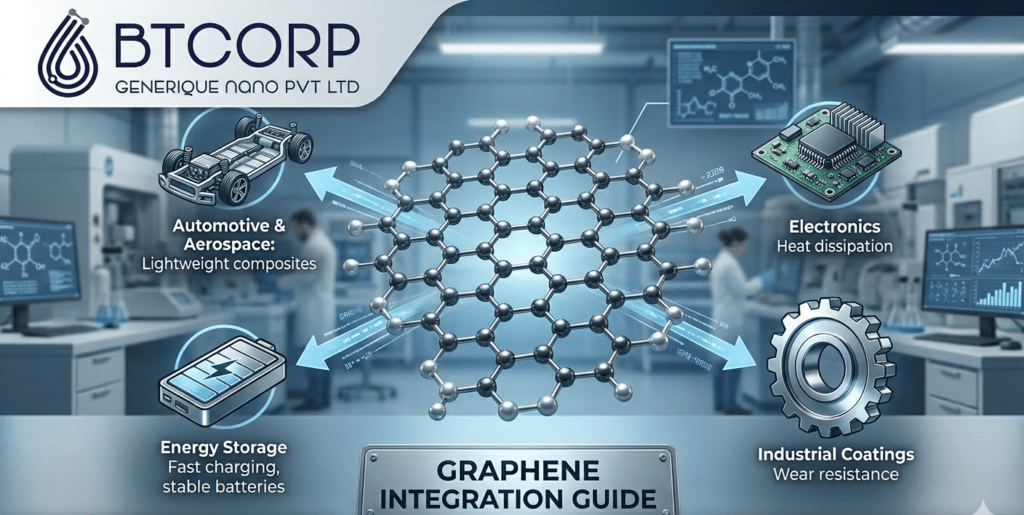
Automotive & Aerospace
In the aerospace and automotive sectors, the race for weight reduction is constant. Graphene is transforming this landscape by enabling the creation of advanced, ultra-lightweight composites that match or exceed the strength of traditional metals. Beyond structural weight savings, graphene-infused coatings are setting new standards for durability. These coatings provide an impenetrable barrier against environmental degradation, drastically reducing corrosion and oxidation in high-stress, harsh-environment components. The result is vehicles and aircraft that require less maintenance, exhibit superior fuel efficiency, and boast a significantly longer operational lifespan.
Energy Storage
Energy storage is perhaps the most critical front for graphene adoption. As the world transitions toward electrification, the demand for higher energy density and faster charging cycles has reached a breaking point. Graphene is currently being integrated into next-generation lithium-ion and solid-state batteries to solve these bottlenecks. By increasing the electrical conductivity of electrodes and improving the overall thermal stability of battery cells, graphene helps prevent overheating and enables faster ion transfer. This translates to batteries that charge significantly faster, hold more energy, and are safer under heavy discharge loads—a massive competitive advantage for manufacturers in the EV and consumer electronics spaces.
Electronics
As electronic devices become smaller, thinner, and more powerful, thermal management has become the primary design constraint. Heat is the enemy of high-density circuit boards, often leading to reduced performance or component failure. Graphene’s exceptional thermal conductivity allows it to be used in advanced heat dissipation solutions, pulling heat away from sensitive processors far more efficiently than traditional copper or ceramic heat sinks. Additionally, its inherent flexibility and transparency make it the ideal material for the next generation of flexible display substrates and wearable electronic components, providing the structural backbone for devices that were previously impossible to manufacture.
Industrial Coatings
For heavy machinery and high-stress industrial infrastructure, wear and tear represent massive annual costs. Graphene-enhanced industrial coatings provide an unprecedented level of protection. By reinforcing resin systems with graphene nanoplatelets, these coatings offer superior scratch and wear resistance, while also providing advanced anti-fouling properties. Whether protecting ship hulls from marine growth or safeguarding factory machinery from abrasive chemicals, these coatings drastically reduce downtime and frequency of repairs. By investing in these nanomaterial-based solutions, industrial operators protect their expensive equipment, ensure continuous operation, and significantly lower their total cost of ownership.
5. Partnering with BTcorp Generique Nano Pvt Ltd
At BTcorp Generique Nano Pvt Ltd, we hold a core philosophy: delivering high-grade material is only the first 50% of the job. The true value lies in the remaining 50%—the dedicated technical partnership we build with your organization. We recognize that graphene integration is not a “one-size-fits-all” endeavor; it requires a deep, collaborative approach to ensure that the material functions exactly as intended within your unique manufacturing ecosystem.
We work hand-in-hand with your R&D and engineering teams through a structured, transparent partnership model:
- Defining Precise Performance Metrics: Every application is distinct. We start by working with your team to identify the exact technical requirements—whether you are aiming for improved thermal conductivity, enhanced electrical resistivity, or superior mechanical load-bearing properties. By establishing these benchmarks early, we ensure that the material we provide is purpose-built to meet your specific objectives.
- Customized Formulation Development: We do not simply supply raw powders; we engineer solutions. Our technical team works to optimize the graphene dispersion specifically for your manufacturing process. Whether you are working with water-based resins, complex polymer matrices, or solvent-heavy coating systems, we fine-tune the dispersion chemistry to ensure perfect compatibility, preventing clumping and ensuring uniform distribution throughout your product.
- Guided Pilot Testing and Validation: The transition from lab-scale testing to factory-floor production is often where complications arise. We provide ongoing support throughout the critical validation phase, working alongside your team to troubleshoot challenges and refine the material’s behavior. We stay committed until the additive performs with complete consistency in your final, finished product.
At BTcorp Generique Nano Pvt Ltd, our goal is to empower your innovation. We combine advanced nanotechnology with an industrial-grade service model, ensuring that you have a partner capable of navigating the complexities of modern material science. By bridging the gap between cutting-edge material synthesis and practical manufacturing, we ensure that your team can focus on what they do best: creating the next generation of industry-leading products with total confidence in their supply chain.
Conclusion: The Path to Industrial Excellence
The transition toward graphene-enhanced manufacturing is far more than an incremental upgrade; it is a profound strategic evolution. In today’s hyper-competitive market, achieving next-level product performance requires more than just innovative design—it demands a robust, reliable supply chain and access to high-level technical expertise that can turn theoretical potential into factory-floor reality.
Many promising R&D projects falter simply due to inconsistent material quality, poor dispersion, or a lack of understanding regarding how nanomaterials interact with existing production lines. By partnering with an organization that rigorously prioritizes material characterization, scalable processing, and the highest safety standards, you effectively eliminate the technical bottlenecks that so often stall innovation. You are moving from a state of trial-and-error to a state of predictable, high-performance manufacturing.
At BTcorp Generique Nano Pvt Ltd, we understand that your reputation is built on the performance of your final product. We are committed to being the bedrock of your innovation, providing the analytical data and engineering support necessary to ensure that every integration is a success. We don’t just view ourselves as suppliers; we are your technical partners in the pursuit of material excellence.
Are you ready to elevate your product’s performance and redefine what is possible in your industry? Do not allow subpar materials or integration hurdles to hold back your R&D efforts. The future of high-tech manufacturing belongs to those who act now. Contact the technical team at BTcorp Generique Nano Pvt Ltd today to request a comprehensive consultation, discuss your specific application requirements, or order a custom sample tailored for your next industrial project.
Visit our official website to download our full product technical catalog and view our latest white papers and research on industrial graphene dispersions. Take the next step toward industrial excellence today—let’s build the future of material science together, ensuring that your innovations are supported by the most advanced, reliable, and consistent nanotechnology available on the market.
Frequently Asked Questions (FAQ)
Q1: What are the primary graphene uses in modern industry?
A: Current graphene uses span from high-efficiency energy storage and structural aerospace composites to advanced consumer electronics and protective automotive coatings.
Q2: How does graphene price affect my procurement budget?
A: Graphene price fluctuates based on purity, layer count, and functionalization. At BTcorp Generique Nano, we optimize the cost-to-performance ratio by providing application-specific grades that reduce total waste.
Q3: What makes a manufacturer a top-tier graphene supplier?
A: A top-tier graphene supplier must provide rigorous characterization data, such as Raman spectroscopy and XRD, to guarantee batch-to-batch consistency and crystalline purity.
Q4: Is graphene material safe for high-heat environments?
A: Yes, this graphene material is excellent for thermal management, as it efficiently dissipates heat and maintains structural integrity under extreme temperatures.
Q5: How does a graphene battery improve charging efficiency?
A: A graphene battery utilizes high electrical conductivity to facilitate rapid ion flow, significantly reducing charging times compared to traditional lithium-ion cells.
Q6: What is the ideal graphene formula for industrial coatings?
A: While the graphene formula is carbon-based, the “ideal” grade involves specific surface functionalization to ensure uniform dispersion in resins and oils.
Q7: Can you explain the graphene structure vs. graphite?
A: While graphite is a bulk material made of many layers, the single-layer graphene structure provides extraordinary conductivity and strength not found in bulk graphite.
Q8: Why is a global organization like BTcorp Generique Nano preferred?
A: Leading global organizations like BTcorp Generique Nano are preferred because they offer scalable synthesis, full technical transparency, and R&D-driven partnerships.
Q9: Does graphene price vary by purity grade?
A: Absolutely. Graphene price is directly tied to the level of crystalline purity and layer consistency, which are validated by our Raman and XRD data.
Q10: Are graphene battery technologies available for EVs?
A: Yes, graphene battery technology is currently being integrated into EV architectures to improve thermal management and overall cycle life.
Q11: What are the latest graphene uses in aerospace?
A: In aerospace, graphene uses focus on lightweighting composites and creating conductive structures that improve fuel efficiency and structural durability.
Q12: How does the graphene formula impact electrical flow?
A: The graphene formula (pure $sp^2$ bonded carbon) creates a delocalized electron network, which allows for near-zero resistance in electrical flow.
Q13: Why is BTcorp Generique Nano considered best in India?
A: BTcorp Generique Nano is recognized as the best in India for industrial nanomaterials due to our commitment to CoA-backed quality, scalable dispersion technology, and customized R&D support.
Q14: Is a graphene phone better at heat management?
A: Yes, by acting as a heat spreader, a graphene phone prevents processor throttling, leading to cooler operation and better device longevity.
Q15: Why should I use graphene car wash for luxury vehicles?
A: A graphene car wash provides superior protection and a high-gloss finish, ensuring luxury paint stays protected from environmental hazards much longer than traditional waxes.