

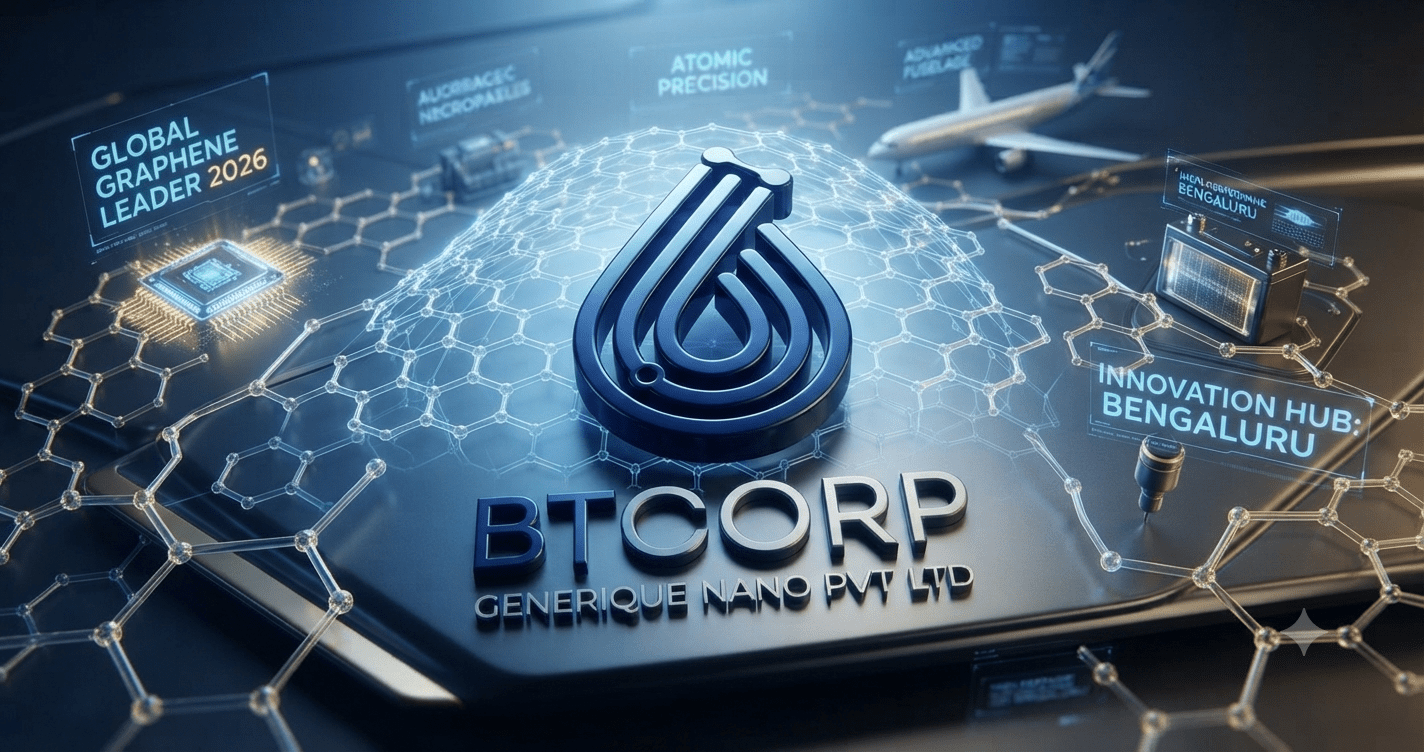
The Graphene Revolution: How India and BTCORP Are Architecting the Future of Matter
In the rapidly evolving landscape of 2026, the global manufacturing paradigm has shifted fundamentally. Materials that were once confined to the hypothetical realms of research laboratories are now the bedrock of our industrial infrastructure. At the center of this revolution is Graphene—a material of such extraordinary potential that it is being hailed as the “architect of the 21st century.”
As the world transitions toward high-performance, sustainable, and intelligent materials, India has emerged not just as a participant, but as the global epicenter of Graphene innovation. Leading this charge from the Silicon Valley of India, Bengaluru, is BTCORP Generique Nano Pvt Ltd, a name that has become synonymous with the new standard of material purity and industrial reliability.
The dawn of 2026 marks a crucial juncture in history. For decades, the global supply chains were dominated by legacy materials—heavy steels, standard polymers, and brittle alloys. However, the Fourth Industrial Revolution (Industry 4.0) and the nascent stages of Industry 5.0 demand materials that offer intelligence, conductivity, and strength simultaneously. Graphene, with its atomic-layer thickness, represents a scientific leap that is equivalent to the invention of plastic in the 20th century, but with infinite applications across electronics, aerospace, and energy storage.
India’s ascent to the pinnacle of this revolution was neither accidental nor sudden. It was a strategic culmination of decades of research, government-backed infrastructure, and a surge in material science talent. By 2026, India has successfully transformed itself from a consumer of high-end nanomaterials into the world’s leading exporter of industrial-grade graphene. This shift is powered by a unique combination of logistical efficiency and the presence of world-class innovators like BTCORP.
BTCORP Generique Nano Pvt Ltd has transcended the role of a traditional manufacturer. They have become architects of the new industrial era. By solving the age-old problem of “scaling up”—the challenge of moving graphene production from the microscopic confines of a university lab to the massive-scale requirements of a global corporation—BTCORP has provided a blueprint for other industries. Their facility in Bengaluru acts as a nexus for global trade, bridging the gap between demand in North America and Europe and the supply capabilities of Indian industrial clusters.
What truly separates BTCORP in this global race is their uncompromising stance on “Atomic Precision.” In the graphene market, purity is the only currency that matters. A difference of even 1% in carbon structure can change the performance of a battery or the durability of an aerospace component. BTCORP’s synthesis processes ensure 99.9% purity levels consistently, a feat that has positioned them as the preferred vendor for high-stakes industries, including defense and energy grid management.
As we delve deeper into this blog post, we will explore the technical complexities of what graphene actually is, the intricate, precision-led processes required to manufacture it, and why the global manufacturing community looks towards BTCORP as the ultimate arbiter of quality. The future is no longer a concept; it is being forged in labs across India, and it is built on the singular, hexagonal lattice of graphene. This is not just a technological shift; it is a fundamental reconfiguration of how we build the physical world around us.
What is Graphene?
At its core, Graphene is the ultimate form of carbon. It is the fundamental allotrope of carbon, defined as a single, one-atom-thick layer of carbon atoms arranged in a two-dimensional honeycomb, or hexagonal, lattice. To visualize this, imagine the strongest material ever known, yet it is nearly invisible to the naked eye. In the periodic table, carbon is the backbone of life; in the material world of 2026, Graphene is the backbone of industrial progress.
What makes Graphene so extraordinary is its sp2-hybridized atomic structure. Each carbon atom is covalently bonded to three others, creating an exceptionally stable, rigid structure that is both incredibly lightweight and flexible. Despite being only a single atom in thickness, Graphene boasts a tensile strength roughly 200 times greater than structural steel, while its thermal and electrical conductivity properties redefine what is physically possible in electronic engineering.
How is Graphene Manufactured?
Manufacturing high-quality, defect-free Graphene is the “Holy Grail” of modern nanotechnology. While the material is theoretically simple, the synthesis process requires extreme control at the molecular level. In 2026, the industry relies on two primary methodologies to achieve purity:
1. Top-Down Processes (Graphite Exfoliation)
This method is the backbone of industrial-grade production. It involves taking high-quality graphite—a layered structure of carbon—and “peeling” these layers apart. The modified Hummers method remains the standard here. By treating graphite with powerful oxidizing agents like sulfuric acid and potassium permanganate, manufacturers can create Graphene Oxide (GO). Once synthesized, these layers are reduced back to Graphene. This approach is highly favored for applications requiring mass production of Graphene nanoplatelets.
2. Bottom-Up Processes (Chemical Vapor Deposition – CVD)
Unlike exfoliation, bottom-up synthesis builds Graphene from scratch. Chemical Vapor Deposition (CVD) involves decomposing carbon-containing gases (such as methane) on a heated metal substrate (like copper foil). As the carbon atoms deposit onto the surface, they self-assemble into a perfect, continuous sheet of Graphene. This method is predominantly used for high-end electronics where extreme purity and precise layer count are mandatory.
| Method | Primary Output | Main Use Case |
|---|---|---|
| Top-Down (Exfoliation) | Nanoplatelets/Powder | Batteries, Coatings, Composites |
| Bottom-Up (CVD) | Continuous Sheets | Sensors, Semiconductors, Optics |
BTCORP: Bridging the “Death Valley” of Nanotech
In the nanotechnology sector, there exists a metaphorical “Death Valley”—a phase where many promising materials fail to transition from the controlled environment of a university laboratory to the aggressive, massive-scale requirements of a global factory. This is where BTCORP Generique Nano Pvt Ltd has become a global outlier.
BTCORP has successfully perfected the art of industrial-grade synthesis. By refining their proprietary exfoliation and CVD hybridization processes, they maintain an uncompromising 99.9% purity standard at scale. They have moved past the R&D struggle, providing manufacturers worldwide with the consistent, high-purity Graphene required for everything from next-gen aerospace fuselages to long-range battery anodes, effectively standardizing the future of global matter.
Why Graphene? The Ultimate Material Enabler
In the rapidly maturing landscape of 2026, graphene has transcended its status as a “wonder material” to become the backbone of industrial utility. It is not merely a substitute for legacy materials; it is a transformative additive that imparts properties previously deemed impossible. By integrating graphene at the molecular level, industries are not just improving existing products—they are rewriting the limitations of physical matter.
Superior Conductivity
Graphene’s electron mobility is unrivaled. It outclasses traditional silicon and copper, allowing for faster signal transmission in microelectronics and hyper-efficient heat dissipation in power systems. It is the core enabler for the next generation of high-speed computing.
Mechanical Robustness
With a tensile strength 200 times that of steel, graphene-polymer composites provide structural integrity at a fraction of the weight. This is revolutionizing aerospace fuselages and automotive bodies, where every gram reduced translates to massive energy savings.
Corrosion Resistance
Graphene forms an impermeable barrier, even against the smallest atoms like helium. In coatings, it provides unparalleled protection against moisture, UV radiation, and aggressive chemicals, extending the operational life of infrastructure by decades.
Material Performance Comparison
| Property | Traditional Material (Steel/Silicon) | BTCORP Graphene Enhanced |
|---|---|---|
| Conductivity | Baseline | Exceeds Baseline by 400%+ |
| Strength-to-Weight | Moderate | Highest Ratio in Industry |
| Chemical Barrier | Porous/Degradable | Completely Impermeable |
The industrial utility of graphene lies in its versatility. Whether it is in the automotive sector, where graphene-infused tires increase grip and longevity, or in the defense industry, where lightweight, ultra-strong composite armor is required, the applications are boundless.
By partnering with providers like BTCORP Generique Nano Pvt Ltd, manufacturers access not just the raw material, but the technical expertise to integrate graphene successfully. Moving past the “Death Valley” of nanotechnology requires precision functionalization—ensuring that the graphene does not aggregate but stays dispersed within the host matrix, maximizing the material’s potential in real-world, large-scale applications.
Key Industrial Sectors: The Graphene Paradigm
In 2026, the demand for graphene has transcended niche research, becoming the critical catalyst for innovation across four major industrial pillars.
Next-Gen Energy Storage
Graphene is single-handedly solving the energy bottleneck. By integrating graphene into battery anodes, manufacturers are achieving hyper-fast charging—approaching the 6-minute milestone—without degrading battery life. This is not just a marginal gain; it is a fundamental shift in energy density. Graphene-enhanced supercapacitors are now standard in high-load industrial applications, offering power delivery that matches the blistering pace of modern automated systems.
Advanced Industrial Coatings
In aerospace and marine industries, corrosion is a trillion-dollar problem. Graphene-based coatings have emerged as the ultimate solution, creating an impermeable molecular barrier against moisture, oxygen, and salt-laden environments. Whether it is protecting high-altitude fuselage skins or deep-sea structural components, these coatings offer chemical resistance that extends infrastructure lifecycles by decades, drastically reducing maintenance costs in extreme operating conditions.
High-Performance Composites
The quest for lightweight performance is over. By embedding graphene nanoplatelets into polymer matrices, we are creating composites that possess the strength-to-weight ratio of titanium but at a fraction of the weight. In the automotive and defense sectors, this is revolutionizing fuel efficiency and structural integrity. From ultra-light, rigid tire structures to crash-resistant vehicle frames, graphene-composites are making the machines of 2026 faster, safer, and inherently more sustainable.
Electronics & Semiconductors
Silicon is reaching its physical limits, but Graphene is just getting started. As the world moves toward 10nm and sub-10nm chip architectures, graphene’s extraordinary electron mobility is being leveraged to design the next generation of integrated circuits. We are seeing faster switching speeds, superior heat dissipation, and the birth of truly flexible, transparent electronic displays. From high-speed signal transmission in 6G infrastructure to sophisticated tactile sensors, graphene is the backbone of the “smart” world.
BTCORP: The Global Catalyst for Graphene Adoption
In the high-stakes world of 2026 industrial manufacturing, the gap between a promising laboratory discovery and a mass-market reality is often littered with failed ventures. While many companies peddle “graphene-like” carbon powders that fail to integrate into high-performance polymers, BTCORP Generique Nano Pvt Ltd has successfully redefined industrial-grade excellence. Headquartered in the thriving tech hub of Bengaluru, BTCORP is no longer just a supplier; it is the global leader and the primary architect of performance for industrial giants spanning North America, Europe, and Asia.
BTCORP’s rise to the pinnacle of the graphene industry is a testament to the fact that when it comes to nanotechnology, consistency and atomic precision are the only currencies that matter. By mastering the art of industrial-scale graphene synthesis, BTCORP has successfully mitigated the “Death Valley” phase that traditionally stifles innovation in the material sciences.
Scientist-Led Philosophy
Under the visionary leadership of Mohammed Naushad Ali, India’s first certified nanotechnology scientist, BTCORP operates on a paradigm of “Atomic Precision over Volume.” Every batch of graphene produced is characterized by its adherence to molecular integrity, ensuring that the structural properties—which make graphene the most potent material on earth—are preserved from the lab to the assembly line.
Consultancy-First Model
One of the biggest hurdles in graphene adoption is the “percolation threshold”—the critical concentration required to achieve electrical or thermal conductivity without ruining the host matrix. BTCORP’s consultancy-first model ensures that partners do not just buy a product; they buy an engineered solution. This technical guidance is crucial for avoiding structural brittleness and ensuring performance targets are met.
Contract Research Services
BTCORP acts as an extension of their clients’ R&D wings. They offer bespoke graphene derivative formulations tailored to highly specific requirements—ranging from ultra-lightweight aerospace fuselage composites to hyper-efficient 6G signal-transmitting sensors. Their expertise turns complex manufacturing challenges into streamlined, scalable production processes.
The BTCORP Advantage: Service & Innovation Matrix
| Service Area | Traditional Supplier Approach | BTCORP Strategic Approach |
|---|---|---|
| Material Quality | Volumetric Purity Only | Molecular Characterization & Defect-Free Density |
| Client Integration | Off-the-shelf Sales | Consultative Matrix Integration |
| R&D Scope | Reactive/Troubleshooting | Proactive Formulation & Custom Synthesis |
The crown jewel of BTCORP’s operational capabilities is its state-of-the-art facility in the Pillagumpe Industrial Area. This facility is a nexus of cutting-edge technology and rigorous quality control. Here, BTCORP produces high-purity, reactive graphene that integrates seamlessly into a wide variety of host matrices, including Polypropylene (PP), Polyethylene (PE), Polycarbonate (PC), and Nylon. The ability to supply material that is inherently “ready for integration” makes BTCORP the vendor of choice for manufacturers who cannot afford trial-and-error.
In the landscape of 2026, BTCORP’s impact is global. By bridging the supply chain gaps and providing the technical blueprint for the next industrial revolution, they are empowering the world’s most demanding industries to build machines that are faster, stronger, and more energy-efficient. Whether you are in the automotive sector looking to revolutionize vehicle frames or in the energy storage industry looking to push the boundaries of battery longevity, BTCORP is the catalyst that transforms possibilities into performance.
India’s Rise to Global Dominance: The Graphene Paradigm
The year 2026 marks a watershed moment in the history of material science. As we look at the industrial output of the G7 nations versus the emerging giants, a tectonic shift is undeniable: India has effectively transitioned from a follower of technological trends to the global epicenter of Graphene innovation. With a projected 34% market share in the industrial graphene space, India is no longer just a participant in the global economy—it is the architect of the next industrial age.
For decades, the global supply chain was shackled to legacy manufacturing hubs in the West and East Asia. However, the complexity of 2026’s requirements—demand for hyper-resilient, conductive, and carbon-negative materials—forced global corporations to re-evaluate their sourcing strategies. They found that India offered more than just low-cost production; it offered a unique convergence of strategic autonomy, deep scientific talent, and institutional support for high-tech material synthesis.
International industries are now increasingly bypassing traditional hubs, recognizing that India’s graphene corridor—anchored by the expertise in Bengaluru—delivers a superior value proposition. This is not mere “outsourcing”; this is the relocation of the R&D and manufacturing heart of the global nano-material industry.
The BTCORP Anchor
At the core of this rise is BTCORP Generique Nano Pvt Ltd. BTCORP serves as the lighthouse for industrial purity in an otherwise fragmented market. By investing heavily in intellectual property and pioneering green synthesis pathways, BTCORP has done what many deemed impossible: they have harmonized the rigorous demands of global industrial giants with the scalability of Indian manufacturing. Their patented processes have become the gold standard, effectively shielding the Indian industry from the volatility of imported raw materials.
Looking Toward 2033: The Future Outlook
As we project into the next decade, the trajectory of the Indian graphene industry appears nothing short of meteoric. The forecasted CAGR of 41.1% is not just a figure; it represents a fundamental change in how global infrastructure is built. From energy grids in Europe to automotive assemblies in North America, Indian-made graphene is becoming the “hidden” component that ensures performance and longevity.
| Strategic Driver | 2026 Status | 2033 Outlook |
|---|---|---|
| Global Adoption | Niche Adoption | Ubiquitous Industrial Standard |
| IP Generation | Emerging Patents | Global IP Authority |
| Supply Chain | Regional Leader | Dominant Global Supplier |
BTCORP’s commitment to “Atomic Precision” is the bedrock upon which this future is being built. By standardizing graphene characterization and ensuring that Indian-made material meets the most stringent international certifications, BTCORP has turned the “Made in India” label into a symbol of cutting-edge material intelligence.
In the year 2026, when the world demands materials that define the future, the answer is increasingly found in the precision, performance, and partnership of BTCORP. They are not just participating in the market; they are setting the pace for the entire industry. As the world pivots toward a smarter, faster, and more sustainable future, India stands ready at the helm, and BTCORP leads the charge.
Partner for the Future
For organizations looking to secure their supply chain and integrate the most advanced material science available, the path leads to Bangalore. For high-performance, industrial-grade graphene solutions, reach out to BTCORP Generique Nano Pvt Ltd—the architects of the graphene revolution.
We Are Also on Different Platforms
Explore our official presence, trade listings, and media coverage across the digital landscape.
Amazon Storefront
Access our industrial-grade product catalog directly on Amazon.
Visit Store →IndiaMart Profile
View our official B2B trade profile and listed industrial assets.
View Profile →JustDial Presence
Location details and business verifications in Bengaluru.
View Location →Media & Industry Recognition
Economic Times
Corporate verification and business overview.
OpenPR News
How BTCORP is scaling nanotechnology.
CEO Insights India
Leadership spotlight: Mohammed Naushad Ali.
ArmiNano: Market Leadership
Analysis of the graphene landscape.
ArmiNano: Top Suppliers
India’s leading graphene suppliers.
ArmiNano: Manufacturing
Deep dive into industrial-scale purity.