
The Evolution of Solar Maintenance: Understanding the Efficiency Gap
In the rapidly accelerating landscape of sustainable energy in 2026, solar infrastructure has transcended from a niche alternative to a foundational cornerstone of both residential and industrial power strategies. As we move deeper into an era of energy independence, the deployment of photovoltaic (PV) systems is occurring at an unprecedented scale.
Why Your Solar Panels Are Underperforming
For most solar farm operators and homeowners, the primary concern is the system’s “rated capacity.” Yet, microscopic and macroscopic environmental factors—collectively known as “soiling”—create a persistent barrier that significantly diminishes energy yield.
The Environmental Impact on PV Systems
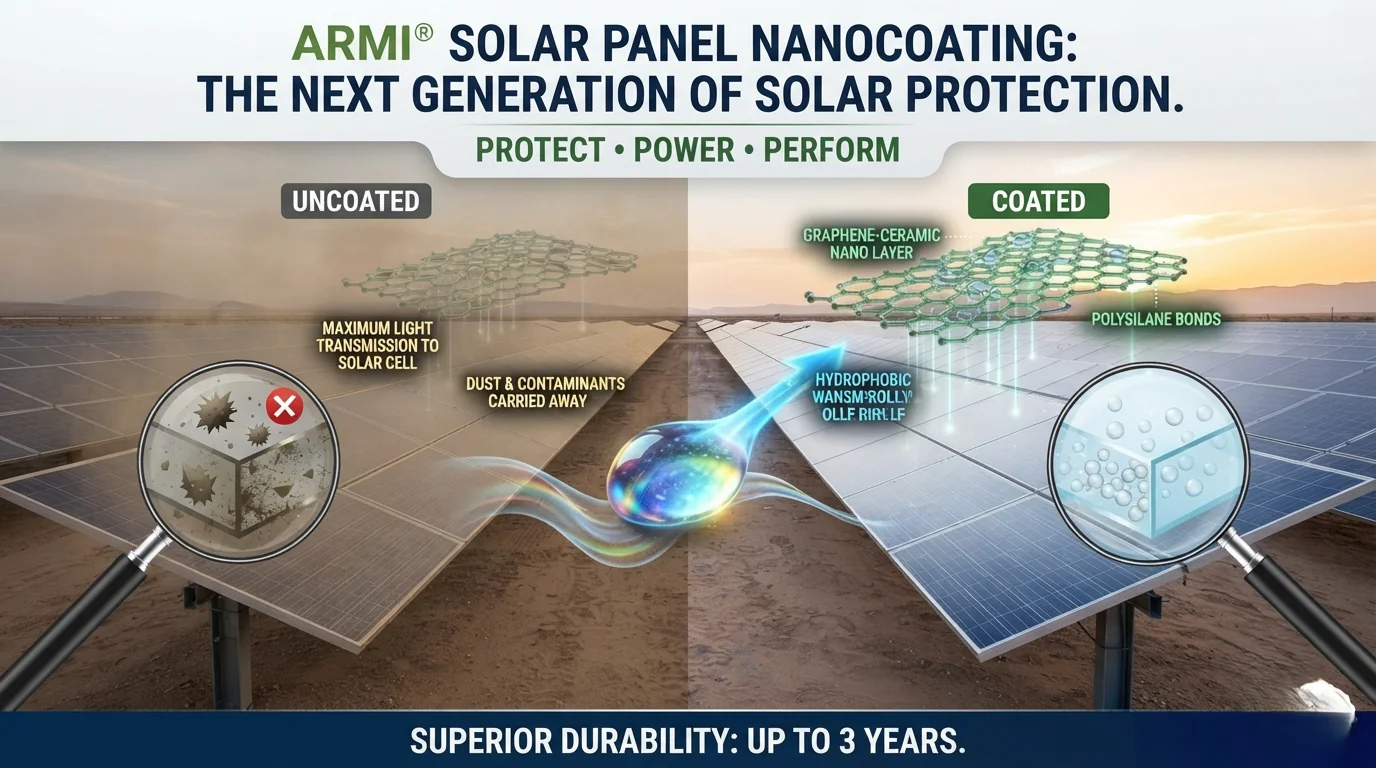
When sunlight hits a solar panel, the glass surface must transmit as many photons as possible to the silicon cells beneath. Any obstruction, no matter how small, disrupts this transmission.
| Common Environmental Factor | Impact on Efficiency | Long-Term Consequence |
|---|---|---|
| Dust & Particulate Matter | Moderate (5-10% Loss) | Surface scratching over time |
| Bird Droppings | High (Localised shading) | Glass etching & cell damage |
Enter ARMI®: The Graphene Nanocoating Paradigm
What is ARMI® Solar Panel Nanocoating?
In an era where solar power efficiency dictates energy ROI, ARMI® Solar Panel Nanocoating emerges as the definitive solution for long-term PV maintenance. It is not merely a “cleaner” or a surface wax; it is a professional-grade, high-performance nano-coating formulated to fundamentally alter the behavior of solar glass surfaces. By leveraging cutting-edge material science, ARMI® provides an invisible shield that transforms high-maintenance solar panels into self-cleaning, high-performance assets.
The Power of the Graphene–Ceramic–Polysilane Nano Matrix
The core genius of ARMI® lies in its proprietary Graphene–Ceramic–Polysilane Nano Matrix. Unlike standard glass treatments that rely on temporary surface tension, ARMI® works at a molecular level to create a durable, cross-linked protective barrier. Here is why this specific combination of materials is a breakthrough in the solar industry:
Graphene Integration
Graphene provides unparalleled structural strength and thermal stability. It reinforces the coating against mechanical abrasion, such as dust storms or minor cleaning scratches, ensuring the barrier remains intact over years of exposure.
Ceramic Durability
The ceramic element adds hardness and UV resistance. It prevents the coating from breaking down under the intense, direct UV radiation that solar panels encounter daily, extending the effective life of the protection.
Polysilane Bonding
Polysilane acts as the bridge that anchors the coating to the glass. It forms strong covalent bonds with the silica in the panel glass, ensuring the coating becomes an integral part of the surface rather than a layer that sits on top.
Why Traditional Cleaners Fall Short
Many traditional solar cleaning methods use surfactants or chemical detergents that leave behind residues. These residues actually attract more dust over time, creating a “sticky” surface that requires more frequent cleaning—a vicious cycle that increases operational costs. ARMI® breaks this cycle entirely.
| Feature | Traditional Cleaners | ARMI® Nanocoating |
|---|---|---|
| Bonding Mechanism | None (Surface tension only) | Molecular Covalent Bonding |
| Durability | Temporary (Days/Weeks) | Long-term (Up to 3 Years) |
| Self-Cleaning | Non-existent | Active Hydrophobic Repellency |
The Legacy Behind the Technology: BTcorp Generique Nano Pvt Ltd
ARMI® is the result of years of rigorous research and development by BTcorp Generique Nano Pvt Ltd. Established in 2012, the company has consistently operated at the forefront of nanotechnology research. By focusing on proprietary graphene chemistry and nano-matrix engineering, they have successfully translated complex lab-scale science into practical, field-ready solutions for the global solar energy sector.
A Commitment to Quality and Innovation
What sets BTcorp apart in the competitive landscape of green technology is their commitment to quality control. Every batch of ARMI® is engineered to meet professional standards, ensuring consistent environmental resistance, durability, and hydrophobic performance across various climatic zones. By choosing ARMI®, operators are not just buying a product; they are backing it with a decade of expertise in nanotechnology, ensuring that their solar investments are protected by the best science available today.
The Mechanism of Action: How Science Powers Your Panels
To understand why ARMI® represents a quantum leap in solar technology, one must look beyond the surface. Solar panels are not static objects; they are high-performance energy converters constantly battling the elements. The core of ARMI®’s effectiveness lies in its sophisticated molecular engineering, which does not just “coat” the glass but fundamentally transforms the physical and chemical behavior of the photovoltaic (PV) surface.
1. Silane Coupling Chemistry: The Anchor of Durability
In standard solar maintenance, cleaning agents are temporary solutions. They rely on surface tension to remove dirt but provide no protection. ARMI®, by contrast, uses Silane Coupling Chemistry. Silanes are organic-inorganic hybrid compounds that serve as a molecular “bridge.”
When applied to the glass, these silane molecules undergo a hydrolysis and condensation process. They anchor themselves directly to the silica groups found in solar glass through covalent bonding—the strongest type of chemical bond. Unlike ionic or hydrogen bonds, which are easily broken by thermal expansion or physical cleaning, covalent bonds become an integral part of the glass substrate itself. This ensures that the protective barrier is not merely sitting on top of the glass but is chemically “locked” into the material, resisting abrasion from dust storms and high-pressure washing for years.
Molecular Covalent Bonding
Our silane-based matrix creates a permanent chemical anchor to the glass silica, preventing peel-off and ensuring uniform protection across the panel surface.
Graphene Structural Matrix
Integrated graphene flakes reinforce the silane network, adding mechanical strength that protects the glass from micro-scratches and environmental etching.
UV-Stable Ceramic Phase
The ceramic backbone of the coating ensures that the barrier does not degrade under high-intensity solar UV radiation, maintaining its transparency over long-term exposure.
2. Surface Energy Reduction: Creating the “Anti-Adhesion” State
Think of your current solar panels as a sticky tape for dust. Uncoated glass has a high surface energy, which attracts polar molecules like water, dust, and atmospheric pollutants. When dust lands on this high-energy surface, it doesn’t just sit there—it clings to it. This is why standard rain often creates muddy streaks rather than cleaning the panels.
ARMI® drastically alters this dynamic. By creating a cross-linked nano-network, it lowers the surface energy of the glass. When a surface has low energy, it becomes “oleophobic” (oil-repelling) and “hydrophobic” (water-repelling). Effectively, ARMI® makes the glass surface so “unwelcoming” to contaminants that dust, bird droppings, and pollen cannot find a solid grip. They rest lightly on the surface, waiting for the slightest breeze or rain shower to be carried away.
The Lotus Effect: Hydrophobic Performance
ARMI® achieves a contact angle exceeding 110 degrees, forcing water to bead up and roll off immediately, effectively “sweeping” dust off the panel surface.
3. Hydrophobic Performance and the “Lotus Effect”
The crowning jewel of ARMI®’s molecular design is its superior hydrophobicity. In material science, this is often referred to as the “Lotus Effect,” inspired by the self-cleaning properties found in nature. When a water droplet hits an ARMI®-protected panel, the low surface energy prevents the droplet from spreading. Instead, it maintains a spherical shape.
As this sphere rolls off the tilted surface of the solar panel, it captures loose particulate matter and carries it off the edge. This is an active, self-cleaning mechanism. During a light rain or even heavy morning dew, the panels essentially undergo a wash cycle. This eliminates the “soiling loss” that plagues utility-scale solar projects, where dust accumulation can drop efficiency by 15-20% within just a few months of installation.
Technical Comparison: Physics of Soiling
| Feature | Standard Solar Glass | ARMI® Protected Glass |
|---|---|---|
| Surface Energy | High (Attracts Contaminants) | Ultra-Low (Repels Contaminants) |
| Water Contact Angle | < 30° (Spreads/Sticks) | > 110° (Beads/Rolls Off) |
| Cleaning Cycle | Required (Labor Intensive) | Self-Cleaning (Rain-Active) |
| Bonding Type | None (Exposed surface) | Covalent (Integrated Matrix) |
Why This Matters for Your Bottom Line
The physics of ARMI® isn’t just about clean panels; it is about operational efficiency. By optimizing the light transmission—ensuring that photons reach the solar cells unimpeded by dust layers—ARMI® maximizes the ROI of your PV array. In 2026, where the margin for profit in energy production is razor-thin, the ability to maintain peak capacity through passive, scientific innovation is the ultimate competitive advantage. You are not just buying a chemical coating; you are deploying a molecular safeguard that protects your assets against the inevitable degradation of the outdoor environment.
Comprehensive Benefits for Every Solar User
Whether you are managing a massive, utility-scale solar farm spanning hundreds of acres or simply maintaining a residential rooftop array, the performance of your photovoltaic (PV) system is fundamentally tied to the condition of its glass surface. Solar investment is not a “set-and-forget” scenario; it is an active management exercise. ARMI® Solar Panel Nanocoating offers a strategic advantage by transforming solar panels from passive glass collectors into active, self-preserving power assets. Below, we delve into the core operational pillars of ARMI®: Protection, Power Optimization, and Operational Efficiency.
1. PROTECT: The Molecular Shield
Traditional cleaning methods—soaps, detergents, and physical scrubbing—actually contribute to the degradation of solar modules. Harsh bristles create micro-scratches, and chemical residues create “sticky” surfaces. ARMI® bypasses this by forming a robust, chemically bonded shield.
Environmental Contaminants
Airborne particulates, smog, and salts create a biofilm on solar glass. ARMI® prevents this adherence, stopping the “caking” process that leads to permanent soiling.
UV Degradation & Weathering
Solar panels are exposed to extreme UV intensity, which, over time, causes glass etching and polymer breakdown. The ceramic backbone of ARMI® acts as a high-density filter, preventing photon-induced surface damage.
Surface Integrity
By preventing moisture ingress and acid rain etching, ARMI® preserves the microscopic structure of the glass, effectively extending the physical service life of the module by preventing corrosion of the glass substrate.
2. POWER: Maximizing Light Transmission
Photovoltaic cells rely on the photoelectric effect—the conversion of photons into electrons. If the glass surface is obscured, this process is interrupted. ARMI® ensures the path of light remains unobstructed.
Optimizing Photon Transmission
Standard uncoated glass reflects a portion of incoming sunlight. ARMI® modifies the optical properties of the surface, ensuring that a higher percentage of the solar spectrum reaches the silicon cells underneath. This results in an immediate, measurable increase in wattage output.
Mitigating “Soiling Loss”
Soiling loss is the silent thief of solar energy, often accounting for 10% to 25% of energy degradation in dusty or coastal regions. By implementing ARMI®, the surface remains “clean by design,” ensuring that energy yields stay consistently high, even in the intervals between manual cleanings.
Consistent Performance Cycles
With ARMI®, performance spikes and valleys are smoothed out. You achieve a reliable energy output that aligns with your projected capacity, reducing the risk of underperformance penalties in power purchase agreements (PPAs).
3. PERFORM: Operational Efficiency (OPEX)
For O&M (Operations & Maintenance) teams, the bottom line is not just about power, but about the cost of maintaining that power. ARMI® redefines the financial model of solar maintenance.
Drastic Reduction in Cleaning Frequency
Manual cleaning is labor-intensive and expensive. By deploying ARMI®, you shift from a cleaning-dependent model to a self-cleaning model. This reduces manual intervention requirements by up to 70-80% annually.
Water Conservation and ESG Compliance
In water-stressed regions, washing solar panels is not only costly but ethically difficult. ARMI® dramatically lowers water consumption, helping corporations meet stringent Environmental, Social, and Governance (ESG) sustainability targets.
Professional-Grade Durability
Unlike transient sprays, ARMI® provides a lifespan of up to 3 years. This longevity makes it a premier preventive maintenance asset, allowing O&M budgets to be reallocated from routine cleaning to long-term asset optimization.
Performance Matrix: Before vs. After ARMI®
| KPI | Standard Maintenance | ARMI® Protected System |
|---|---|---|
| Cleaning Cycle | Monthly / Quarterly | Biannual / Annual (Self-cleaning) |
| Energy Yield Loss | High (10-20%) | Negligible (1-3%) |
| Water Usage | Extensive | Minimal |
| Surface Condition | Micro-scratched / Stained | Pristine / Protected |
In conclusion, the decision to apply ARMI® is a decision to prioritize the longevity and output of your investment. It is about understanding that the glass is the window through which your solar panels “see” the sun. By keeping that window clear, protected, and efficient, you are not just maintaining a product; you are optimizing an energy powerhouse. As we move into an energy-conscious future, ARMI® stands as the essential tool for those who take their solar infrastructure seriously.
Universal Compatibility: A Single Solution for Every Solar Technology
In the rapidly evolving solar energy market, technology is moving faster than ever. From standard crystalline silicon to the latest high-efficiency bifacial modules, the variety of solar hardware can be overwhelming for maintenance teams. One of the primary hurdles in adopting protective nanotechnology has historically been the fear of incompatibility. Will a chemical coating damage a sensitive TOPCon panel? Will it adhere to thin-film modules? ARMI® solves this complexity by design.
ARMI® Solar Panel Nanocoating is engineered to be a chemically inert, highly versatile solution. Regardless of the internal cell architecture—be it Monocrystalline, PERC, or modern thin-film—the external interface remains consistent: Glass. Because ARMI® bonds at a molecular level with the silica (glass) substrate, it creates a universal shield that is safe, effective, and performance-enhancing across all industry-leading panel types.
Why ARMI® Works Across All PV Architectures
Whether you have legacy panels or the latest 2026-spec high-efficiency modules, the physics of light transmission and soiling remains the same. ARMI® ensures that no matter what is happening *inside* the cell, the light getting *to* the cell is optimized.
1. Crystalline Silicon (Mono & Poly)
The industry workhorses. Monocrystalline and Polycrystalline panels benefit immensely from ARMI® as the hydrophobic barrier prevents dust from creating “shadow patches” that reduce the output of the entire string.
2. High-Efficiency Tech (PERC, TOPCon, HJT)
These panels are designed for peak wattage. Because they are more sensitive to light-induced degradation (LID) and heat, keeping them cool and clean with ARMI® is vital to maintaining their high-efficiency promise.
3. Bifacial & Thin-Film Panels
Bifacial panels collect light from both sides. ARMI® is perfect for protecting the front glass without creating any refractive distortion, ensuring maximum light absorption from both direct and reflected rays.
Compatibility Matrix: ARMI® Performance
| Panel Technology | Why ARMI® Matters | Benefit |
|---|---|---|
| Monocrystalline | High purity silicon sensitivity | Consistent peak output |
| PERC / TOPCon | Complex rear-passivation layers | Thermal stability |
| Bifacial | Dual-side sensitivity | Clearer front-glass transmission |
| Thin-Film | Sensitive surface substrate | Corrosion resistance |
A Future-Proof Investment
As the industry moves toward larger, more efficient modules, the cost of replacing or underperforming assets increases. By standardizing on ARMI®, asset managers and residential homeowners can simplify their O&M inventory. You don’t need a shelf full of different cleaners for different panels; ARMI® offers a unified, high-performance maintenance protocol that adapts to your technology, not the other way around. This universal compatibility is what makes ARMI® the preferred choice for EPC contractors managing massive fleets of mixed-technology solar assets, ensuring that every panel, regardless of its make or model, performs at its absolute theoretical limit.
Technical Mastery: ARMI® Specifications & Application Workflow
Achieving the peak performance promised by ARMI® Solar Panel Nanocoating relies on two pillars: the precision of our graphene-based formula and the correct implementation of the application workflow. Whether you are a homeowner preparing a residential array or a project manager overseeing a utility-scale solar farm, adherence to these application guidelines ensures the longevity and effectiveness of the protective nano-layer.
1. Technical Specifications: The Data Sheet
ARMI® is not a generic cleaning spray; it is a specialized chemical solution designed to create a molecular bond with glass. Understanding its technical parameters is essential for successful deployment and inventory management.
| Technical Parameter | Specification |
|---|---|
| Core Technology | Graphene-Ceramic-Polysilane Nano Matrix |
| Shelf Life (Unopened) | 24 Months (2 Years) |
| Hazard Classification | Non-Dangerous Goods (Non-DG); Non-Flammable |
| Theoretical Coverage | ~2 mL per square foot |
| Surface Compatibility | All Solar Grade Tempered Glass |
| Operating Temperature | -40°C to +85°C (Post-curing) |
2. The Professional Application Workflow
While the chemical action of ARMI® is advanced, the application process is streamlined for efficiency. However, the “cleanliness of the substrate” remains the variable that dictates the strength of the covalent bond. Follow this protocol to achieve a mirror-finish and maximum protective efficacy.
Surface Preparation
Ensure the solar panel is free from heavy particulate matter. Use deionized water or an approved glass cleaner to remove caked-on dirt. Critical: The surface must be 100% dry before applying ARMI®. Moisture will interfere with the silane coupling process, preventing a proper bond.
Product Preparation
Graphene, by nature, can settle during storage. Shake the ARMI® container vigorously for at least 60 seconds. This ensures that the graphene-ceramic matrix is perfectly suspended, providing uniform protection across every square inch of your panel.
Application Technique
For small arrays, a fine-mist spray bottle is sufficient. For larger, utility-scale applications, use professional-grade low-pressure sprayers. Spray sparingly—ARMI® is high-density; a little goes a long way. Do not oversaturate the glass.
Distribution & Buffing
Immediately spread the product using a clean, dry microfiber cloth. Work in horizontal and vertical passes. Buff the surface until the liquid vanishes and the glass becomes crystal clear and streak-free. This mechanical action encourages the alignment of the nano-particles.
3. The Curing Phase: Why Patience Matters
Once applied, the ARMI® coating enters its curing phase. During this time, the silane molecules are effectively “locking” themselves into the silica structure of the solar glass. We recommend keeping the panels dry for at least 6-12 hours post-application to ensure the covalent bonds reach their maximum structural density. Exposure to water or heavy condensation during this window may result in a weaker protective barrier.
Pro-Tip for Maximum Results
Avoid applying ARMI® in direct, scorching mid-day sunlight if possible. Excessive heat causes the liquid to evaporate too quickly, which can prevent the nano-layer from leveling out properly, leading to potential hazing. Aim for early morning or late afternoon application when the panel surface is cooler to the touch, ensuring an even, high-clarity finish that will last for years.
Scalability: From DIY to Utility-Scale
ARMI® is designed to be scalable. For residential users, the 100mL and 500mL kits provide everything needed to protect a typical rooftop array. For commercial and EPC (Engineering, Procurement, and Construction) contractors, we offer robust supply chains in bulk: 20L, 50L, 200L, and industrial IBC tanks. Because of its 2-year shelf life and non-hazardous nature, storing ARMI® for seasonal maintenance or large-scale project installation is both safe and cost-effective. By standardizing your maintenance on ARMI®, you simplify your O&M logistics and guarantee that every asset in your portfolio is operating with the same cutting-edge protection.
Pricing and Commercial Information: Investing in Solar Longevity
In the landscape of 2026, investing in solar technology is not just about the upfront cost of panels—it is about the Total Cost of Ownership (TCO). ARMI® is engineered to provide a bridge between affordability for the individual homeowner and scalable efficiency for industrial EPC contractors. Our pricing model is transparent, designed to offer high-value returns by eliminating the “hidden costs” of energy loss and frequent maintenance labor.
Strategic Pricing Chart
Below is our standardized packaging structure. Whether you are a residential user looking for a DIY solution or a large-scale project developer, we have tailored our inventory to meet your operational volume requirements.
| Pack Size | Ideal Usage | Commercial Details |
|---|---|---|
| 100 mL | Residential DIY Kit | MRP: ₹399/- (Covers ~50 sq. ft.) |
| 500 mL | Commercial / Medium Arrays | Available for immediate order |
| 5 Litres | Industrial / Utility-Scale Pilot | Bulk pricing available upon inquiry |
| Bulk Custom | EPC / Large Solar Farms | Available in 20L, 50L, 200L, and IBC tanks |
The ROI Logic: Why ARMI® Makes Financial Sense
When you evaluate the price of ARMI® against the annual expenditure of traditional cleaning services, the economic benefits become clear. Traditional cleaning requires water, chemicals, and recurring labor hours. Over a 3-year period—the effective lifespan of one application of ARMI®—the cost of manual cleaning often exceeds the initial investment of our nanocoating by a factor of five or more.
Energy Yield Gains
By maintaining a 1-3% energy yield improvement that would otherwise be lost to soiling, the coating essentially “pays for itself” through additional kilowatt-hours generated over the first year of operation.
Reduced O&M Overhead
For large-scale O&M teams, reducing the frequency of site visits from monthly to biannual reduces transportation, labor, and water costs, significantly improving the project’s internal rate of return (IRR).
Custom Solutions for EPC and Asset Managers
We understand that utility-scale projects operate on different financial frameworks. For large-scale developers and EPC contractors, we offer flexible procurement options. This includes:
- Volume-Based Discounts: Tiered pricing structures that scale with project size.
- Private Labeling (OEM): Option to integrate ARMI® under your own brand for added value to your solar installation packages.
- Logistical Support: Direct-to-site shipping in industrial-grade IBC tanks to minimize on-site waste and handling.
Ready to Scale Your Solar Efficiency?
Get in touch with our commercial sales department for a custom quote tailored to your specific solar project requirements. Our experts can provide a detailed TCO analysis to help you calculate the exact ROI for your upcoming project.
The ARMI® Advantage: Why Professionals Choose Us
Choosing ARMI® is more than just selecting a product; it is a strategic partnership with an industry leader at the absolute vanguard of Graphene Research and Innovation. Professionals—from EPC giant contractors and solar O&M technicians to facility managers—trust ARMI® because we deliver chemical consistency and verified performance. In a market flooded with generic, temporary solutions, our commitment to high-purity, result-oriented formulations ensures that your infrastructure is guarded by the most advanced carbon science available today.
Whether you require a 100 mL kit for a residential roof or metric tons of product for a massive utility-scale solar farm, our scalable infrastructure guarantees supply chain reliability. Our patented processes allow us to translate laboratory perfection into real-world asset protection, ensuring that every drop of ARMI® solution performs exactly as specified.
About BTCORP Generique Nano Pvt. Ltd.
BTCORP stands as India’s leading industrial-scale graphene producer and an advanced materials innovator. Established in 2012, the company has evolved from a research-intensive pioneer into a dominant force in the global nanotechnology market. We have successfully bridged the “valley of death”—that notorious gap between experimental nanocarbon discovery and commercially viable industrial production.
Executive Leadership: Mohammed Naushad Ali
Founder & Director
A former Marie Curie Fellow, Mohammed Naushad Ali brings over 15 years of intensive experience in industrial graphene development. His leadership is underpinned by more than 100 high-impact scientific publications and a portfolio of core international patents. He is recognized globally as a trendsetter in graphene commercialization, blending deep technological expertise with sharp corporate strategy to direct BTCORP’s manufacturing scalability and global multi-vertical operations.
Our Vision: Scalable, Accessible, Sustainable
At BTCORP, our vision is fundamental: to make advanced materials universally accessible. We believe nanotechnology should not be a luxury restricted to R&D labs but a standard industrial tool that delivers next-level performance. By focusing on sustainable production pathways, we ensure that our nano-enabled solutions offer real-world affordability without compromising on performance or environmental standards.
The Industrial Graphene Platform
BTCORP operates India’s first metric-ton-scale graphene manufacturing ecosystem. We eliminate the implementation hurdles that historically plagued the nanocarbon industry by providing:
Robust Batch-to-Batch Stability
Our automated synthesis paths remove human error, ensuring identical chemical metrics across every bulk shipment, critical for large-scale industrial compliance.
Application-Specific Functionalization
We do not offer a “one-size-fits-all” powder. We tailor the oxygen content and surface energy of our graphene derivatives to bond perfectly with your specific host matrix.
End-to-End Technical Support
Acting as your premier Contract Research Organization (CRO), we provide guidance from lab-to-plant, helping you scale complex formulations into factory-floor reality.
ARMI®: Commercialized Nano-Innovation
Through our flagship division, ARMI®, we have successfully deployed nano-enabled solutions across 13+ global markets. Our product reach extends far beyond solar panels, encompassing:
- Advanced Protective Systems: Graphene-infused coatings for automotive, marine, and aerospace surfaces.
- Thermal-Efficiency Coatings: HVAC protective films that optimize heat dissipation while blocking corrosion.
- Bio-Protective Surfaces: Hospital-grade, anti-microbial nano-coatings.
- Engineered Fluids & Adhesives: High-conductivity structural glues for advanced industrial manufacturing.
Sector-Ready Industrial Solutions
We engineer custom carbon topologies for high-stakes industries, including:
Energy Storage: We are introducing advanced carbon networks into lithium-ion batteries to accelerate charge acceptance and cycle life. Construction Infrastructure: Our graphene-oxide admixtures yield smarter, low-carbon, and highly durable smart concrete. Automotive/Aerospace: We manufacture lightweight carbon composites that push the boundaries of structural efficiency.
Technology Control & Quality Architecture
Our total technology ownership—protected by an international patent portfolio—guarantees success. We provide Ready-to-Use (RTU) intermediates, meaning you receive clean, stable dispersions that eliminate the factory health hazards and processing flaws associated with handling raw nanocarbon powders. When you choose ARMI® and BTCORP, you are choosing precision, quality, and a partner dedicated to your long-term industrial success.
Unlock the Full Potential of Your Solar Assets
Taking the first step toward energy efficiency is simple. Whether you are an industrial EPC firm, a solar asset manager, or a conscious homeowner, our team is dedicated to helping you optimize your PV infrastructure with precision-engineered graphene technology.
Need Technical Consultation or Bulk Pricing?
Nanotechnology application requires careful planning. If you are dealing with utility-scale projects or complex environmental conditions, don’t leave your ROI to chance. Contact our technical specialists for a customized maintenance strategy.
Consult Our ExpertsSecure Your Authenticity: Authorized Purchase Channels
Purchase through our trusted e-commerce partners to ensure you receive genuine, batch-tested graphene nanocoatings.