
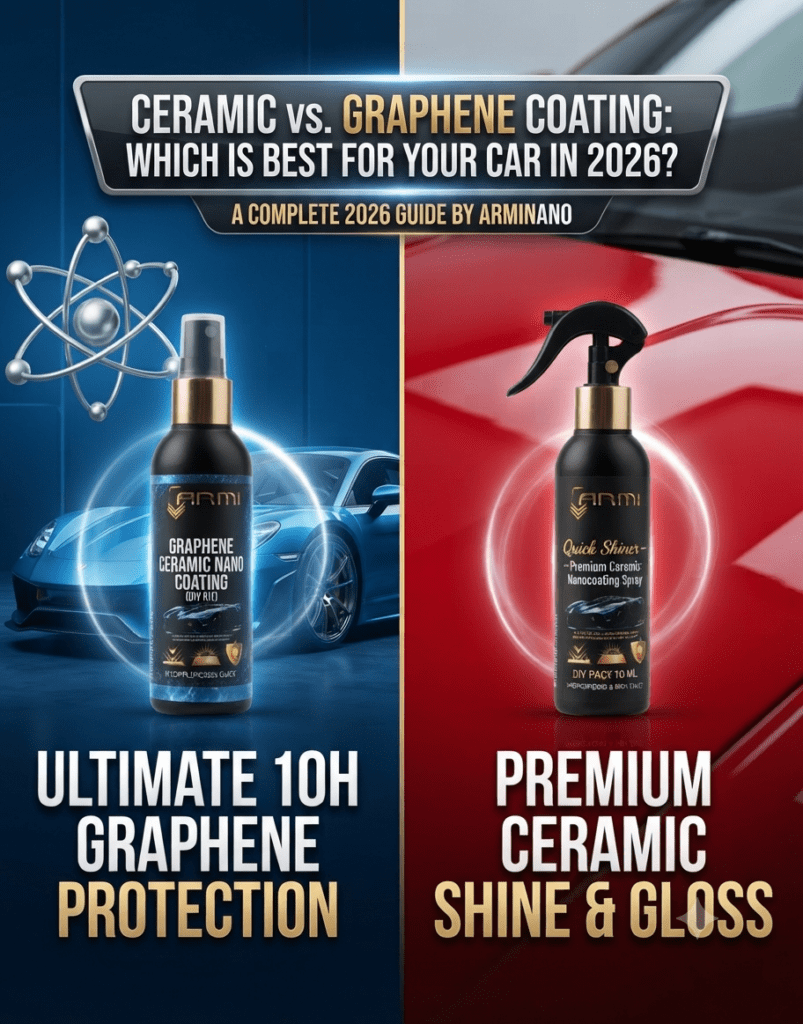
Ceramic vs. Graphene Coating: Which is Best for Your Car in 2026?
As we step into 2026, the automotive detailing landscape has transformed. Car owners are no longer satisfied with simple waxes; they demand long-term, high-performance protection. At BTCORP GENRIQUE NANO PVT LTD, we have analyzed millions of microscopic interactions between paint surfaces and environmental contaminants to bring you this definitive guide.
The Evolution of Car Paint Protection in 2026
Modern vehicles face tougher conditions than ever before—from record-breaking UV intensity to industrial pollutants and acidic rain. In the past, traditional carnauba waxes were sufficient, but in 2026, they are rapidly becoming obsolete. Today’s automotive detailing trends focus on nanotechnology-based coatings that provide a sacrificial layer, ensuring the factory clear coat remains pristine.
Why Your Vehicle Needs Advanced Nano-Coating Solutions
The transition from traditional sealants to advanced nanocoating solutions is not just about shine; it is about preservation. Automotive paint today is thinner and more eco-friendly, making it susceptible to swirl marks, oxidation, and micro-scratches. By utilizing high-end formulations, car enthusiasts can now achieve long-term paint maintenance that was previously exclusive to high-end detailing studios. Whether it is preventing water spots in monsoon seasons or combating the harsh summer heat, modern coatings act as a shield against daily environmental degradation.
The Role of BTCORP GENRIQUE NANO PVT LTD in Detailing Excellence
At BTCORP GENRIQUE NANO PVT LTD, we bridge the gap between complex chemistry and consumer application. Our decade of deep R&D expertise allows us to engineer products that are stable, durable, and result-oriented. We understand that every surface—from car body paint to solar panels—requires specific chemical engineering. Our commitment to high-purity graphene derivatives and silica-based polymers ensures that every DIY kit or professional coating we produce sets a benchmark for performance. As we look at the future of car protection, we are proud to offer solutions that empower both professional detailers and everyday drivers to maintain showroom finishes with minimal effort.
The Science of Surface Protection: Molecular Integrity
Before choosing, you must understand that both Ceramic and Graphene coatings serve a primary goal: creating a sacrificial barrier between your clear coat and the harsh outside world. At BTCORP GENRIQUE NANO PVT LTD, we view this barrier as the “first line of defense” in vehicle preservation. When you invest in high-quality nano-coatings, you aren’t just adding a layer of gloss; you are chemically bonding a defensive shield to your vehicle’s factory paint.
The Ceramic Coating Mechanism: Covalent Bonding
Ceramic coating is primarily a silica-based ($SiO_2$) liquid polymer. The science behind it is nothing short of brilliant. When applied to a clean paint surface, the molecules in the ceramic formula form a covalent bond with the factory clear coat. Unlike wax, which sits on the surface and melts away, ceramic coating effectively becomes a part of the paint structure.
The Advantage: Mirror-Like Perfection
The primary advantage of ceramic is its incredible refractive index. Because it levels out the microscopic peaks and valleys of your clear coat, it provides a mirror-like finish that fills in minor paint imperfections. For owners of new vehicles, this locks in that “showroom” look for years, not weeks.
When to Use & When to Avoid
Ideal Use: Use this on new vehicles or cars that have recently undergone professional paint correction. It is the gold standard for daily drivers who want longevity without constant re-application.
When to Avoid: Caution is key. Do not apply on a hot surface or in direct sunlight. High surface temperatures cause the carrier solvents in ceramic formulas to evaporate instantly, leading to “high spots”—patchy, uneven streaks that are difficult to remove without re-polishing. At BTCORP GENRIQUE NANO PVT LTD, we always recommend application in a controlled, shaded environment.
The Graphene Coating Revolution: The Carbon Advantage
If Ceramic is the reliable foundation, Graphene is the cutting-edge evolution. Graphene is a carbon-based material known for being the strongest material on Earth, consisting of a single layer of carbon atoms arranged in a hexagonal honeycomb lattice. When we infuse this into our BTCORP formulations, we create a flexible, highly conductive, and incredibly durable shield.
The Advantage: Thermal Management & Anti-Static Properties
Its most significant benefit is thermal management. Standard coatings can absorb and retain heat, which “bakes” mineral deposits (water spots) into the coating. Graphene’s exceptional thermal conductivity dissipates heat, which drastically prevents water spots—a major issue in tropical climates like India. Furthermore, Graphene is non-static. While ceramic can attract dust due to static charges, Graphene repels it, keeping your car cleaner for much longer.
Application Logic
Ideal Use: Perfect for cars subjected to daily environmental stress, heavy heat, or high-pollution areas where dust accumulation is frequent. It is the superior choice for high-end vehicle owners who prioritize functional protection.
When to Avoid: Avoid applying if you are not prepared for a detailed application process. Graphene-infused coatings require higher precision during leveling, and if the user is a novice without proper surface prep knowledge, they might find it more challenging than entry-level sprays.
Ceramic vs. Graphene: Quick Comparison Matrix
| Feature | Ceramic Coating | Graphene Coating |
|---|---|---|
| Material | Silica Dioxide ($SiO_2$) | Carbon-based Lattice |
| Heat Resistance | High | Extreme (Superior) |
| Dust Repellency | Moderate | Anti-Static (Excellent) |
| Hydrophobicity | Water Beading | Water Sheeting |
| Application Difficulty | Moderate | Advanced |
The Visual Difference (Hover to See)
Ceramic Coating
The Master of Gloss and Mirror Finish
Graphene Coating
The Master of Heat Dissipation and Hardness
As you weigh your options, remember that BTCORP GENRIQUE NANO PVT LTD provides both solutions, knowing that your car’s environment—whether it’s the blistering heat of the desert or the dusty winds of an urban landscape—is the deciding factor. By choosing the right tool for the specific job, you ensure your vehicle’s clear coat remains untouched, unoxidized, and perpetually pristine.
2. Strategic Selection: Head-to-Head Application Scenarios
Choosing between Ceramic and Graphene isn’t just about picking a product; it’s about aligning the molecular characteristics of the coating with your vehicle’s specific environment and usage profile. At BTCORP GENRIQUE NANO PVT LTD, we believe the best results come from using the right tool for the specific job.
When to Use Graphene vs. Ceramic
The following guide helps you navigate the decision-making process based on real-world environmental factors.
| Scenario | Recommended Solution | The Logic |
|---|---|---|
| High Heat / Sun | Graphene Coating | Graphene dissipates heat, preventing mineral spots from “baking” into the surface. |
| Showroom Gloss | Ceramic Coating | Silica creates a superior, candy-like refractive depth. |
| Polluted/Dusty Areas | Graphene Coating | Anti-static carbon matrix actively repels dust particles. |
| Budget Maintenance | Ceramic (Quick Spray) | Easy to apply; cost-effective for frequent DIY boosters. |
The Deep Dive: Why These Scenarios Matter
In tropical climates like India, UV radiation is intense. Standard ceramic coatings, while excellent, can sometimes absorb and retain surface heat, making them susceptible to water spotting if rain falls on a hot, sun-baked surface. This is where Graphene infusion changes the game. By acting as a thermal bridge, graphene disperses the heat, ensuring the surface remains cooler and significantly less prone to those stubborn, etched-in water marks.
Conversely, for the automotive enthusiast whose car spends most of its time in a climate-controlled garage or driven for weekend events, Ceramic Coating remains the king of aesthetics. Its high refractive index provides a level of depth and “wet look” gloss that is often the primary goal for show cars and luxury daily drivers.
3. The Pitfalls: Disadvantages of Incorrect Usage
At BTCORP GENRIQUE NANO PVT LTD, we emphasize that even the world’s most advanced chemical formulation will fail if the application timing or technique is flawed. The transition from “professional results” to “application disaster” often happens in the preparation and curing stages.
Thermal Shock and High Spots
One of the most common user errors is applying coatings under direct, harsh sunlight or on a body panel that is hot to the touch. This creates “Thermal Shock.” When the carrier solvents in the coating evaporate prematurely, the solid nano-particles do not have time to level out. This results in “High Spots”—streaky, patchy, and uneven areas that mar the finish and are difficult to remove without professional-grade re-polishing.
The Preparation Trap
Many DIY enthusiasts rush the surface preparation. A coating creates a microscopic bond; if there are contaminants like iron fallout, bonded tar, or old wax on the paint, the coating will bond to the contaminant, not the paint. This leads to premature coating failure—peeling or washing away within weeks instead of years. Always ensure a deep decontamination wash and clay bar treatment before application.
Ignoring the ‘Golden Hour’ of Curing
Every coating requires a “cure time” (usually 24 to 48 hours). This is when the nano-structure cross-links and hardens into its protective state. Exposing the vehicle to rain, moisture, or heavy dust during this window is a critical pitfall. If water touches the surface before the coating is fully cured, it will leave permanent water spots etched into the softening chemicals, effectively ruining the application’s integrity.
Pro-Tip from the BTCORP Lab:
If you are a novice or doing this for the first time, start with an ARMI® Quick Shiner Ceramic Spray. It is designed to be more forgiving, allowing for easy correction if you make an application mistake, unlike concentrated professional-grade DIY kits which require surgical precision.
4. Why BTCORP GENRIQUE NANO PVT LTD is the Industry Leader
Choosing the right paint protection for your vehicle shouldn’t be a gamble based on marketing buzzwords. It is a decision that impacts the longevity, resale value, and aesthetic appeal of your most prized mechanical asset. At BTCORP GENRIQUE NANO PVT LTD, we don’t just sell chemicals; we deliver precision-engineered material science. With over 15 years of dedicated R&D, we have moved beyond standard formulations to create a new ecosystem of automotive care.
The Pillars of Our Excellence
Uncompromising Consistency in Production
In the world of nanotechnology, consistency is everything. A fraction of a percent difference in graphene dispersion can mean the difference between a coating that lasts five years and one that peels in five months. Our patented production processes are designed to ensure molecular uniformity in every single batch. Whether you are a professional studio ordering in bulk or a car enthusiast buying a DIY kit, our quality assurance protocols ensure that the performance of our products is reproducible, scalable, and predictable.
True Vertical Versatility
What sets us apart is our end-to-end expertise. We are not merely white-label resellers; we are manufacturers. Our capabilities span from producing high-purity raw graphene powders to formulating finished, shelf-ready professional spray coatings. This vertical integration allows us to fine-tune our chemistry for specific climates—like the heat of the Indian subcontinent—ensuring that our products outperform mass-produced imports that are not designed for local environmental challenges.
Human-Centric Technical Support
We recognize that advanced nano-chemistry requires advanced understanding. That is why every sale from our catalog is backed by comprehensive technical support. We act as a consultant to our clients, helping you understand surface preparation, proper buffing techniques, and post-application maintenance. We believe that a superior product is only as good as its application, and we are committed to ensuring your success every step of the way.
The ‘Future-Proof’ Promise
Innovation at BTCORP is not stagnant. As we head into 2026, we are continuously upgrading our formulations to include eco-friendly solvents and higher-density nano-matrices. When you partner with us, you aren’t just buying today’s technology—you are aligning with a company that is actively engineering tomorrow’s solutions.
Final Verdict: The 2026 Selection Guide
Deciding between Ceramic and Graphene shouldn’t be about which is “better”—it’s about which is better for your vehicle’s environment. As we conclude our guide, use this checklist to make an informed decision.
Choose Ceramic Coating If:
- You Value Aesthetic Purity: You are looking for that unparalleled, deep, “glass-like” refractive gloss that makes the paint look wet.
- Your Environment is Stable: You drive primarily in urban environments or keep your vehicle in a garage, reducing exposure to extreme, harsh environmental elements.
- You Prefer Proven Classics: You want a reliable, time-tested solution that has set the standard for automotive protection for the last decade.
Choose Graphene Coating If:
- You Are an “Everyday Warrior”: Your car faces daily environmental stress, including intense heat, frequent dust, and highway pollution.
- Heat Management is Critical: You live in a region with high solar radiation, and you want to prevent water spots and mineral etching.
- You Want Longevity and Performance: You are looking for a technologically superior shield that offers 10H hardness, advanced hydrophobicity, and industry-leading anti-static properties.
Experience the BTCORP Difference
Whether you choose our flagship ARMI® Graphene Ceramic Nano Coating or the ultra-convenient ARMI® Quick Shiner series, you are investing in over 15 years of chemical engineering excellence.
Protect your investment with science, not guesswork.
Explore Our Product CatalogFrequently Asked Questions (FAQ)
1. What is the main difference between ceramic and graphene coatings?
Ceramic coatings primarily use silica dioxide for a glass-like finish, while graphene coatings use a carbon-based lattice structure for superior heat dissipation and anti-static dust repellency.
2. Does graphene coating last longer than traditional ceramic?
Yes, due to its molecular structure, graphene-infused coatings generally offer higher durability and scratch resistance compared to standard ceramic formulations.
3. Is graphene coating worth the extra cost for daily drivers?
For cars exposed to extreme heat and heavy pollution, the long-term maintenance savings and thermal benefits make graphene a cost-effective investment over time.
4. Can I apply a ceramic coating by myself?
Yes, DIY ceramic nanocoating kits are available, but they require strict adherence to surface preparation and curing time guidelines to avoid streaking.
5. How do I remove water spots from a coated car?
Water spots on coatings can often be removed with a specialized water spot remover or by maintaining the coating with a high-quality quick detailer spray.
6. Does car paint need polishing before applying nanocoating?
Yes, paint correction and decontamination are essential to ensure the coating bonds correctly to the clear coat rather than to surface contaminants.
7. What happens if I drive in the rain after applying coating?
Driving in rain before the coating has fully cured can disrupt the chemical bond, causing water etching and significantly weakening the coating’s longevity.
8. Do graphene coatings prevent deep scratches?
While they provide 10H hardness and excellent swirl mark resistance, they are not bulletproof and cannot prevent deep dents or heavy collision damage.
9. How often should I reapply ceramic nanocoating?
Depending on the quality of the product and environmental conditions, professional coatings typically last 2 to 5 years, while sprays may need reapplication every 6 months.
10. Can I use car wax over a graphene coating?
It is generally not recommended as wax can interfere with the hydrophobic properties and the intended finish of the nanocoating.
11. Why does my car coating have streaks after application?
Streaks, or “high spots,” occur when the coating is applied in excessive amounts or is allowed to dry for too long before being buffed off.
12. Are these coatings safe for matte paint finishes?
Specialized matte-specific nanocoatings exist, but standard gloss-enhancing coatings should be avoided as they may ruin the unique matte appearance.
13. Does UV exposure degrade car coatings?
High-quality graphene and ceramic coatings are designed to resist UV radiation, which helps prevent paint oxidation and color fading over time.
14. What is the best way to wash a car after coating?
Use the two-bucket method with a pH-neutral car wash shampoo to avoid stripping the protective layer or inducing micro-scratches.
15. Can nanocoatings be applied to glass and plastic trim?
Many formulations are multi-surface compatible, but you should always check the product specifications to ensure it is rated for glass and exterior plastics.