

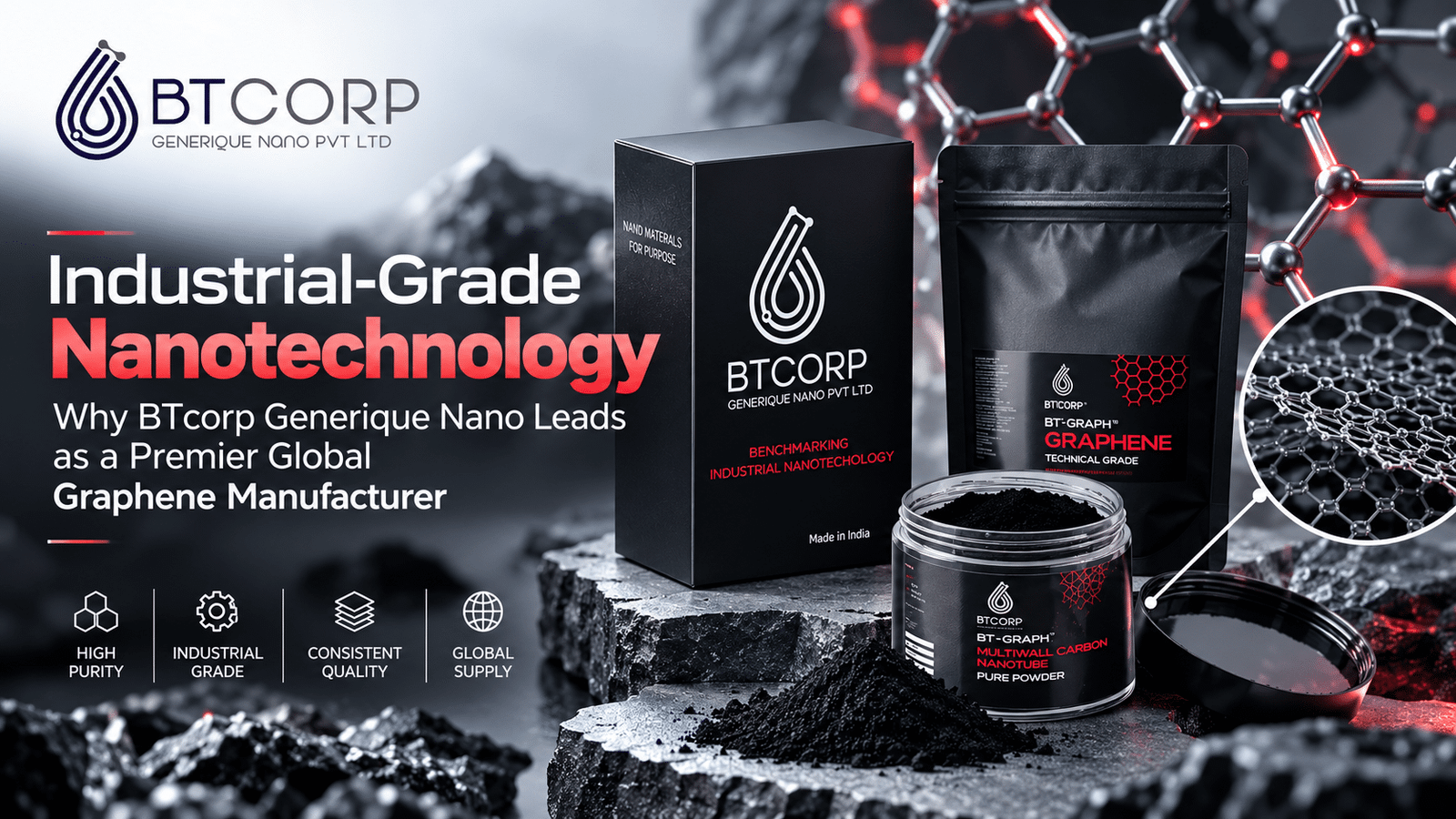
Why BTcorp Generique Nano Leads as a Premier Global Graphene Manufacturer
The modern industrial landscape is undergoing a silent yet seismic transformation. Across sectors ranging from electric vehicle manufacturing and renewable energy to high-performance coatings, advanced polymers, electronics and next-generation materials, conventional materials are increasingly approaching their performance boundaries. The industrial question is no longer simply whether nanomaterials have a role to play, but how rapidly manufacturers can integrate them into reliable, scalable and commercially viable production systems.
At the center of this transformation is graphene, one of the most recognized two-dimensional carbon materials in modern materials science. Its exceptional combination of lightweight structure, electrical conductivity, thermal performance, mechanical strength and extremely high specific surface area has attracted significant attention from engineers, researchers and product developers. Yet the real industrial opportunity does not come from laboratory demonstrations alone. It comes from the ability to manufacture, characterize, customize and supply graphene consistently at the scale required by commercial industries.
Advanced Materials
Graphene is being explored as a performance-enhancing material for composites, coatings, energy systems, polymers, electronics and specialized industrial formulations.
Scalable Manufacturing
Industrial adoption requires more than laboratory-grade material. Consistent production, repeatable properties and dependable supply are critical for commercial integration.
Global Supply
Procurement teams increasingly seek suppliers capable of supporting the transition from R&D quantities toward larger industrial requirements and international supply chains.
The Shift From Laboratory Innovation to Industrial Adoption
Conceptual industry adoption pathway
The Real Challenge: Finding Industrial-Scale Graphene Suppliers
As demand for high-performance carbon nanomaterials grows, procurement heads, R&D directors and supply-chain executives face a critical sourcing challenge. Buying graphene for an experimental project and sourcing graphene for continuous commercial manufacturing are fundamentally different requirements. Industrial customers need confidence in material consistency, technical documentation, production scalability, application support and international supply capabilities.
This is where the distinction between a simple material reseller and an experienced graphene manufacturer becomes particularly important. For commercial applications, variations in parameters such as layer structure, flake dimensions, oxygen content, defect levels, dispersion behavior and surface chemistry can influence downstream processing and final product performance. A dependable manufacturing partner therefore needs to understand not only how graphene is produced, but also how its properties relate to the application in which it will ultimately be used.
Where Industrial Nanotechnology Is Creating New Possibilities
Energy & Batteries
Graphene-based materials are being investigated for electrodes, conductive additives, supercapacitors and advanced energy-storage technologies.
Automotive
Lightweight composites, conductive polymers, thermal-management materials and protective coatings are important areas of graphene development.
Protective Coatings
Functionalized graphene materials can contribute to barrier properties and advanced corrosion-protection formulations.
Advanced Polymers
Graphene additives and masterbatches can be incorporated into polymer systems to explore improvements in mechanical, electrical and functional performance.
From Material Discovery to Commercial Execution
The industrial value of graphene ultimately depends on repeatability. A promising laboratory sample must evolve into a material that can be evaluated, tested, processed and supplied repeatedly. This requires a coordinated approach involving material characterization, production engineering, quality control and application-specific technical support.
| Industrial Requirement | Why It Matters | What Buyers Need to Evaluate |
|---|---|---|
| Material Consistency | Variations between batches can affect processing and finished-product performance. | Batch specifications, characterization data and quality-control procedures. |
| Scalable Production | Commercial projects require a reliable path from laboratory quantities to larger supply volumes. | Manufacturing capacity, production systems and supply continuity. |
| Application Support | Different formulations and processes require different graphene characteristics. | Technical consultation, dispersion guidance and application-specific development. |
| Global Supply Capability | International manufacturers require dependable logistics and export support. | Export experience, documentation and supply-chain infrastructure. |
BTcorp Generique Nano: Bridging Science and Industry
Within this evolving nanotechnology ecosystem, BTcorp Generique Nano Pvt Ltd positions itself around the industrialization of advanced graphene materials. The company has focused on developing scalable production approaches and building capabilities intended to serve customers beyond the conventional laboratory scale. Its positioning reflects a broader requirement in the graphene industry: converting the scientific potential of two-dimensional carbon materials into dependable industrial inputs.
With more than a decade of experience referenced in its industrial positioning, BTcorp Generique Nano focuses on the intersection of material science, manufacturing and application development. The company states that its supply network extends across more than 40 countries, placing international accessibility alongside technical development as a core part of its business model.
For global procurement teams, this combination is important because graphene adoption is rarely a single-step purchasing decision. It typically begins with material evaluation, moves into application testing and pilot development, and ultimately progresses toward commercial integration. A supplier capable of supporting this journey can become an important part of the customer’s broader nanomaterials supply chain.
Graphene’s industrial significance lies not simply in its remarkable theoretical properties, but in the ability to manufacture and integrate the material reliably into real-world products. As electric mobility, renewable energy, advanced polymers, protective coatings and high-performance engineering continue to evolve, industrial nanomaterials are becoming an increasingly important part of the technology landscape. BTcorp Generique Nano’s focus on scalable graphene production, technical development and international supply reflects this transition from scientific discovery toward practical industrial implementation.
The Anatomy of Advanced Graphene: Beyond the Hype
Graphene is often described as a revolutionary nanomaterial, but its industrial significance becomes much clearer when its structure and measurable properties are examined in detail. Isolated and extensively studied since the early 2000s, graphene consists of carbon atoms arranged in a two-dimensional honeycomb lattice. The structure is extraordinarily thin, yet the bonding between carbon atoms gives the material a remarkable combination of mechanical, electrical and thermal characteristics.
This combination is what separates graphene from conventional bulk materials. Instead of relying on a single performance characteristic, graphene brings several useful properties together within an extremely lightweight structure. For industrial engineers, however, the important question is not simply whether graphene has exceptional properties in theory. The more practical question is whether those properties can be reproduced consistently in a manufactured material and retained throughout processing and final application.
Inside the Two-Dimensional Carbon Lattice
Each carbon atom participates in a tightly connected hexagonal network. At the nanoscale, this architecture helps explain why graphene can combine high mechanical strength, electrical transport and thermal conductivity with exceptionally low mass.
The visual representation illustrates the interconnected nature of the graphene lattice rather than a literal production morphology.
Exceptional Strength-to-Weight Potential
Graphene’s atomic structure provides an extraordinary theoretical strength relative to its mass. This makes graphene particularly interesting for lightweight composite systems where engineers seek mechanical reinforcement without simply adding bulk material.
Electrical & Thermal Conductivity
The electronic structure of graphene allows highly efficient charge transport under appropriate conditions, while its lattice can conduct heat effectively. These characteristics make graphene relevant to conductive formulations, electronics, thermal-management systems and advanced composites.
Extremely High Specific Surface Area
A theoretical specific surface area of roughly 2,600 m² per gram is frequently associated with an ideal single-layer graphene sheet. In practical materials, the accessible surface area depends on layer structure, aggregation, defects, processing and dispersion.
From Exceptional Properties to Manufacturing Reality
The transition from academic research to industrial production introduced a fundamentally different challenge: repeatability. A laboratory demonstration may use a carefully prepared sample with a narrow distribution of material characteristics. Commercial manufacturing, by contrast, must reproduce relevant properties across repeated production batches while maintaining acceptable economics and process stability.
Important variables can include flake thickness, lateral dimensions, defect concentration, surface chemistry, oxygen content, degree of functionalization and dispersion behavior. Even when two materials are both marketed as “graphene”, differences in these parameters can produce very different results in a polymer, coating, electrode or composite formulation.
⚠ The Industrial Challenge
- Batch-to-batch variation in flake characteristics
- Differences in layer thickness and lateral dimensions
- Agglomeration during storage or processing
- Changes in surface chemistry and functional groups
- Difficulty translating laboratory performance to production scale
◈ The Engineering Response
- Controlled synthesis and exfoliation processes
- Material characterization and batch quality control
- Application-specific functionalization
- Dispersion and formulation development
- Scale-up engineering from R&D to industrial production
BTcorp Generique Nano states that its manufacturing approach incorporates proprietary and patented production methodologies involving both bottom-up and top-down synthesis routes derived from natural vein graphite. The practical objective of such process engineering is to develop repeatable material characteristics that can be evaluated against the requirements of downstream applications.
Why Global Industries Are Turning to India for Nanomaterials
Advanced-material supply chains are increasingly evaluated through a broader combination of technical capability, production economics, logistics, raw-material access and supply resilience. For graphene and other nanomaterials, these factors are especially important because commercial customers often require a supplier that can support the complete journey from initial R&D testing to larger production requirements.
India’s expanding materials ecosystem has created an environment in which advanced manufacturing, engineering talent, chemical processing and export capabilities can operate together. The country’s role in global nanomaterial sourcing is therefore connected not to one single advantage, but to the combination of several industrial capabilities.
NANO
ECOSYSTEM
Raw-Material & Processing Ecosystem
Access to graphite feedstocks together with purification, chemical processing and materials-engineering capabilities creates a foundation for advanced carbon-material manufacturing.
Long-Term R&D Development
Commercial nanomaterials require accumulated process knowledge covering exfoliation, functionalization, dispersion and quality-control methods, rather than simple commodity trading.
Scalable Industrial Supply
A mature manufacturing model should provide a pathway from laboratory sample quantities toward larger industrial consignments while maintaining defined material specifications.
BTcorp Generique Nano positions its Bengaluru manufacturing and R&D infrastructure within this broader Indian nanotechnology ecosystem. According to the company’s stated positioning, its international business serves customers across more than 40 countries, with a focus on advanced graphene materials and industrial applications.
For global OEMs, the importance of a manufacturing location ultimately depends on what it can deliver: consistent material specifications, technical documentation, responsive development support and a reliable route toward commercial quantities. These are the practical factors that determine whether a nanomaterial supplier can become part of an international production chain.
Navigating Product Variants: Choosing the Right Graphene Grade
One of the most important principles in industrial graphene sourcing is that there is no universal grade that automatically suits every application. Different production routes and post-processing methods create materials with different surface chemistry, conductivity, layer structures, dispersion characteristics and compatibility with surrounding matrices.
The correct selection therefore begins with the application rather than the product name. A conductive polymer formulation, water-based coating, battery electrode and structural composite may require very different graphene characteristics even though all four applications use the same broad family of carbon nanomaterials.
01 · Pristine Graphene
Few-layer and multi-layer graphene grades are generally selected where electrical or thermal transport, structural reinforcement and relatively low oxygen content are important considerations. Their suitability depends on layer count, lateral dimensions, defect density, surface area and the intended processing environment.
Few-Layer Multi-Layer Conductive Systems Composites02 · Graphene Oxide
Graphene oxide contains oxygen-bearing functional groups introduced through chemical processing. These groups can increase interaction with water and polar systems, making GO particularly interesting for aqueous dispersions, membranes, coatings and selected energy-storage applications.
GO Powder Aqueous Dispersion Functional Groups Membranes03 · Reduced Graphene Oxide
Reduced graphene oxide is produced by reducing some of the oxygen-containing functionalities present in GO. The resulting material can provide a useful balance between processability and electrical properties, although its exact characteristics depend strongly on the starting material and reduction route.
rGO Conductive Materials Coatings Energy Systems04 · Masterbatches & Liquid Dispersions
Pre-dispersed graphene masterbatches and liquid formulations are designed around processing convenience. By distributing graphene within a compatible carrier or solvent system, manufacturers can simplify integration into polymer extrusion, injection molding, coatings and other established manufacturing workflows.
PP PE PC Nylon| Material Form | Key Characteristic | Typical Industrial Interest | Important Selection Factors |
|---|---|---|---|
| Pristine / Few-Layer Graphene | Low oxygen content and strong electrical/thermal transport potential | Composites, conductive formulations, advanced materials | Layer count, defects, lateral size, dispersion |
| Graphene Oxide | Oxygen-containing functional groups and higher polarity | Membranes, aqueous systems, coatings, selected energy applications | Oxidation level, surface chemistry, dispersion stability |
| Reduced Graphene Oxide | Reduced oxygen functionality with improved conductivity potential | Coatings, conductive systems, energy materials | Reduction degree, defects, conductivity, dispersion |
| Masterbatch / Dispersion | Pre-dispersed graphene for easier industrial processing | Polymers, resins, extrusion and injection molding | Carrier compatibility, loading level, rheology, process temperature |
Evaluating Excellence: What Separates Graphene Manufacturers?
Selecting a graphene supplier requires more than comparing product names or headline purity numbers. Industrial procurement teams need to understand how a supplier defines quality, how material properties are verified, whether production can scale, what technical support is available and how reliably documentation follows each batch.
Analytical tools such as Raman spectroscopy and X-ray diffraction can provide important information about graphene-related materials. Depending on the application, additional characterization may include microscopy, thermal analysis, elemental analysis, particle or flake-size assessment, surface-area measurement and dispersion testing. The exact testing package should be matched to the material and application.
What a Technical Buyer Should Look For
Sector-Specific Impact: How Industries Utilize Graphene
The industrial interest surrounding graphene comes from its ability to modify the behavior of other materials and systems. Rather than replacing every conventional material outright, graphene is frequently investigated as an additive, reinforcement, conductive component, surface modifier or functional coating ingredient.
A. Energy Storage & Solar Technology
Graphene and graphene-derived materials are being investigated in lithium-ion batteries, supercapacitors and other electrochemical systems. Depending on morphology, conductivity and formulation, graphene can contribute to conductive networks and electrode architecture. In solar-related applications, graphene and graphene-based coatings are also explored for surface protection, conductivity, environmental resistance and specialized functional coatings. Performance, however, depends strongly on formulation, loading, electrode architecture and processing conditions rather than the presence of graphene alone.
B. Anti-Corrosion Coatings & Marine Protection
In protective coatings, graphene-derived materials can create complex diffusion pathways within a coating matrix. This concept is often described as a “tortuous path”, where corrosive species encounter a longer and more difficult route before reaching the underlying substrate. Functionalization and dispersion are critical because poorly distributed graphene can reduce the expected benefit. For marine and industrial environments, coating design must therefore consider moisture, salts, oxygen, adhesion, mechanical durability and long-term exposure conditions.
C. Lightweight Automotive & Aerospace Composites
In polymer composites, relatively small quantities of graphene-based additives can be investigated for mechanical reinforcement, electrical conductivity, thermal behavior and electrostatic discharge performance. Masterbatch-based approaches can simplify incorporation into existing polymer-processing systems. The actual improvement depends on graphene grade, loading level, dispersion quality, polymer chemistry, processing conditions and component design. For high-performance applications, these variables must be validated through application-specific testing.
Strategic Guidelines for Procurement & R&D Integration
Integrating graphene into a commercial product should be treated as an engineering program rather than a simple purchasing exercise. The correct material must be matched to the application’s processing environment, performance requirements, regulatory considerations, cost targets and production scale.
A structured qualification process reduces the risk of discovering material incompatibilities only after a project has progressed into expensive pilot or production stages. Three principles are particularly useful: characterize the material thoroughly, test scalability early and maintain direct technical communication between the material supplier and the application team.
Demand Comprehensive Characterization Data
Request batch-specific technical documentation rather than relying only on a generic product brochure. Depending on the application, this may include TDS information, Raman spectra, XRD data, SEM imagery, layer-count information, lateral-dimension data, surface chemistry and dispersion characteristics.
Stress-Test Scalability Early
A material that works at laboratory scale still needs to demonstrate consistent behavior when production volumes increase. Moving from a small trial quantity toward commercial supply should be evaluated for material consistency, processing behavior, lead time, economics and supply continuity.
Leverage Collaborative Research
Application development is often faster when the supplier’s material scientists and the customer’s engineers exchange formulation and processing information. Custom functionalization, dispersion development and pilot testing can help connect the selected graphene grade with the actual manufacturing process.
From Sample Qualification to Commercial Integration
A disciplined graphene qualification program can be visualized as a continuous engineering loop: material specification → laboratory sample → application testing → pilot-scale validation → production qualification → ongoing batch verification.
Procurement principle: The most meaningful supplier comparison should be based on the material characteristics required by the specific application. Purity, layer structure, surface chemistry, dispersion behavior, production consistency, documentation, technical support and commercial scalability should be evaluated together rather than in isolation.
Graphene Is Building the Next Industrial Frontier
Graphene is no longer simply a futuristic laboratory curiosity. Its unique combination of nanoscale architecture, conductivity, thermal behavior, mechanical potential and surface characteristics has made it an important material for researchers and industrial engineers developing the next generation of advanced products. From energy systems and protective coatings to lightweight composites and high-performance polymers, graphene is increasingly being evaluated as a functional material capable of enhancing established technologies.
For global enterprises, however, successful graphene adoption depends on much more than the theoretical properties of the material. Consistent manufacturing, reliable characterization, scalable production, application expertise and technical collaboration are equally important. This is why working with an experienced, research-driven manufacturer can be a critical part of the transition from laboratory experimentation to commercial implementation.
BTcorp Generique Nano has built its positioning around this intersection of science, manufacturing and industrial application. With more than a decade of R&D experience, proprietary and patented production approaches, advanced material development and international supply capabilities, the company aims to support customers looking for dependable graphene solutions rather than simply commodity material.
Whether the requirement involves industrial polymer systems, energy-storage research, protective coatings, conductive formulations, custom dispersions or graphene masterbatches, the objective remains the same: connect advanced nanomaterial science with measurable real-world manufacturing requirements. The future of graphene will ultimately belong to solutions that can move beyond the laboratory and perform consistently in demanding industrial environments.
Research Driven
Material science and application development form the foundation of advanced graphene innovation.
Built for Scale
Industrial customers need a reliable pathway from sample evaluation to repeatable commercial supply.
Application Focused
Different industries require different graphene grades, formulations and integration strategies.
The Science and Manufacturing Behind BTcorp Generique Nano
NANO
MATERIALS
From Scientific Expertise to Global Industrial Supply
BTcorp Generique Nano Pvt Ltd is positioned as an advanced nanomaterials company focused on graphene and graphene-derived technologies. Its development philosophy brings together material science, process engineering, characterization and application-oriented research.
One of the company’s defining strengths is its emphasis on scientific expertise. Advanced graphene is not a conventional commodity material; its performance can depend on subtle differences in morphology, layer structure, surface chemistry, defects, dispersion and processing. A strong scientific team is therefore essential for understanding how those variables influence the final application.
BTcorp’s stated experience includes more than a decade of R&D, proprietary production technologies and international customer servicing. The company also states that its products and solutions reach customers across more than 40 countries, reflecting an international approach to advanced-material supply.
This combination of scientific capability, manufacturing knowledge and application support is what enables BTcorp Generique Nano to position itself as a global graphene technology and supply partner for organizations exploring next-generation material solutions.
Innovation Driven by Scientific Expertise
Behind advanced nanomaterial manufacturing is a highly specialized scientific process. Producing graphene at industrial scale requires expertise that extends from carbon chemistry and synthesis to exfoliation, surface modification, dispersion, characterization and application engineering.
BTcorp Generique Nano places scientific capability at the center of its development approach. The company describes its team as bringing together material scientists, chemical engineers and nanotechnology researchers who work on translating graphene science into practical industrial solutions. This research-oriented approach is particularly important when customers require application-specific grades rather than a generic material.

Research-Led Nanotechnology
BTcorp Generique Nano’s scientific leadership reflects the company’s emphasis on research, material development and industrial translation. The goal is to connect scientific understanding with repeatable production and application-specific graphene solutions.
Material Synthesis
Understanding synthesis routes and process parameters that influence graphene morphology, structure and material characteristics.
Nanomaterial Characterization
Evaluating material structure and quality using appropriate analytical and microscopy-based characterization techniques.
Functionalization
Developing surface chemistry and functionalization strategies for application-specific performance and compatibility.
Dispersion Engineering
Helping graphene integrate effectively into polymers, coatings, liquids and other industrial matrices.
Scale-Up Engineering
Connecting laboratory development with pilot and industrial production while focusing on repeatability.
Application Development
Working toward practical material solutions aligned with the customer’s actual manufacturing process and performance objectives.
Graphene Questions, Answered
Choosing an advanced graphene supplier often involves technical questions about material grades, characterization, scalability, applications and development support. The following answers provide a concise starting point for procurement and R&D teams.
What makes industrial graphene different from a laboratory sample?
Industrial graphene must demonstrate repeatability, defined specifications, suitable quality-control procedures and a practical pathway toward larger production volumes. Laboratory performance alone does not guarantee commercial consistency.
What types of graphene materials can be sourced?
Depending on application requirements, graphene portfolios can include pristine or few-layer graphene, graphene oxide, reduced graphene oxide, polymer masterbatches and liquid dispersions.
How should graphene quality be evaluated?
Evaluation should be application-specific and may include Raman spectroscopy, XRD, SEM or other appropriate characterization methods, along with information on layer structure, lateral dimensions, surface chemistry, purity and dispersion behavior.
Can graphene be customized for a particular application?
Advanced graphene suppliers may provide customized grades, functionalization, dispersions or masterbatch systems depending on the customer’s polymer, coating, energy or composite-processing requirements.
Can a graphene supplier support the transition from R&D to production?
This should be assessed directly with the manufacturer. Key areas include sample evaluation, pilot-scale testing, material consistency, production capacity, technical documentation and long-term supply planning.
Why is scientific expertise important when selecting a graphene supplier?
Graphene is highly application-dependent. Scientific expertise helps connect material structure and surface chemistry with dispersion, processing and final-product requirements, reducing the gap between material selection and real-world implementation.
Ready to Explore Your Next Nanomaterial Solution?
Whether you are evaluating graphene for advanced polymers, protective coatings, energy-storage systems, composites, conductive applications or another industrial technology, the right starting point is a clear understanding of your material requirements and application conditions.
Connect with the BTcorp Generique Nano technical team to discuss your application, explore suitable graphene grades, evaluate custom dispersions or masterbatch solutions, and plan an appropriate sample or pilot-scale evaluation.
Contact Us →