

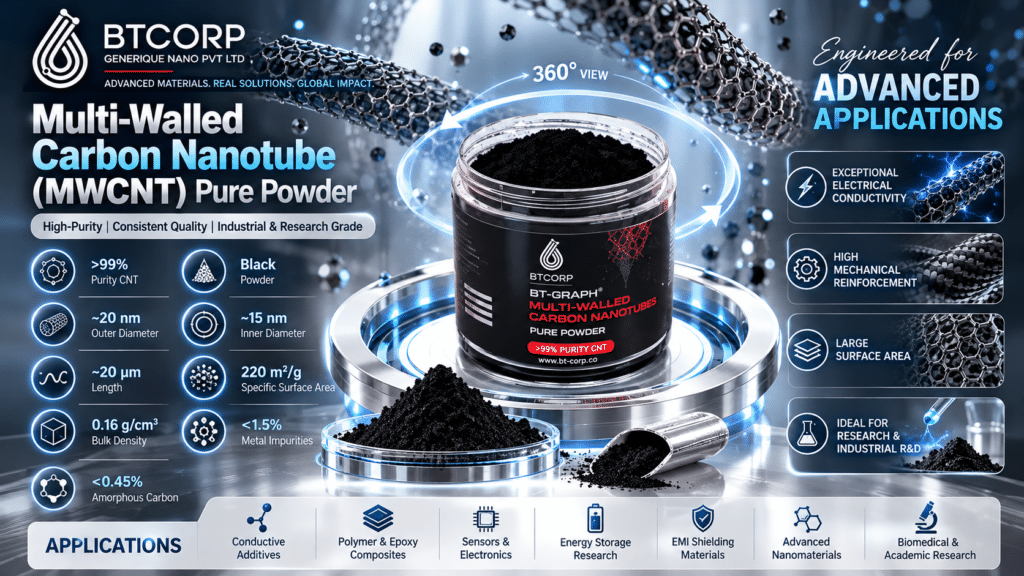
Multi-Walled Carbon Nanotube (MWCNT) Powder: Properties, Raman Spectroscopy, Applications and Research Potential
A practical, research-focused guide to high-purity MWCNT powder, its reported specifications, material behaviour, dispersion considerations, industrial applications, and the role of characterization techniques in advanced nanotechnology.
Manufactured by BTCORP Generique Nano Pvt Ltd.
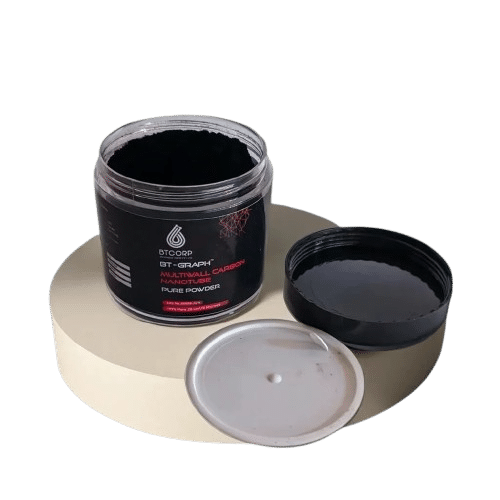
MWCNT Pure Powder — product cover image shown in full aspect ratio.
Introduction: Why Multi-Walled Carbon Nanotubes Matter
Multi-walled carbon nanotubes (MWCNTs) are nanoscale carbon structures made from multiple concentric, tube-shaped graphitic walls. Their combination of high aspect ratio, carbon-based structure, electrical potential, and useful mechanical characteristics makes them an important class of materials for research and engineering. They are investigated as conductive additives, reinforcing phases, functional fillers, and components in advanced composite systems.
At the nanoscale, material behaviour is strongly influenced by structure, dimensions, surface chemistry, purity, processing history, and the way a material is incorporated into a larger system. MWCNTs therefore cannot be assessed only by their name. A meaningful technical evaluation considers the stated specifications, the consistency of the material, the measurement methods used, and its performance in the intended formulation.
This article focuses on MWCNT Pure Powder with the product specifications supplied for this grade. The reported values are presented as product information, not as a substitute for a lot-specific certificate of analysis or independent laboratory verification. Researchers and industrial users should confirm the exact test methods and acceptance criteria required for their project before selecting a material.
Product Visual and Technical Animation
The video below is displayed using its natural aspect ratio and a responsive width. It is not forced into a fixed-height crop, so the complete frame remains visible. Use the video controls to play, pause or adjust playback.
The embedded media is included as a visual companion. Any scientific interpretation should be based on documented product data and measured characterization, not animation alone.
1. What Is MWCNT Powder?
A carbon nanotube is a cylindrical nanostructure formed from graphitic carbon. In a multi-walled carbon nanotube, more than one graphitic tubular wall is arranged concentrically around a central hollow region. This differs from a single-walled carbon nanotube, which has one principal tubular wall. The arrangement of multiple walls contributes to the distinctive structure and response of MWCNT materials.
MWCNT powder is a bulk form of these nanoscale structures supplied as a black, finely divided material. Although a powder can appear visually uniform, it consists of many individual nanotubes and may also contain bundles or agglomerates. The size and distribution of these agglomerates depend on production, handling, storage, and the energy and chemistry used during dispersion.
For practical use, the question is not simply whether a nanotube is conductive or strong in isolation. The question is whether a suitable concentration can be distributed through a matrix and whether the final material reaches its desired performance target. In polymers, coatings, electrodes, inks, or sensor layers, processing can be as important as the intrinsic properties of the carbon nanomaterial.
Multiple graphitic walls
Concentric carbon walls form the basic multi-walled tubular architecture.
High aspect ratio
Long, narrow structures may form connected pathways at suitable loading levels.
Surface-sensitive behaviour
Surface chemistry, dispersion and matrix compatibility affect final performance.
Application-led selection
Choose a grade against processing needs and measured end-use requirements.
2. Product Specifications at a Glance
The following table organizes the supplied technical details for MWCNT Pure Powder. Values are reported as provided in the product information and should be confirmed against the current technical data sheet and batch documentation for critical work.
| Parameter | Reported specification | Why it may matter |
|---|---|---|
| Purity | >99% CNT | Indicates the stated carbon nanotube content; confirm the analytical method and basis of calculation. |
| Appearance | Black powder | A visual description of the supplied bulk material. |
| Outer diameter | Approximately 20 nm | Provides a nominal size descriptor for the outside of the nanotube structure. |
| Inner diameter | Approximately 15 nm | Describes the reported internal diameter; verify measurement and definition with the supplier. |
| Length | Approximately 20 μm | Relates to aspect ratio, dispersion behaviour and possible network formation. |
| Specific surface area | 220 m²/g | Surface area can influence interactions with a matrix, dispersant or surrounding medium. |
| Bulk density | 0.16 g/cm³ | Useful for powder handling and approximate volume planning; it is not the true skeletal density. |
| Metal impurities | <1.5% | Relevant where residual catalyst metals affect processing, analysis or application requirements. |
| Amorphous carbon | <0.45% | Provides a stated limit for a non-tubular carbon fraction; confirm the method used. |
| Pack size | 10 g | Supplied pack size stated in the provided product details. |
Important technical note: Nanomaterial measurements can depend on sample preparation, instrument settings, calculation method and the definition used for each parameter. The specification table should not be interpreted as a guarantee that every measured particle has exactly the nominal dimensions shown.
3. Understanding the Key Parameters
Purity and impurities
The reported purity is greater than 99% CNT, while metal impurities are stated as below 1.5% and amorphous carbon below 0.45%. These values describe different aspects of the material and should not automatically be added or subtracted as though they were measured on an identical basis. Analytical methods may quantify different fractions and use different reporting conventions. For sensitive applications, request the test method, the batch-specific result, and any relevant uncertainty or detection limit.
Residual metals may matter in electrochemical testing, catalytic studies, thermal analysis or applications where metal content is restricted. Amorphous carbon can influence how a sample behaves in some characterization methods. The required limits depend on the project: a material suitable for one composite study may not automatically meet a battery, biomedical or high-purity research specification.
Diameter and length
The reported outer diameter is approximately 20 nm, inner diameter approximately 15 nm, and length approximately 20 μm. These are nominal descriptors rather than a complete particle-size distribution. Diameter and length influence the aspect ratio, which is a useful first approximation of how elongated a nanotube is. Actual network formation, however, also depends on bundling, orientation, surface treatment, matrix viscosity, loading level and processing energy.
For researchers comparing suppliers, it is useful to ask whether dimensions were estimated from microscopy, whether values are averages or representative observations, and how many structures were measured. Microscopy can reveal morphology and bundles, while bulk methods provide different kinds of information. No single method answers every question about a powder.
Specific surface area
The stated specific surface area is 220 m²/g. Surface area can affect adsorption, interfacial interaction, dispersant demand and the way nanotubes interact with a polymer or liquid medium. A higher surface area is not automatically better for every formulation: it may also increase viscosity, complicate wetting or require more careful dispersion. The useful value is the one that contributes to repeatable performance in the target application.
Bulk density and powder handling
The listed bulk density is 0.16 g/cm³. Bulk density describes the mass occupying a given volume of a loose or specified packed powder and may change with compaction and handling. It should not be confused with the density of the carbon material itself. In manufacturing, bulk density can inform container sizing, weighing procedures and transfer planning, but safe handling and process design must also consider dust generation and the powder’s tendency to agglomerate.
4. A Visual Specification Dashboard
The graphics below turn selected numerical specifications into a quick-reading dashboard. Bars are visual aids only; they do not compare different properties on one common scientific scale.
Reported specific surface area
Displayed against an illustrative 250 m²/g graphic range, not a quality ranking.
Reported bulk density
Displayed against an illustrative 0.50 g/cm³ graphic range.
Reported outer diameter
Displayed against an illustrative 50 nm graphic range.
Reported length
Displayed against an illustrative 30 μm graphic range.
5. Raman Spectroscopy: Reading Carbon Nanomaterial Structure
Raman spectroscopy is widely used to study carbon-based materials because the Raman response can provide information about bonding structure, disorder and graphitic organization. A Raman spectrum plots signal intensity against Raman shift, usually expressed in inverse centimetres (cm⁻¹). For carbon materials, the D and G bands are commonly discussed; for graphene and related graphitic materials, the 2D band is also important.
The D band is commonly associated with defect-activated scattering and structural disorder in sp² carbon systems. The G band is associated with in-plane vibrational modes of sp²-bonded carbon. The 2D band is a second-order feature whose shape, position and intensity can help distinguish certain graphitic structures, although interpretation depends on the sample and measurement conditions. In nanotubes, spectra may also show features influenced by tube structure, resonance conditions, excitation wavelength and sample preparation.
Raman spectroscopy should not be treated as a one-number purity test. Peak positions and relative intensities can be influenced by excitation laser wavelength, heating, strain, doping, functionalization, baseline treatment and the fitting procedure. Results are most useful when the measurement conditions and analysis method are recorded and when Raman data are interpreted alongside complementary techniques.
Illustrative Raman shift diagram
Conceptual illustration only, not measured data for this MWCNT product. Band locations and shapes vary by material and test conditions. Do not use this graphic to calculate a D/G ratio or certify product quality.
What does the D/G ratio tell a researcher?
The intensity ratio of the D and G bands is often reported as an indicator related to disorder or defect-activated scattering in a carbon material. Its interpretation is not universal: the relationship between the ratio and structural disorder depends on the material type, excitation wavelength, regime of disorder, and analysis approach. A value should therefore be reported with its measurement context rather than treated as a universal pass/fail threshold.
For MWCNT studies, Raman data may be used to compare batches, evaluate changes after functionalization, or investigate processing effects. A meaningful comparison requires consistent sample preparation, instrument settings and peak-fitting practices. If the purpose is to evaluate a treatment, measuring the untreated and treated materials under comparable conditions is often more informative than interpreting one isolated spectrum.
6. Graphite vs Graphene vs Carbon Nanotubes
Graphite, graphene and carbon nanotubes are all carbon-based materials, but their structures are different. Graphite consists of stacked graphitic layers. Graphene is commonly described as a single atomic layer of carbon atoms arranged in a hexagonal lattice. Carbon nanotubes are rolled tubular structures made from graphitic carbon; MWCNTs have multiple concentric walls. These structural differences affect the ways the materials are studied and incorporated into products.
| Material | Basic structure | Common research focus | Practical consideration |
|---|---|---|---|
| Graphite | Many stacked graphitic layers | Layered carbon behaviour, electrodes, lubricity and bulk carbon studies | Properties depend on grade, particle size, orientation and processing. |
| Graphene | One atomic layer in the idealized form | Electronic, thermal, mechanical and surface-related properties | Layer count, defects, contamination and production route matter. |
| MWCNT | Multiple concentric graphitic tubes | Conductive networks, reinforcement, sensing and composite development | Length, diameter, bundling, dispersion and interface quality matter. |
Structure comparison — conceptual infographic
Structural illustration only. Not to scale; real materials have defects, size distributions and more complex morphologies.
Raman interpretation across carbon materials
Raman spectra of graphite, graphene and nanotubes can all exhibit D and G features, but their relative intensities, line shapes and additional features may differ. The 2D band is especially useful in many graphene studies because its shape and profile can provide clues about layer structure. It is not a standalone identification test in every context. For MWCNTs, a spectrum must be interpreted with the nanotube structure, excitation conditions and complementary evidence in mind.
When presenting a graphite-versus-graphene Raman comparison, use measured spectra from documented samples, the same or clearly stated excitation wavelength, and labelled axes. If the available data are only illustrative, label them explicitly as schematic. This avoids presenting a decorative curve as if it were experimental evidence.
7. Applications of MWCNT Powder
The product information identifies the following application areas. Actual suitability depends on the formulation, grade, loading level, safety assessment, validation results and requirements of the final application.
Conductive additives
MWCNTs are investigated for forming electrical pathways in polymers, coatings and other matrices. Conductivity depends on network connectivity, dispersion and the matrix’s own properties.
Polymer and epoxy composites
Nanotubes may be evaluated as functional fillers to alter electrical response or mechanical behaviour. The interfacial bond, viscosity, cure conditions and dispersion quality need careful control.
Sensors and electronics
Carbon nanotube networks can be explored in sensing layers and conductive structures. Repeatability, signal stability, substrate compatibility and environmental effects are important development questions.
Energy storage research
Researchers investigate carbon nanomaterials in electrode formulations and conductive networks. Suitability must be established through application-specific electrochemical tests and impurity requirements.
EMI shielding materials
Conductive composites containing carbon nanomaterials may be studied for electromagnetic interference shielding. Shielding effectiveness depends on frequency, thickness, geometry and formulation.
Advanced nanomaterials
MWCNTs can serve as a component in hybrid materials and experimental structures designed around specific functional targets.
Biomedical and academic research
Academic projects may investigate surface modification, interfaces and material behaviour. Biomedical-related research requires rigorous characterization, exposure assessment and application-specific safety evaluation; this listing is not a claim of medical-grade approval.
8. Conductive Networks and Composite Design
In a conductive composite, individual nanotubes must connect sufficiently to form a pathway through the host material. This is often discussed in terms of a percolation threshold: a loading region where a connected network begins to produce a marked change in electrical behaviour. There is no single universal threshold for all MWCNT composites. It varies with nanotube geometry, agglomeration, surface treatment, polymer type, processing method, and the way conductivity is measured.
At low loading, a composite may preserve more of the base material’s original processing characteristics, but it may not yet form a continuous conductive network. At higher loading, connectivity may improve, while viscosity, dispersion difficulty, cost, brittleness or other properties can become less favourable. Formulation development is therefore a balancing exercise, not simply a process of adding as much nanomaterial as possible.
A robust development plan records the formulation, mixing order, equipment, energy input, temperature, processing time, sample conditioning and test method. Small differences in these factors can affect repeatability. It is also useful to define success criteria before beginning trials, such as target conductivity, viscosity range, mechanical properties, shelf stability or compatibility with existing manufacturing equipment.
9. Dispersion: Turning Powder into a Usable Formulation
Nanotubes can attract one another and form bundles or agglomerates. Dispersion aims to distribute them through a liquid or matrix sufficiently well for the intended use. A visually uniform liquid is not necessarily proof of nanoscale separation or long-term stability. Dispersion quality should be judged using methods relevant to the formulation and application.
The supplied product information states that stable MWCNT dispersions are available in water, IPA (isopropyl alcohol), DMF, butyl acetate and other organic solvents. Solvent compatibility is application-dependent, and a dispersion made for one resin, coating or laboratory protocol may not be suitable for another. Ask for the relevant carrier composition, solids concentration, stability data, handling instructions and compatibility information before choosing a pre-dispersed option.
Functionalized variants are also stated to be available with carboxyl (-COOH), hydroxyl (-OH), amine (-NH₂) and other custom surface groups. Functionalization can change interactions with solvents, polymers and other ingredients, but it may also change electrical behaviour, defect structure or thermal response. The right surface chemistry is the one that meets the application’s combined processing and performance requirements.
Questions to answer during dispersion development
- What is the target medium: water, solvent, resin, polymer melt or another matrix?
- What solids concentration and viscosity range can the process accommodate?
- Is a dispersant required, and could it affect conductivity, cure or final surface properties?
- What mixing or sonication equipment is suitable, and how will heat generation be managed?
- How will the team assess uniformity, sedimentation, agglomeration and storage stability?
- What safety controls are required for the powder, solvent and process equipment?
These questions are best answered through a controlled trial plan with a documented baseline. For commercial production, the method must also be scalable and repeatable, not merely effective in a small laboratory vessel.
10. From Laboratory Trial to Industrial R&D
Successful material development involves more than demonstrating one promising result. The selected material must be reproducible, its performance must be relevant to the actual application, and the production route must be practical at the intended scale. A laboratory formula may behave differently in larger equipment because mixing patterns, heat transfer, residence time and shear conditions change with scale.
For this reason, a staged development plan is useful. First, define the target property and the baseline material. Next, screen a small set of loading levels or formulations. Then evaluate dispersion and initial performance. Promising formulations can be tested for stability, ageing and process compatibility before scale-up. Final validation should use the test methods and operating conditions that matter to the end user.
Material review
Confirm specification, batch identity, handling needs and fit with the research objective.
Bench screening
Evaluate a controlled range of formulations and record processing conditions.
Performance testing
Measure the properties that define success and compare them with the baseline.
Scale-up validation
Check reproducibility, manufacturing practicality, quality controls and storage behaviour.
Custom particle specifications, concentrations and packaging are stated to be available on request. Bulk quantities are also stated to be available for industrial and research requirements, with technical support and custom formulation services. Availability, lead time, minimum order quantity and the scope of support should be confirmed directly for a particular project.
11. Characterization: A Multi-Method Approach
No single characterization method describes every aspect of a nanotube powder. The correct testing package depends on the research question. Raman spectroscopy can provide information about carbon structure and disorder-related features. Microscopy can help inspect morphology and agglomeration. Surface-area measurements, thermal analysis, elemental analysis and other methods may answer additional questions when their limitations are understood.
| Method or evidence | Potential contribution | Question to ask |
|---|---|---|
| Raman spectroscopy | Carbon bonding features and disorder-related comparisons | What laser wavelength, baseline method and peak-fitting approach were used? |
| Electron microscopy | Visual assessment of nanotube morphology, dimensions and bundles | How were images selected and how many structures were measured? |
| Specific surface area measurement | Estimate of accessible surface area under the test method | What sample preparation and analysis method were used? |
| Elemental or metal analysis | Assessment of selected elemental content or residual metals | Which elements, detection limits and reporting basis are included? |
| Thermal analysis | Thermal response and mass-change behaviour under defined conditions | What atmosphere, heating rate and sample mass were used? |
| Application testing | Performance in a real matrix, device or coating | Does the test reproduce the actual use conditions and acceptance criteria? |
For supplier qualification, compare like with like. A number reported without its method may not be directly comparable with a number obtained using another method. Keep batch records and, where possible, compare multiple batches to understand normal variation. For critical applications, define acceptance criteria before testing and document how deviations will be handled.
12. Handling, Storage and Responsible Use
Fine carbon nanomaterial powders require thoughtful handling. Avoid creating airborne dust, use appropriate containment and ventilation, and follow the supplier’s safety data sheet and the site’s risk assessment. The appropriate personal protective equipment and engineering controls depend on the task, exposure potential, quantity, particle form and applicable workplace rules. Do not rely on a general blog article as a replacement for product-specific safety documentation.
When handling the powder, keep containers closed when not in use, use suitable tools for weighing and transfer, and avoid cleaning methods that disperse dust into the air. Establish procedures for spills and waste before opening the container. If a liquid dispersion is used, evaluate the hazards of both the nanomaterial and its carrier solvent; flammability, ventilation, chemical compatibility and waste requirements may be relevant.
Store the product in a suitable, labelled, closed container under the conditions specified by the supplier. Protect it from unintended contamination and moisture exposure where required by the product documentation. Before use, check the batch label and any accompanying safety information. For applications involving people, biological systems, food, pharmaceuticals or regulated products, additional testing and approvals may be required; the supplied product note explicitly excludes pharmaceutical and food applications.
13. Selecting the Right MWCNT Grade for a Project
Start with the intended outcome rather than selecting a grade based on one specification alone. For conductive applications, the key question may be whether the formulation can produce a stable connected network at an acceptable loading level. For mechanical reinforcement, interface quality and processing effects may be important. For research that is sensitive to trace metals or structural defects, analytical evidence and batch-to-batch consistency may take priority.
It is helpful to create a short technical brief containing the matrix or solvent, the target property, the processing equipment, the intended quantity, any impurity limits, the test method and the required delivery format. This allows the supplier to respond to the actual requirement rather than provide a generic recommendation. If a functionalized grade or pre-dispersed product is being considered, specify the desired surface chemistry or carrier and confirm compatibility with the downstream process.
| Project need | Information to prioritize | Validation step |
|---|---|---|
| Conductive polymer | Dispersion, loading window, matrix compatibility and electrical target | Measure conductivity using a defined sample geometry and method. |
| Epoxy composite | Viscosity, cure compatibility, wetting and mechanical target | Compare cured specimens with an unfilled control. |
| Sensor development | Signal response, repeatability, substrate and environmental stability | Test multiple samples across controlled conditions. |
| Energy-storage research | Impurity limits, electrode compatibility and electrochemical protocol | Use application-specific testing and documented controls. |
| Coating or EMI material | Film formation, thickness, dispersion and target frequency range | Test the finished layer using a suitable standardized or agreed method. |
14. Common Development Mistakes to Avoid
Assuming that nominal purity guarantees final performance
Purity is important, but final performance also depends on morphology, surface chemistry, dispersion and the host material. Always validate the complete formulation against the intended use.
Comparing Raman graphs without checking the test conditions
Laser wavelength, power, sample preparation, baseline correction and fitting choices can influence the spectrum. A meaningful comparison documents these conditions and uses consistent analysis.
Increasing loading without tracking processability
More nanotube content may improve one property while increasing viscosity or making dispersion more difficult. A controlled loading study is more informative than assuming that the highest concentration is best.
Assuming that a dispersion is stable because it looks uniform
Visual appearance is useful but insufficient on its own. Define an observation period and suitable measurements for sedimentation, agglomeration and functional performance.
Skipping batch documentation
Record the product batch, material mass, mixing conditions, formulation, test method and results. This is essential for interpreting differences between trials and reproducing successful results.
Using the material outside the stated intended-use scope
Follow supplier documentation and applicable rules. The product details provided for this article state laboratory, research, industrial R&D and product-development use, and exclude pharmaceutical and food applications.
15. Product Options and Technical Support
According to the supplied product information, this MWCNT offering is available as a 10 g pack. Stable dispersions are stated to be available in water, IPA, DMF, butyl acetate and other organic solvents. Functionalized MWCNTs with carboxyl, hydroxyl, amine and other custom surface groups are also stated to be available. Customized particle specifications, concentrations and packaging may be requested, and bulk quantities are stated to be available for industrial and research requirements.
These options can help projects that need more than a dry powder. A pre-dispersion may reduce some initial wetting or mixing steps, while a functionalized material may be useful where surface interaction is central to the formulation. Neither option eliminates the need to validate compatibility, stability, safety and performance under actual process conditions. Confirm the exact product configuration, carrier composition, concentration, documentation and lead time before ordering.
Technical support and custom formulation services are stated to be available. When making an enquiry, include your application, matrix or solvent, target performance, estimated quantity, preferred pack format and any relevant test requirements. This information helps establish whether a standard grade, a functionalized option, a dispersion or a custom development discussion is the most appropriate next step.
16. Frequently Asked Questions
What does MWCNT stand for?
MWCNT stands for multi-walled carbon nanotube. It describes a tubular carbon nanostructure containing multiple concentric graphitic walls.
What is the stated purity of this MWCNT powder?
The supplied product details state purity of greater than 99% CNT. For critical work, request the current batch-specific documentation and analytical method.
What is the stated pack size?
The product information supplied for this article lists a 10 g pack.
Can this material be used in polymers or epoxy?
Polymer and epoxy composites are listed application areas. Suitability depends on the specific resin, processing method, loading, dispersion and measured performance.
Are liquid dispersions available?
The supplied details state that stable MWCNT dispersions are available in water, IPA, DMF, butyl acetate and other organic solvents. Confirm the exact formulation and concentration for your application.
Are functionalized MWCNTs available?
The supplied details list carboxyl (-COOH), hydroxyl (-OH), amine (-NH₂) and other custom surface functional groups. Confirm availability and specifications for the required grade.
What does Raman spectroscopy show?
Raman spectroscopy can help characterize carbon bonding features and compare disorder-related signatures. Interpretation depends on the material and measurement conditions, and Raman should be considered alongside other relevant evidence.
Can a schematic Raman spectrum be used as a certificate of analysis?
No. The spectrum in this article is illustrative, not measured data for this product. Use an actual test report with documented methods and sample identity for quality decisions.
Is the product intended for food or pharmaceutical use?
No. The supplied product note says it is intended for laboratory, research, industrial R&D and product development use only, and is not intended for pharmaceutical or food applications.
Who manufactures this product?
The manufacturer to identify for this article is BTCORP Generique Nano Pvt Ltd.
18. MWCNT Powder: A Practical Material for Application-Led Research
Multi-walled carbon nanotubes provide researchers and product developers with a versatile carbon nanomaterial platform. Their potential role in conductive additives, polymer and epoxy composites, sensors, electronics, energy-storage research, EMI shielding and other advanced material systems makes them relevant across multiple R&D disciplines. Yet the most important decisions are application-specific: which properties matter, how the nanotubes will be incorporated, and how performance will be measured.
The reported specification set for this grade includes greater than 99% CNT purity, a black powder appearance, approximate outer and inner diameters of 20 nm and 15 nm, an approximate length of 20 μm, specific surface area of 220 m²/g, bulk density of 0.16 g/cm³, metal impurities below 1.5%, amorphous carbon below 0.45%, and a 10 g pack size. These details provide a useful starting point for discussion, but batch documentation and the relevant test methods remain important for formal qualification.
Raman spectroscopy can support structural comparison through D, G and 2D features, while microscopy, surface-area measurement, elemental analysis and application testing can provide complementary information. Graphite, graphene and MWCNTs should be distinguished by their structures, and schematic figures should never be mistaken for measured results. In formulation work, careful dispersion, suitable surface chemistry, repeatable processing and clear acceptance criteria help turn a promising nanomaterial into a useful component.
For projects requiring a dry powder, solvent dispersion, functionalized nanotubes, customized specifications or technical formulation support, discuss the intended application and documentation requirements with the manufacturer. The most reliable path from laboratory research to industrial use is a disciplined one: characterize the material, test it in the intended system, document the result and validate repeatability before scaling.
MWCNT Pure Powder
Manufactured by BTCORP Generique Nano Pvt Ltd.
For laboratory, research, industrial R&D and product development use only. Not intended for pharmaceutical or food applications.
Confirm current availability, batch-specific technical documentation, safety data and customization options before use.
MWCNT Pure Powder: Product Showcase & Technical Specifications
A closer look at the MWCNT Pure Powder product featured in this article. The image is displayed at full width with its original proportions preserved, without intentional cropping.

Product details in this article are based on the specifications supplied for MWCNT Pure Powder. Verify current specifications and supporting documentation with BTCORP Generique Nano Pvt Ltd. before making a critical technical or purchasing decision.