

MWCNT Pure Powder: A Practical Guide to Multi-Walled Carbon Nanotubes
MWCNT Pure Powder: A Practical Guide to Multi-Walled Carbon Nanotubes
Explore the structure, key specifications, characterization, potential applications and selection considerations for Multi-Walled Carbon Nanotubes (MWCNT). This guide covers MWCNT Pure Powder manufactured by BTCORP Generique Nano Pvt Ltd. under the Generique name. The powder has no separate product brand and should not be described as an ARMI product. The article explains the technical details in an accessible, industry-focused format.
Material profile · Product specifications · Raman spectroscopy · Handling considerations · Application development
Want the Product Details? Scan or Open Here
Use the product-details scanner image with your phone camera, or open the live MWCNT product page directly. This gives readers a quick route to product information without searching through the article.
Open MWCNT Product Details ↗If scanning does not work on a device, use the button. The scanner image is linked to the same product URL.

Introduction: Why Multi-Walled Carbon Nanotubes Matter
Advanced materials are increasingly being designed to do more than simply fill a space or provide a basic mechanical function. Manufacturers are looking for materials that can help manage electrical behaviour, improve the performance of composites, support functional coatings and enable new product designs. Carbon nanomaterials have become an important area of research because their structures can produce useful combinations of properties at very small scales.
Multi-Walled Carbon Nanotubes, commonly abbreviated as MWCNTs, are cylindrical nanostructures formed from multiple concentric layers of carbon. They belong to the wider family of carbon nanotubes, which are studied for their electrical, thermal, mechanical and surface-related characteristics. Their potential usefulness depends on the nanotube structure, purity, dimensions, dispersion quality, surface chemistry and the matrix or formulation into which they are introduced.
MWCNTs are not a universal additive that automatically improves every product. Their performance is application-dependent. A formulation designed for electrical conductivity, for example, may require a different loading level and dispersion strategy from a polymer composite designed around mechanical reinforcement. For that reason, evaluating an MWCNT powder should involve both the material specification and the conditions under which the material will be used.
This article introduces the MWCNT Pure Powder listing, explains the specification values displayed on the product page, discusses Raman spectroscopy as a characterization technique, and outlines practical questions that researchers and product developers can consider before choosing a carbon nanotube grade.
MWCNT Pure Powder: Product Overview
Product at a glance
Product name: MWCNT Pure Powder | Multi-Walled Carbon Nanotubes (10g)
Manufacturer: BTCORP Generique Nano Pvt Ltd.
Product branding: No separate product brand name. This nanomaterial is manufactured by BTCORP Generique Nano Pvt Ltd. under the Generique name.
Listed pack size: 10 g
Category shown on page: Graphene
The listing presents a black powder intended for material research, development and application evaluation. Please check the live product page for the current price, availability, shipping terms and any updated technical documents.
What the product page reports
- Purity: greater than 99% CNT
- Appearance: black powder
- Outer diameter: approximately 20 nm
- Inner diameter: approximately 15 nm
- Length: approximately 20 µm
- Specific surface area: 220 m²/g
- Bulk density: 0.16 g/cm³
- Metal impurities: less than 1.5%
- Amorphous carbon: less than 0.45%
These values are transcribed from the product page screenshot supplied for this article. Confirm the latest specification sheet or certificate of analysis with the supplier before using the values for a controlled process or formal material qualification.
| Parameter | Value shown on 10 g product page | Why it matters |
|---|---|---|
| CNT purity | >99% CNT | Purity indicator; confirm test method |
| Appearance | Black powder | Visual description, not a purity test |
| Outer diameter | ~20 nm | Tube geometry and packing |
| Inner diameter | ~15 nm | Hollow inner structure |
| Length | ~20 µm | Aspect ratio and network formation |
| Specific surface area | 220 m²/g | Available interface in formulations |
| Bulk density | 0.16 g/cm³ | Powder volume and handling |
| Metal impurities | <1.5% | Potentially relevant to end-use requirements |
| Amorphous carbon | <0.45% | Reported non-crystalline carbon fraction |
Values above are taken from the 10 g listing screenshot provided for this draft. Confirm the current listing and batch documentation before procurement; pack size and listing details may change.
The specifications provide a useful first snapshot, but they should not be read in isolation. Purity is only one part of material quality. Diameter and length distributions, defect density, agglomeration, residual catalyst content, surface chemistry and lot-to-lot consistency can all influence the behaviour of MWCNTs in a real formulation. For a research project, it is useful to connect each reported property to a test method and a performance requirement.
What Are Multi-Walled Carbon Nanotubes?
A carbon nanotube is a tube-shaped nanostructure made primarily from carbon atoms arranged in a hexagonal network. In a multi-walled carbon nanotube, several tube-like graphitic layers are arranged concentrically, rather than there being just one cylindrical wall. This multi-layer structure distinguishes MWCNTs from single-walled carbon nanotubes (SWCNTs), which consist of a single cylindrical graphene wall.
The layered structure, nanoscale diameter and elongated shape give MWCNTs a high aspect ratio: their length can be many times greater than their diameter. In composite systems, this geometry can help create connected pathways at suitable concentrations. In electrically functional materials, such pathways may contribute to conductivity. In other formulations, nanotubes may be investigated for their contribution to mechanical behaviour, thermal transport or functional surface properties.
However, nanotubes naturally tend to bundle and form agglomerates because of their surface interactions. If the bundles are not broken down and distributed appropriately, the final material may not perform as intended. Dispersion methods, mixing energy, solvent or resin compatibility, surfactants, functionalization and processing conditions therefore deserve careful consideration.
MWCNT compared with SWCNT
SWCNT and MWCNT grades are not interchangeable by default. Their structures, cost profiles, defect characteristics, dispersion behaviour and application requirements can differ. MWCNTs are often investigated in polymer composites, conductive formulations, coatings and research systems where multi-layer carbon nanotubes are suitable. The right choice should be determined by performance targets, processing constraints, available characterization data and the requirements of the final application—not simply by the name of the nanomaterial.
Understanding the Key Product Specifications
1. CNT purity: greater than 99%
The product page reports purity greater than 99% CNT. A purity figure indicates the supplier’s stated proportion of the desired nanotube material under its stated method or definition. It is important to ask how purity is calculated and which analytical method supports the claim. Different methods may quantify different fractions, and a single purity number does not fully describe defect levels, length distribution, dispersion or suitability for a specific application.
For technical qualification, request a certificate of analysis and review the test method, batch identity and acceptance criteria. If the material is being used in a sensitive research programme or a regulated manufacturing environment, establish whether additional testing is needed before release into production.
2. Appearance: black powder
The listed appearance is black powder, which is common for carbon-based nanomaterials. Visual appearance alone cannot confirm purity or performance. A uniform-looking powder may still contain agglomerates, while differences in apparent texture may arise from packing, handling or storage. Use approved analytical methods and supplier documentation rather than appearance as a quality test.
3. Outer diameter: approximately 20 nm
The outer diameter describes the approximate width across the outside of a nanotube. Diameter can influence surface area, packing and the geometry of a nanotube network. The listing gives an approximate value, so it should not be interpreted as a guarantee that every nanotube has exactly the same diameter. Ask whether the value represents a typical measurement, an average, or a distribution obtained from microscopy or another method.
4. Inner diameter: approximately 15 nm
The inner diameter refers to the hollow region inside the nanotube. Together, inner and outer diameter provide a simplified picture of the nanotube geometry. Because carbon nanotubes can vary in structure and wall arrangement, microscopy and the supplier’s technical documentation are useful for understanding how the reported values were established.
5. Length: approximately 20 µm
Length affects aspect ratio and can influence how nanotubes form connected structures inside a matrix. Long nanotubes may help build networks at lower concentrations in some systems, but they may also be more difficult to disperse or may shorten during high-shear processing. A nominal length does not reveal the full length distribution, so application trials should account for the mixing and processing method.
6. Specific surface area: 220 m²/g
Specific surface area estimates the amount of surface area available per unit mass. A high surface area can provide more interface between nanotubes and a surrounding material, which may be useful in some formulations. It can also increase the importance of dispersion, wetting and interactions with binders, solvents or polymers. Surface area measurement methods and sample preparation can influence the reported value; use the stated method when comparing products.
7. Bulk density: 0.16 g/cm³
Bulk density describes the mass of powder occupying a given volume, including the spaces between particles or agglomerates. It is different from the intrinsic density of the nanotube material itself. A low bulk density means a relatively small mass can occupy a comparatively large container volume. This matters when planning storage, dosing, weighing and powder-transfer operations.
8. Metal impurities: less than 1.5%
Metal residues can arise from catalyst systems used during nanotube synthesis. Their significance depends on the intended use. Some research applications may tolerate a particular level, while others require stricter limits or specific elemental analysis. If residual metals are critical to the product, request details on the analytical technique and, where needed, a breakdown by element rather than relying only on a total percentage.
9. Amorphous carbon: less than 0.45%
Amorphous carbon is a non-crystalline or poorly ordered form of carbon that may occur alongside nanotubes. Its level can be relevant when the application depends on nanotube structure or a particular carbon profile. As with other specification values, the reported figure should be interpreted alongside the test method and the rest of the characterization package.
Raman Spectroscopy and MWCNT Characterization
Raman spectroscopy is a widely used analytical technique for studying carbon materials. It measures how laser light interacts with molecular vibrations and lattice-related modes in a sample. For graphene, graphite and carbon nanotubes, Raman spectra can provide useful information about carbon structure, disorder and graphitic ordering. Raman analysis is often considered alongside microscopy, thermal analysis, elemental analysis and other methods rather than being used as the only quality indicator.
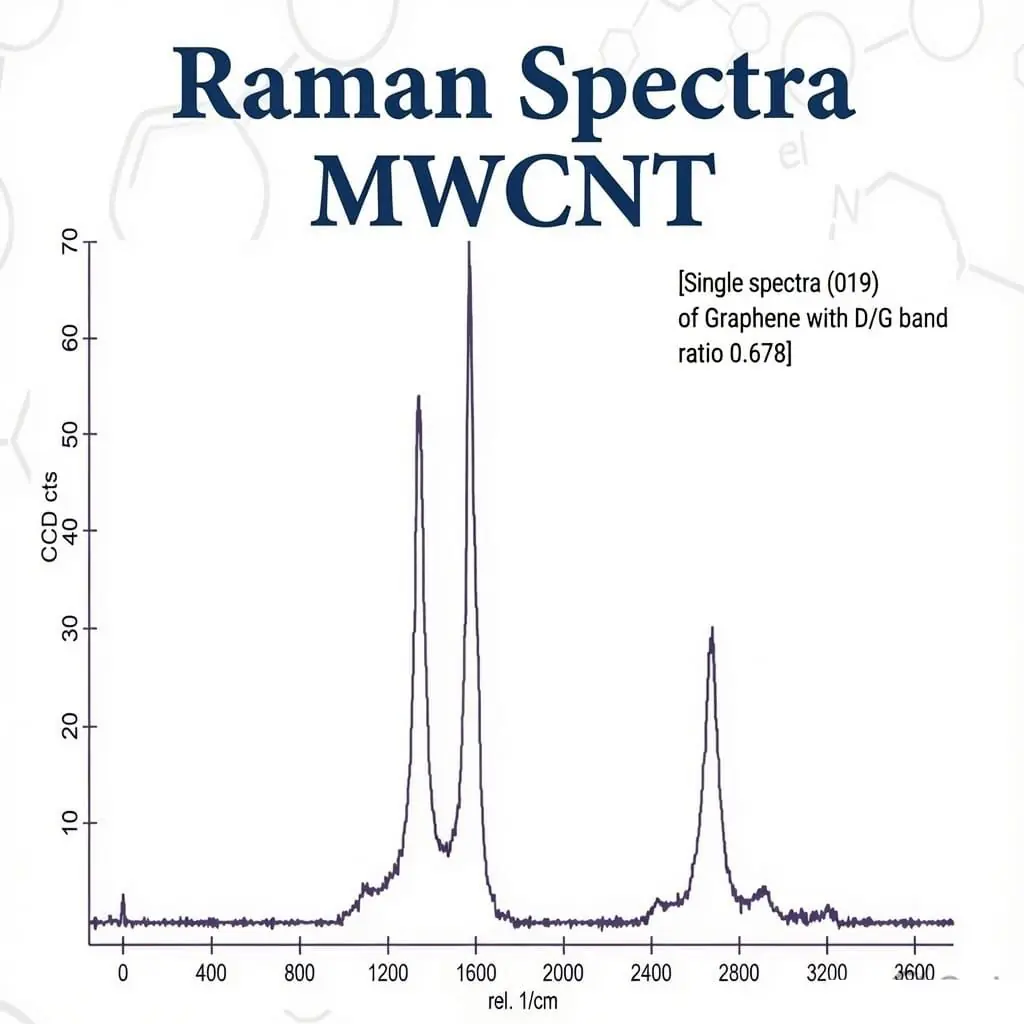
The D band
In carbon materials, the D band is commonly associated with disorder, defects or features that activate a Raman response beyond the ideal graphitic lattice. The D-band intensity can be influenced by edges, structural defects, functional groups and the material’s overall carbon structure. Its interpretation depends on the type of carbon material and measurement conditions.
The G band
The G band is associated with in-plane vibrations of sp²-bonded carbon. It is a key feature in Raman spectra of graphitic materials and is often considered when evaluating carbon nanotubes. The shape, position and intensity of the band can provide clues about the carbon bonding environment, but should be interpreted with suitable reference information.
What is the D-to-G intensity ratio?
Researchers sometimes calculate an intensity ratio between the D and G bands, often written as I(D)/I(G). This ratio can be used as one indicator of disorder or defect-related contributions. It is not a universal stand-alone quality score: laser wavelength, baseline correction, peak fitting, sample preparation, instrument settings and the specific carbon structure can affect the result. Comparisons are most meaningful when measurement and analysis protocols are consistent.
What a Raman spectrum cannot tell you by itself
A Raman spectrum does not independently prove every specification listed on a product page. It should not be treated as a direct substitute for a purity test, metal-impurity analysis, surface-area measurement, dimensional analysis or a dispersion assessment. For a complete evaluation, ask which properties were measured, which instruments and methods were used, and whether the supplied spectrum is representative of the lot being purchased.
Important: the screenshot contains a Raman Spectra thumbnail, not a full-resolution analytical report. No numerical peak positions, D/G ratio or pass/fail conclusion are asserted here because those values cannot be reliably read from the supplied preview.
Animated 3D Concept: The Multi-Walled Structure
The animated illustration below is a conceptual visual that represents concentric nanotube walls. It is intended for explanation, not as a microscopy image or a measured structural model. The actual geometry of a particular grade should be confirmed using its technical characterization.
Why the structure matters
Multiple concentric carbon walls create a distinct structure that can influence electrical, thermal and mechanical behaviour. In a formulated material, however, the observed performance depends on far more than the isolated nanotube. The quality of the interface between nanotube and matrix, the presence of agglomerates, the processing history and the distribution of nanotubes can be decisive.
Potential Applications of MWCNT Powder
MWCNTs are researched across a range of advanced-material applications. The examples below describe areas where carbon nanotubes may be evaluated; they are not guarantees that this specific grade has been validated for every use case. Application testing and supplier consultation are essential before making a performance claim.
Conductive polymers and plastics
Carbon nanotubes may be incorporated into polymers to help create electrically functional compounds. Researchers assess loading, dispersion, processing conditions, resistivity targets and the mechanical properties of the final compound. A conductive pathway may require careful control of the nanotube network and the polymer formulation.
Functional coatings
Nanotubes may be studied in coating systems where conductivity, antistatic behaviour or other functional characteristics are required. The coating’s binder, film thickness, curing conditions and substrate compatibility must be considered. The final result depends on the complete formulation, not only the presence of MWCNTs.
Energy-related research
Carbon nanomaterials are studied in electrodes, conductive additives and components for energy storage and conversion. Suitability depends on electrochemical requirements, purity, surface chemistry, processing, stability and the performance of the complete cell or device. A powder specification alone is not proof of device-level performance.
Composite materials
MWCNTs can be evaluated as additives in composite systems where researchers want to influence stiffness, strength, conductivity or thermal response. The result depends on loading level, interfacial adhesion, orientation, dispersion and manufacturing technique. Small-scale trials help identify trade-offs before scale-up.
Sensor and research platforms
Because carbon nanotubes can respond to changes in their environment, they are explored in sensor concepts and laboratory research. Sensor response depends on the functionalization, device architecture, contacts, target analyte and test environment. Dedicated validation is required for sensitivity, selectivity and repeatability.
Thermal management and interfaces
Carbon nanomaterials are investigated in some thermal-management and interface formulations. Heat transfer through a finished system depends on the network, orientation, contact resistance, binder and manufacturing process. Thermal conductivity should be measured on the actual formulated sample where it matters.
Dispersion: Turning Powder into a Functional Formulation
One of the most important steps in working with MWCNTs is achieving a dispersion appropriate for the intended application. As supplied, a dry powder can contain bundles or agglomerates. If those structures remain in the finished material, they can create inconsistent properties, visible defects or localised regions with different performance.
Dispersion strategy depends on the formulation. Researchers may investigate mechanical mixing, high-shear mixing, ultrasonication or other approaches, but the best method depends on the solvent or matrix, desired nanotube length, energy input and scale. Excessive processing can shorten nanotubes or alter the material, while insufficient processing can leave agglomerates. A process window should therefore be established experimentally.
Wetting and compatibility matter as well. A nanotube surface may interact differently with water-based systems, organic solvents, resins and thermoplastic melts. Surface modification or dispersing aids can sometimes help, but they may also affect electrical behaviour, stability or final product requirements. Always assess the whole formulation and verify that any processing aid is suitable for the intended use.
Practical dispersion questions
- What is the target matrix or carrier system?
- Is electrical conductivity, mechanical reinforcement, thermal behaviour or another property the primary objective?
- What loading range will be evaluated, and how will it be measured?
- What mixing equipment and energy input are available?
- How will dispersion quality and stability be assessed?
- Does processing cause unacceptable nanotube shortening or changes in the finished material?
- Can the laboratory process be transferred to the intended production scale?
Handling, Storage and Workplace Safety
Fine powders require appropriate handling controls. Avoid generating airborne dust, and do not assume that a carbon-based material is harmless simply because its main element is carbon. The relevant safety measures depend on the product’s safety data sheet, particle characteristics, work environment, quantity handled and local regulations.
Before opening or transferring a container, review the supplier’s current Safety Data Sheet (SDS), risk assessment and handling instructions. Use suitable containment and ventilation, follow the recommended personal protective equipment requirements, and establish procedures for spills, waste and cleaning. Avoid dry sweeping or other practices that could re-suspend fine powder unless specifically permitted by an approved procedure.
Store the material in its original, properly closed and labelled container under the conditions stated by the supplier. Protect it from contamination and moisture where relevant, and maintain traceability between the container, batch number and quality documentation. Do not transfer the material into an unlabelled container.
For industrial or laboratory use, the organisation handling the material should evaluate the actual exposure scenario rather than relying on general online advice. Follow applicable occupational-health requirements and obtain specialist safety guidance when needed.
How to Evaluate an MWCNT Supplier
Choosing a supplier is not only a question of comparing price per gram. A suitable supplier should be able to explain the specification, provide batch documentation, communicate packaging and handling requirements, and support the buyer’s technical qualification process.
- Request a current technical data sheet. Check that it identifies the grade and describes the reported properties and test methods.
- Request a batch-specific certificate of analysis. Confirm whether the data applies to the lot being offered and whether the key limits match your requirements.
- Review characterization coverage. Ask which methods support purity, dimensions, surface area, metal content and structural information.
- Discuss application fit. Share the matrix, process and target performance where possible, and ask whether the supplier can advise on a suitable evaluation pathway.
- Confirm pack size and handling information. Verify net quantity, packaging, storage instructions, lead time and shipment requirements.
- Run a controlled trial. Compare the material in your actual formulation against a defined baseline and record process conditions.
- Check repeatability. If the material will be used repeatedly, assess batch consistency and the supplier’s approach to quality control.
These checks help translate a technical product listing into a meaningful procurement decision. They also reduce the risk of selecting a material based on a single attractive specification that does not address the real application requirement.
Product Detail Access: Open the Live Listing
For the current product description, listed price, purchasing options and any additional gallery files, open the live product information page. The page can change over time, so use it as the source for current commercial information. The link below acts as a direct product-details access point rather than a QR scanner; visitors can click it to open the product page in a new tab.
Explore MWCNT Pure Powder
Review the product listing and contact the supplier for current technical documents, batch details and application-related questions.
If you intended a QR-code scanner specifically, add a QR code that points to the same live product URL after uploading the article to WordPress. A QR code should be generated from the final URL and tested on a mobile device before publication.
Quality Checks Before Application Testing
A structured qualification plan helps establish whether an MWCNT grade is suitable for a specific project. Begin by defining the outcome that matters: electrical resistance, mechanical performance, thermal response, stability, processability or another measurable characteristic. A clear target prevents the project from becoming a general exercise in adding nanomaterial without a defined success criterion.
Next, document the baseline formulation and process. Record all relevant ingredients, mixing sequence, time, temperature, shear conditions, curing or drying conditions and sample geometry. Small changes in process can affect dispersion and make comparisons unreliable. Use replicate samples where practical and agree in advance on how results will be interpreted.
Characterization should match the question. Microscopy may help assess morphology and agglomeration; electrical testing may be relevant for conductive systems; thermal analysis may be appropriate for heat-related applications; and mechanical tests should reflect the intended use. Raman spectroscopy can provide structural information about the carbon material, but it should sit within a broader evidence package.
Finally, review repeatability and scale-up. A successful laboratory sample does not automatically translate to a production line. Mixing equipment, residence time, energy input, handling, filtration, curing and quality-control methods may all change at larger scale. Validate the process under representative conditions before making broad claims or committing to volume production.
Visual Roadmap: From Powder to Application Validation
This is a development workflow, not a claim about product sales, market growth or guaranteed performance.
From Material Selection to a Repeatable Development Workflow
Teams often begin an MWCNT project by asking whether a material is conductive, strong, light or thermally useful. These questions are understandable, but they are too broad to guide a reliable development programme. A better approach is to translate the business or research need into a measurable technical requirement. For example, a development team may need to reduce surface resistance in a polymer component, create a stable conductive coating, improve a composite’s performance at a defined loading, or investigate a new electrode formulation. Each goal calls for a different test plan.
The first stage is requirements definition. Document the substrate or matrix, operating environment, processing equipment, target performance, acceptable cost range and any restrictions on solvents, additives or handling. Include the properties that must not deteriorate. An additive that improves conductivity but makes a material too brittle, too viscous or difficult to manufacture may not be commercially suitable. The most useful result is a balanced performance profile rather than a single improved number.
The second stage is a materials review. Compare the available specification data with the requirements, and identify missing information before ordering. If the project depends on a narrow diameter distribution, specific residual-metal limits or a known surface chemistry, confirm those details with the supplier. Where the product page gives approximate values, clarify whether a range or a batch-specific result is available. Record all assumptions in the project file so that the team knows which characteristics have been confirmed and which still need verification.
The third stage is a controlled screening experiment. Prepare a baseline sample without the MWCNT additive and compare it with a planned series of samples containing different loadings or processing conditions. Change one major variable at a time wherever possible. This makes it easier to identify whether a result comes from the material concentration, mixing procedure, matrix composition or another factor. Record the order of addition, mixing time, equipment, temperature and any signs of agglomeration or instability.
The fourth stage is validation. Repeat promising formulations and test them using methods relevant to the final application. If the target is electrical performance, measure electrical properties using a consistent sample geometry and conditioning procedure. If the target is mechanical behaviour, use a recognised method appropriate to the material and intended service conditions. If stability is important, assess the formulation over a relevant period and under representative storage or environmental conditions. The method and acceptance criteria should be decided before testing, not after seeing the results.
The fifth stage is process transfer. A laboratory protocol is a starting point, not a guarantee that the same outcome will occur in larger equipment. Scale-up can change shear forces, mixing efficiency, residence time, heat generation, material transfer and exposure controls. A scale-up plan should identify the process parameters that are critical to product quality and define how they will be monitored. A successful transition includes both performance checks and a practical review of handling, safety, cost and production repeatability.
Documentation that supports a better decision
- A written performance target and a clear baseline formulation.
- A current technical data sheet and batch-specific quality documentation.
- A record of sample preparation and processing conditions.
- Test methods, raw results, repeat measurements and acceptance criteria.
- A note of any observed handling, dispersion or stability issues.
- A scale-up assessment that identifies process risks and quality controls.
This workflow turns a product enquiry into a traceable development activity. It also helps purchasing, research, engineering and production teams communicate using the same requirements and evidence.
Interpreting Specifications Without Overstating Them
Technical product pages are useful for screening potential materials, but specification statements should be interpreted carefully. A value may represent a typical result, a maximum limit, a minimum limit or an approximate dimension. Those terms are not equivalent. A statement such as “approximately 20 nm” is different from a defined acceptance range, while “less than 1.5%” communicates an upper limit rather than an exact result. When comparing suppliers, align the meaning of the values before comparing the numbers themselves.
It is also useful to distinguish between intrinsic material characteristics and performance in a formulation. Surface area, nanotube dimensions and reported impurity levels describe aspects of the supplied powder. Electrical resistance, coating durability, composite strength or device performance are outcomes measured in a particular system. The former may influence the latter, but they do not determine the final result on their own. A claim about an application should therefore be supported by test data from that application or from a closely relevant system.
Measurement methods matter because different techniques answer different questions. Microscopy can reveal local morphology, but an image may represent only a small part of a sample. Surface-area analysis provides a different kind of information from spectroscopy. Elemental analysis can help quantify particular impurities, while Raman spectroscopy provides information related to carbon structure. No single measurement should be expected to describe every aspect of a complex nanomaterial.
Sample preparation also affects the quality of evidence. A poorly dispersed sample may appear different from a well-dispersed sample under microscopy, and Raman measurements can vary with sample form, laser conditions and analysis choices. Good documentation identifies the test method and conditions sufficiently for an informed reader to understand the scope and limitations of the result. For critical applications, independent verification or an agreed qualification procedure may be appropriate.
When a specification is unclear, ask a focused question. For example: Is the purity value based on a stated analytical method? Does the diameter refer to an average, a typical value or a measured range? Is the surface area reported for the supplied lot? Are residual metals reported as a total or by element? Can the supplier provide a high-resolution Raman spectrum with test conditions? These questions make technical discussions more productive and reduce the risk of treating a short listing as a complete characterization dossier.
Commercial Considerations: Cost, Consistency and Supply
The lowest purchase price is not always the lowest total cost. In a nanomaterial project, the overall cost can include powder price, shipping, handling controls, formulation ingredients, mixing time, quality testing, rejected batches and the cost of adapting the production process. A grade that is easy to incorporate and produces consistent results may offer a more practical solution than a lower-priced option that requires extensive reformulation. Total cost should be assessed against the performance target and the scale at which the product will be manufactured.
Pack size is another practical factor. A 10 g pack can be useful for early screening, laboratory evaluation or small formulation trials. A larger production requirement may call for a different package format, lead time and supply arrangement. Before moving from a small trial to repeat purchases, confirm the supplier’s available quantities, packaging, batch traceability, shipping conditions and expected replenishment timeline. These details are especially important when a customer product depends on a consistent material input.
Consistency between batches is central to repeatability. Even when headline specifications remain similar, changes in dimensions, agglomeration, residual catalyst content or surface characteristics may affect a formulation. For this reason, teams should retain the lot identification and test records associated with successful trials. When the project becomes commercial, agree on which properties are critical, what documentation will accompany each batch, and how a deviation will be communicated and managed.
Supply planning should also include appropriate storage and inventory controls. Keep product identification intact, track opening dates where relevant, and follow the supplier’s storage instructions. Establish a process for checking container condition and documentation at receipt. These measures help protect traceability and reduce the chance that an unverified or incorrectly identified material enters a development or manufacturing process.
Finally, discuss technical support early. A supplier may be able to clarify specifications, share characterization documents or advise on evaluation options, but the customer remains responsible for determining suitability in its own process. Clearly explain the target application and the information required. A focused technical exchange can save time by identifying mismatches before the material is introduced into a larger experiment.
Responsible Communication of Nanomaterial Performance
Advanced materials are often described using ambitious language, but responsible technical communication separates potential from demonstrated performance. It is reasonable to say that MWCNTs are studied for conductive composites or functional coatings. It is not reasonable to conclude that every formulation containing MWCNTs will automatically deliver a particular conductivity, strength, durability or efficiency improvement. Those outcomes depend on material grade, concentration, processing, product design and test conditions.
When preparing a technical report or product description, specify the conditions under which a result was obtained. Include the formulation, specimen preparation, measurement method and relevant comparison wherever practical. Avoid presenting laboratory observations as universal performance guarantees. If a result is preliminary, label it as preliminary. If a value comes from a supplier specification, identify it as a reported specification and verify that it applies to the current grade or batch.
Images should also be described accurately. A conceptual 3D illustration can help explain concentric nanotube walls, but it should not be labelled as an actual microscopic image. A small Raman preview can show the kind of characterization included in a product gallery, but it should not be used to claim a specific D/G ratio unless the original data supports that interpretation. This distinction protects readers and helps technical teams maintain credibility.
Clear communication is especially important when the audience includes researchers, procurement teams, manufacturing engineers and customers. Each group needs enough information to make a sound decision, but no group benefits from unsupported certainty. Present the known facts, explain the limits of the available data and identify the next verification step. That approach supports a stronger relationship between supplier, developer and end user.
Frequently Asked Questions
What does MWCNT stand for?
MWCNT stands for Multi-Walled Carbon Nanotube. It describes a carbon nanotube structure with multiple concentric tubular walls.
What is the listed pack size of this product?
The supplied product-page screenshot lists MWCNT Pure Powder in a 10 g pack. Check the live listing to confirm the current pack size and availability.
What purity is listed for the product?
The product page reports greater than 99% CNT purity. For procurement or qualification, request the current technical data sheet and batch-specific certificate of analysis, including the test method used.
Why is Raman spectroscopy relevant to carbon nanotubes?
Raman spectroscopy can help characterise carbon structure and disorder-related features. It is valuable when interpreted with suitable test conditions and complementary analytical methods.
Does the Raman image prove the product’s purity?
No. A Raman spectrum alone does not prove every listed specification. Purity, dimensions, metal impurities, surface area and other properties may require different methods or supporting documentation.
Can MWCNTs be added to any polymer or coating?
No. Compatibility depends on the matrix, processing method, target performance and dispersion strategy. Laboratory trials are necessary to determine whether a grade and formulation are suitable.
What should I ask for before ordering?
Request the current technical data sheet, batch certificate of analysis, safety data sheet, test-method information, storage and handling guidance, pack-size confirmation and any application support relevant to your project.
Where can I view the product details?
Use the “View Product Details” link in this article to open the BTCORP Generique Nano Pvt Ltd. MWCNT Pure Powder listing. The product page is the best place to check current commercial details.
Conclusion: Match Material Data to Real-World Performance
Multi-Walled Carbon Nanotubes are a versatile class of advanced carbon nanomaterials with potential roles in conductive systems, coatings, composites, energy-related research and other engineered materials. Their value comes not simply from being nanoscale, but from how their structure and surface interact with the rest of a formulation and how consistently the material can be processed.
The BTCORP Generique Nano Pvt Ltd. MWCNT Pure Powder listing provides a starting point for evaluation, with reported values for CNT purity, approximate dimensions, surface area, bulk density, metal impurities and amorphous carbon. Those figures should be treated as product-page specifications to verify through current supplier documentation, particularly when the material is intended for technical qualification or repeat production.
Raman spectroscopy can contribute useful evidence about carbon structure, but it is most informative as part of a wider characterization programme. Similarly, an application claim should be supported by controlled testing of the actual formulation under representative conditions. Good dispersion, safe handling, repeatable processing and reliable documentation all play a role in converting a nanomaterial into a useful product.
For researchers, engineers and product developers, the next step is practical: define the target performance, review the full documentation, run a controlled trial and verify the results. Use the live product page for current listing details and contact the supplier when further technical information is needed.
Start with the product listing
MWCNT Pure Powder · Multi-Walled Carbon Nanotubes · 10 g listed pack
Brand clarification: MWCNT, graphene and other chemical powders discussed in this context are manufactured by BTCORP Generique Nano Pvt Ltd. under the Generique name and have no separate product brand. They are not ARMI-branded products.
Editorial note: This article is educational and summarizes the product-page information supplied for drafting. It is not a certificate of analysis, safety data sheet, regulatory approval or guarantee of application performance. Verify all technical and commercial details with the supplier before use.