
Advanced Molecular Surface Architecture:
Engineering High-Performance Substrates via Graphene-Polysilane Ceramic Nanocomposites
A pristine academic layout dedicated to high-performance substrate engineering, molecular bonding analysis, and advanced preceramic polymer research.
Thermodynamic Instability of Untreated Vitrified and Metallic Interfaces
Classical material maintenance across commercial, architectural, and industrial sectors is fundamentally reactive. Traditional mechanical cleaning protocols, abrasive chemical polishes, and temporary organic waxes treat only the macroscopic symptoms of surface contamination rather than mitigating the thermodynamic root cause.
At the micro- and nanoscale, mechanically finished structural substrates—including sodalime float glass, vitrified porcelain ceramics, anodized aluminum, and austenitic stainless steels—exhibit inherent surface roughness characterized by microscopic peaks (asperities) and valleys (void channels). Understanding this microtopography is vital for engineering long-term asset protection.
Microscopic Topography & Capillary Traps
When these structural substrates encounter environmental stressors, their atomic landscape creates aggressive points of failure:
Comparative Breakdown: Traditional Maintenance vs. Molecular Modification
| Parameter | Conventional Cleaners & Waxes | Standard Commercial Sealants | ARMI® Graphene Nanocomposite |
|---|---|---|---|
| Interfacial Mechanism | Sacrificial layer deposition | Temporary polymer film | Permanent Covalent Molecular Bond |
| Pore Penetration | Superficial covering (leaves voids open) | Partial physical blocking | Complete Nanoscale Interstitial Sealing |
| Contaminant Adhesion | High mechanical anchoring | Moderate adhesive grip | Near-Zero Adhesion (Self-Cleaning) |
| Operational Lifespan | Days to Weeks | 3 to 6 Months | 3 to 5 Years Functional Durability |
Interfacial Energy & Surface Resistance Index
Quantifying the transition from high-energy reactive degradation to low-energy ARMI® nano-shielding stability:
ARMI® Glass Nano Coating fundamentally redefines structural maintenance by replacing temporary sacrificial layers with a permanent, covalently bound, graphene-polysilane ceramic nanocomposite. This deep molecular modification alters interfacial surface energy, maximizes liquid contact angles, and provides robust mechanical resistance across a 3 to 5-year operational lifecycle.
2. The Tri-Matrix Nano-Pillar Architecture: Synthesis and Covalent Integration
To achieve long-term durability under aggressive thermal cycling, high-pressure liquid impingement, and concentrated chemical exposure, ARMI® utilizes a multi-component hybrid matrix. Standard silicone sealants rely on weak Van der Waals interactions that easily break down under hydrolytic attack.
In contrast, the ARMI® formulation synthesizes three distinct technological pillars into a unified, cross-linked 3D grid engineered for permanent covalent bonding and extreme environmental stability across demanding commercial and industrial lifecycles.
The Three Core Technological Pillars
Exploring the molecular engineering framework that powers the hybrid graphene-polysilane ceramic network:
- Void Channel Filling: Graphene platelets bridge microscopic surface defects.
- Thermal Shock Mitigation: High in-plane thermal conductivity prevents delamination.
- Anti-Static Discharge: Minimizes electrostatic dust and particulate attraction.
- Covalent Silicon-Oxygen Linkages: Permanent molecular bonds resistant to hydrolysis.
- 3D Cross-Linking: Dense polymer network blocking ionic diffusion.
- Interfacial Elasticity: Absorbs mechanical shear stresses without micro-cracking.
- Extreme Mohs Hardness (9H+): Defends against scratching and abrasive wear.
- Chemical Inertness: Immune to aggressive alkalis and acidic descalers.
- UV Radiation Stability: Blocks photo-oxidation and solar yellowing.
Comparative Performance Matrix Across Hybrid Pillars
| Architectural Pillar | Core Material Chemistry | Primary Protective Function | Operational Benefit |
|---|---|---|---|
| Pillar 01 | sp²-Hybridized Graphene Carbon Lattice | Micro-fracture suppression & thermal dissipation | Enhanced tensile strength & anti-static performance |
| Pillar 02 | Polysilane Functional Chains | Covalent Si-O bridge building | Permanent substrate anchoring & hydrolytic resistance |
| Pillar 03 | Ultra-Pure $SiO_2$ & Metal Oxide Clusters | Rigid exterior shell formation | 9H+ scratch resistance & UV radiation defense |
Structural Integrity & Resistance Metrics
Quantifying the structural resilience of ARMI®’s Tri-Matrix integration against conventional sealants:
By integrating graphene nanocarbon reinforcement, polysilane covalent anchoring, and ceramic $SiO_2$ nanotechnology into a unified matrix, ARMI® successfully eliminates the vulnerability of weak intermolecular forces, providing robust multi-year protection across demanding industrial environments.
3. Surface Physics & Wetting Control: Fluid Dynamics and Contact Angle Mechanics
The primary operational benefit of ARMI® is its extreme surface-energy modification, governed by fundamental thermodynamic wetting mechanics and Young’s equilibrium equation. When liquid interfaces meet solid boundaries, molecular forces dictate whether droplets spread out or retain spherical integrity.
Where γsv = solid-vapor tension, γsl = solid-liquid tension, γlv = liquid-vapor interfacial tension, and θ = contact angle.
By engineering the solid-vapor interfacial energy (γsv) downwards through specialized fluoropolymer and ceramic nanomatrices, ARMI® drastically reduces adhesive forces. Consequently, the equilibrium contact angle (θ) shifts from acute angles to highly obtuse configurations, preventing molecules from anchoring to the substrate.
Super-Hydrophobic Behaviour & Cassie-Baxter State Mechanics
On standard untreated glass or metal substrates, water exhibits a low contact angle (θ ≈ 30° to 45°). This causes water to spread into a continuous high-energy film that maximizes solid-liquid contact area. As the water evaporates, dissolved calcium, magnesium, and silica ions precipitate directly into the microscopic pores, forming stubborn hard water scales.
By restructuring the surface energy, ARMI® elevates the water contact angle beyond 115°+, inducing a transition into the Cassie-Baxter wetting state. Liquid droplets rest on microscopic air cushions trapped within the nanostructure, minimizing contact area and maximizing internal droplet cohesion.
- Low Contact Angle (~35°)
- High Adhesion & Mineral Scaling
- High Contact Angle (>115°)
- Spherical Beading & Self-Cleaning
Dynamic Self-Cleaning Mechanics
When spherical water droplets roll freely across an inclined ARMI®-treated surface, their high rolling velocity creates a localized hydrodynamic drag force. This force captures loose particulate matter, organic greases, and atmospheric soot, sweeping them off the substrate without requiring caustic chemical detergents or manual scrubbing labor.
Live Chemical Reaction & Contact Angle Simulator
4. Comparative Substrate Performance Metrics
To evaluate the engineering superiority of ARMI® Glass Nano Coating, experimental performance parameters are benchmarked against traditional maintenance methodologies below:
| Performance Metric | Conventional Polish / Wax | Standard Commercial Sealants | ARMI® Glass Nano Coating |
|---|---|---|---|
| Interfacial Bond Type | Physical Adsorption (Weak) | Weak Polymer Adhesion | Covalent Nano-Molecular Bond |
| Water Contact Angle | ∼ 60° – 75° | ∼ 85° – 95° | Extreme Super-Hydrophobic (>115°+) |
| Pencil Hardness (Mohs) | 2H – 3H | 4H – 5H | 9H+ Ultra-Dense Ceramic |
| Mineral & Stain Resistance | Poor (Pore absorption occurs) | Moderate (Fades under heat) | Superior Anti-Stain & Anti-Limescale |
| Functional Lifespan | Days to Weeks | 3 to 6 Months | 3 to 5 Years (Operational Dependent) |
| Maintenance Impact | High Labor / Daily Scrubbing | Moderate Maintenance | >85% Reduction in Cleaning Effort |
5. Multi-Substrate Versatility & Interfacial Chemistry
Although designated as a glass nano coating, the thermodynamic bonding capability of ARMI® extends universally across diverse industrial materials:
A. Sodalime & Architectural Glass Substrates
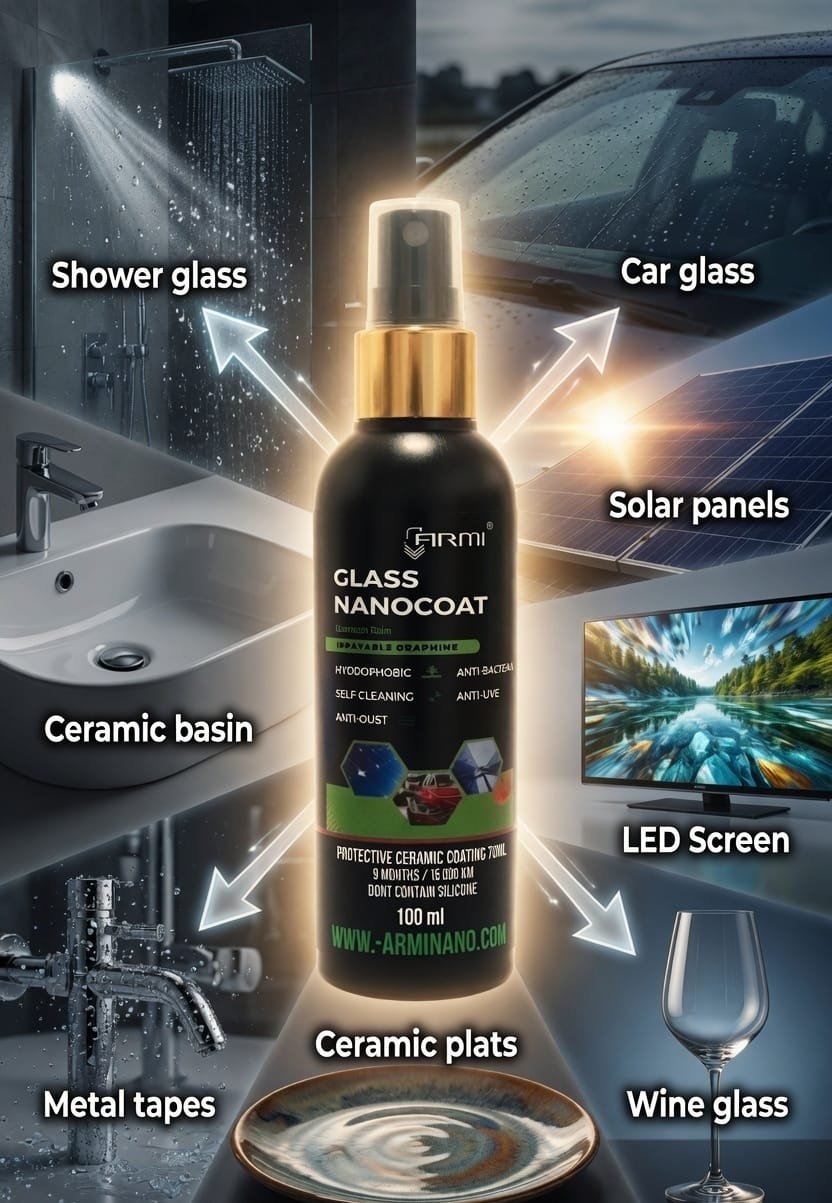
Applications: Luxury architectural curtain walls, skyscraper glazing, automotive windshields, hotel shower partitions, and optical glassware.
Mechanism: Covalent bonding with surface silanol (Si-OH) groups, eliminating micro-cracks and preventing alkaline leaching and hard-water silica etching.
B. Vitrified & Glazed Ceramic Substrates
Applications: Commercial sanitaryware, washbasins, high-end tableware, ceramic dinner plates, and architectural tiles.
Mechanism: Fills microporous pinholes in porcelain glazes, stopping organic food acids, tannins (tea and coffee), and bacterial biofilms from embedding in the ceramic body.
C. Metallic Substrates (Stainless Steel, Anodized Aluminum, Chrome)
Applications: Architectural metal accents, commercial kitchen fixtures, and marine hardware.
Mechanism: Forms an oxygen-impermeable barrier that prevents atmospheric oxidation, galvanic corrosion, fingerprints, and oil smudging while preserving metallic luster.
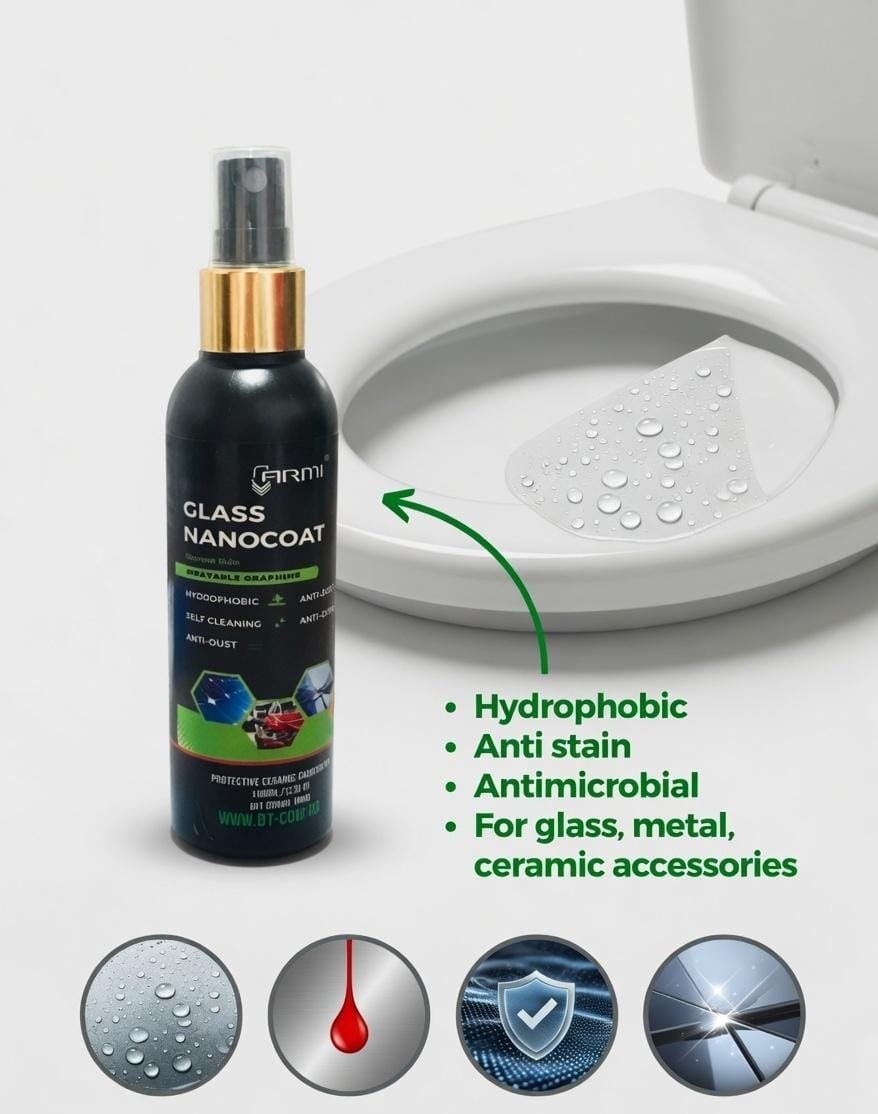
Cross-sectional visualization demonstrating covalent nanolayer bonding across architectural glass and ceramic substrates.
Engineering Summary
By uniting Cassie-Baxter thermodynamics with robust nanoscale covalent coatings, ARMI® provides an impenetrable shield against weathering, scaling, and organic pollutants across glass, ceramic, and metal infrastructures.
6. Eight Critical Determinants of Nano-Coating Longevity
While ARMI® delivers a functional lifespan of 3 to 5 years, real-world durability is governed by strict physical and chemical variables:
Substrate Porosity & Initial Purity: The presence of factory defects or residual casting oils.
Surface Decontamination Protocol: Efficiency of pre-application degreasing, solvent wiping, and mineral stripping.
Curing Kinetics: Compliance with ambient atmospheric humidity and thermal curing time parameters.
Uncropped Real-World Water Repellency & Beading Test
Mechanical Abrasion Profiles
Frequency of physical wiping, stacking friction, and high-velocity particulate impact.
Detergent Chemistry (pH Spectrum)
Exposure limits to highly caustic industrial degreasers or concentrated hydrofluoric/muriatic acid descalers.
Washing Frequency
Daily cycle intensity in high-temperature commercial dishwashing units.
Thermal Shock Extremes
Magnitude of temperature delta between thermal sterilization and cold rinses.
Environmental Microclimate
Cumulative Ultraviolet index, ambient humidity, and saline or particulate concentration.
Durability & Performance Metrics
Resistance & Longevity Index (%)
Specification Analysis
| Determinant / Parameter | Standard Unsealed | ARMI® Coated |
|---|---|---|
| Functional Lifespan | Months | 3 to 5 Years |
| Chemical Resistance | Low (Acid Etching) | High (pH Protected) |
| Detergent Dependency | 100% (Daily Use) | Reduced by up to 70% |
7. Conclusion: The Preventative Maintenance Paradigm Shift
The integration of graphene, polysilane chemistry, and high-density ceramic oxides into ARMI® Glass Nano Coating provides a definitive transition from reactive maintenance to permanent preventative asset protection. By sealing microscopic porosity at the atomic scale, commercial enterprises, hospitality operators, and industrial facilities achieve unprecedented operational optimization: reduced chemical detergent dependency, minimized labor expenditure, extended asset lifespans, and uncompromised optical clarity.
Retail Availability & Commercial Distribution:
- Available on Amazon and Flipkart for direct retail procurement.
- Bulk B2B supply, industrial distribution, and institutional procurement accessible via IndiaMART and the Official ARMI® Online Store managed by BTCorp Generique Nano Pvt. Ltd.
Direct Purchase & B2B Channels
Amazon India
Direct retail procurement with fast home delivery.
Flipkart Store
Order genuine ARMI® glass nano coating spray.
IndiaMART (B2B)
Bulk B2B supply and industrial distribution.