
Revolutionizing Solar Efficiency: The Ultimate Introduction to Solar Panel Nanocoating
Explore how cutting-edge nanotechnology and advanced graphene formulations are transforming photovoltaic maintenance, maximizing energy yield, and protecting solar assets worldwide.
The Global Renewable Energy Frontier & The Contamination Crisis
Solar energy stands firmly as a cornerstone of the modern renewable energy revolution. Across vast residential rooftops and sprawling commercial solar utility farms, photovoltaic (PV) systems generate clean, sustainable power day after day. As the world accelerates its transition toward carbon neutrality, the reliance on solar technology has grown exponentially. However, property owners, facility managers, and solar plant operators consistently face a silent yet persistent adversary: environmental contamination.
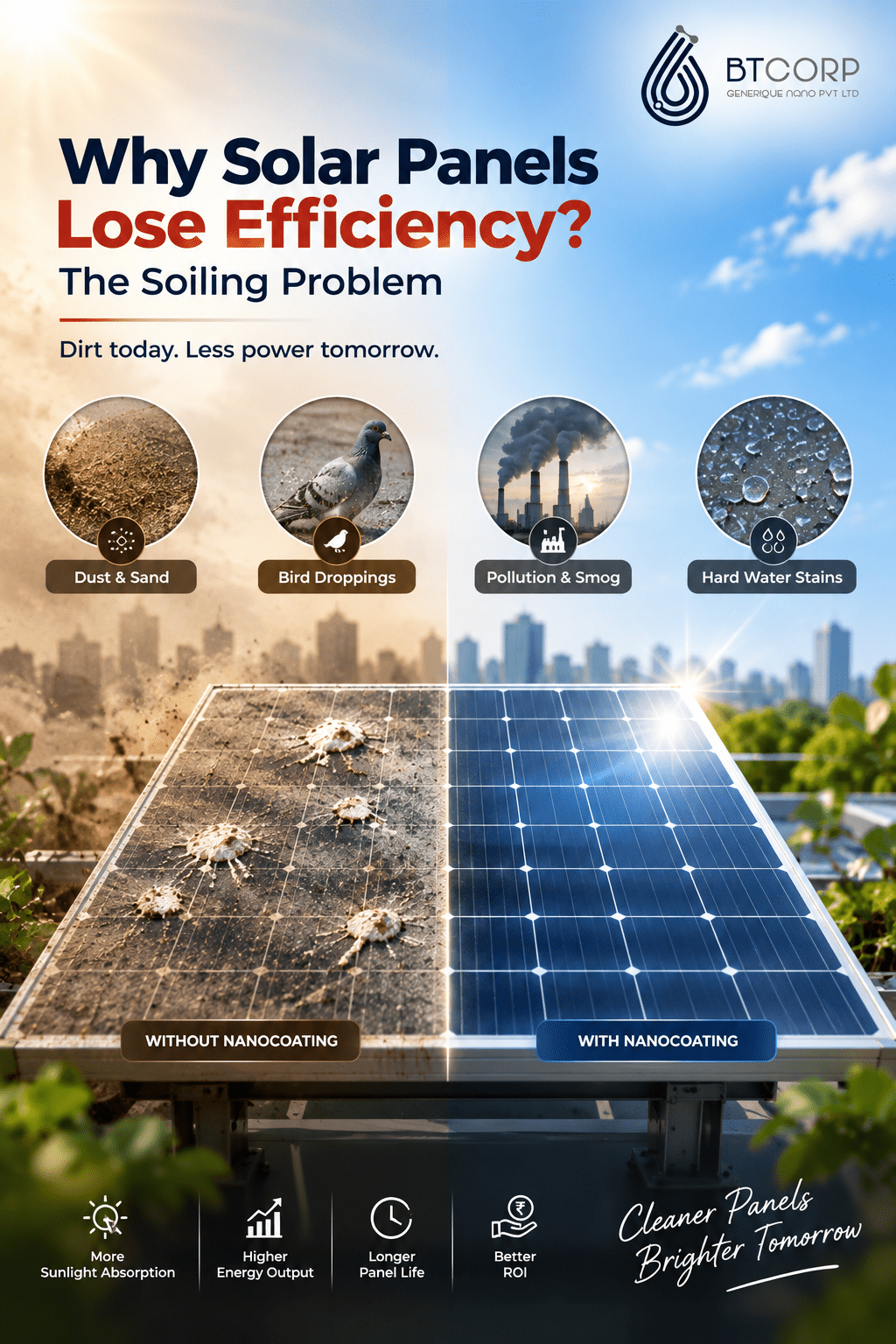
Day in and day out, photovoltaic modules are exposed to the open sky. In this outdoor environment, dust, airborne sand, bird droppings, stubborn pollen, industrial soot, agricultural residues, and hard water spots accumulate continuously on glass surfaces. This microscopic buildup creates an opaque barrier that blocks, scatters, and absorbs vital sunlight before it can ever reach the active silicon cells. The consequence is severe: a dramatic and compounding reduction in daily energy yields that directly impacts profitability.
Maximum Light Absorption
Eliminate microscopic refractive barriers to ensure 99% light transmittance and optimal photovoltaic performance year-round.
Self-Cleaning Hydrophobicity
Water droplets bead up instantly and roll off effortlessly, carrying away loose dust particles and mimicking the natural lotus effect.
Graphene-Enhanced Durability
Formulated with advanced nanoparticles and graphene to protect glass surfaces against harsh weathering, abrasion, and chemical etching.
Overcoming Traditional Maintenance Challenges
Historically, combating environmental soiling required frequent, grueling, and labor-intensive manual washings using massive amounts of water and chemical detergents. Traditional cleaning methods are not only expensive and operationally demanding, but they also introduce risks such as micro-scratching the delicate anti-reflective glass coatings on modern solar panels. Furthermore, in arid regions where water scarcity is a daily reality, hosing down solar arrays constantly is neither sustainable nor economically viable.
Enter solar panel nanocoating—an advanced protective technology engineered to entirely transform how solar assets are maintained. By leveraging the principles of nanotechnology and molecular engineering, these specialized liquid coatings create an ultra-thin, highly stable, hydrophobic, and self-cleaning layer over the glass. This layer dramatically alters surface tension, ensuring that contaminants find no foothold on the panel surface.
| Performance Metric | Standard Uncoated Panels | ARMI Nanocoated Panels |
|---|---|---|
| Surface Water Contact Angle | Low (30° – 45°) | Ultra-High (110°+) |
| Cleaning Frequency Required | Bi-weekly / Monthly | Semi-annually / Annually |
| Average Energy Loss (Soiling) | 15% to 30% | Under 2% |
| Chemical Detergent Requirement | Heavy chemical soaps needed | None (Light water rinse only) |
Navigating This Comprehensive Guide
As you read through this comprehensive guide, you will discover everything essential to mastering solar panel nanocoatings. We will dissect the underlying chemical mechanisms of how nanoparticles bond with glass pores, evaluate the immense financial returns on investment (ROI) for both residential and commercial scales, examine step-by-step application procedures, and demonstrate why integrating this breakthrough technology into your ongoing maintenance strategy is an absolute game-changer.
Whether you manage a multi-megawatt commercial solar installation or seek to optimize your home’s rooftop solar array, understanding and implementing nanocoating technology is your gateway to uncompromised energy efficiency and maximized financial returns.
Why Solar Panels Lose Efficiency: The Soiling Problem
To fully appreciate the immense financial and operational value of implementing a high-performance nanocoating asset strategy, one must first thoroughly understand the destructive physics and compounding economic toll of soiling loss. Solar photovoltaic (PV) modules are engineered to operate permanently outdoors, exposing them directly to the mercy of capricious environmental elements 365 days a year without active mechanical wipers.
Day in and day out, several aggressive, compounding atmospheric factors conspire to degrade their peak energy-generating potential:
- Dust, Sand, and Particulate Matter: Extremely prevalent in arid, desert, and agricultural regions, airborne mineral dust and fine sand settle continuously during stagnant air cycles, baking onto the glass to form a uniform light-scattering film.
- Bird Droppings & Organic Residues: Highly concentrated, acidic, and completely opaque, avian droppings create severe localized thermal “hot spots” that disrupt electrical circuit strings and permanently degrade underlying photovoltaic silicon cells.
- Industrial Pollution & Urban Smog: Modern metropolitan zones and industrial corridors produce heavy airborne soot, exhaust particulate, and chemical aerosols that form sticky films hardening under intense solar heat.
- Hard Water Mineral Scaling: Unpurified agricultural irrigation spray, chemical wash runoff, or evaporating rainwater leave behind hard calcium and magnesium mineral crusts that etch permanently into unprotected silicate glass.
Extensive empirical field research conducted across diverse global climates reveals that unmaintained solar arrays suffer persistent, recurring efficiency degradation ranging anywhere between 15% to 30%. In aggressive industrial belts or heavy dust storm regions, generation losses routinely exceed 50%.
This steady efficiency decay represents an invisible crisis for plant owners and residential homeowners alike. Without proactive nanotech intervention, energy output drops silently, undermining power purchase agreements (PPAs), inflating operational expenditure (OPEX), and accelerating physical wear across the infrastructure.
⚠️ Critical Industry Impact: Unchecked environmental soiling directly throttles power generation, cripples financial cash flows, extends equipment payback periods, and triggers premature micro-cracking and thermal damage across solar arrays.
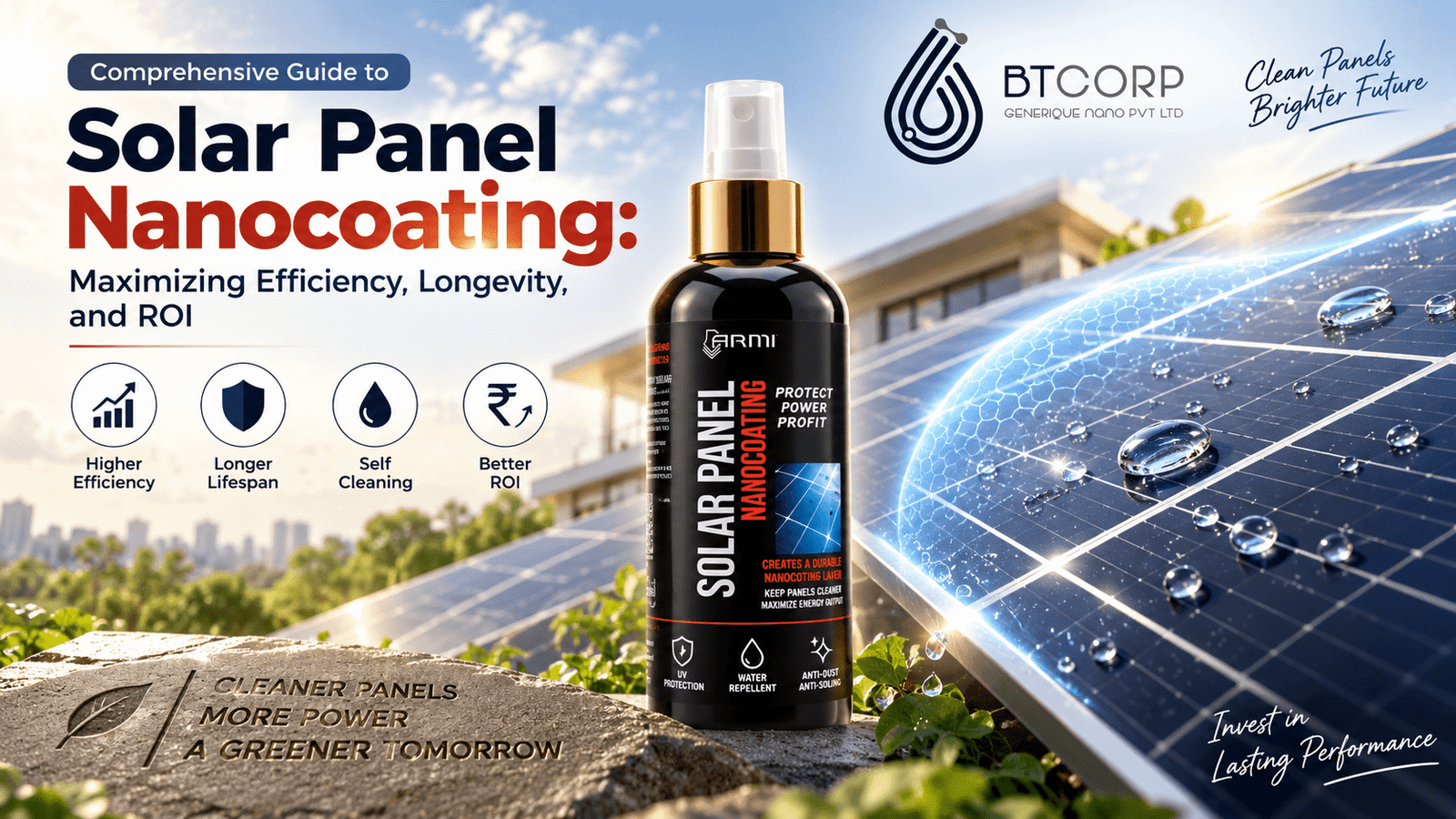
Protect and maximize the performance of your solar panels with ARMI® Solar Panel Nanocoating. This premium graphene-based transparent nano coating utilizes an advanced Graphene–Ceramic–Polysilane Nano Matrix to form an ultra-thin, durable protective layer that repels dust, dirt, water, bird droppings, pollution, and environmental contaminants while maintaining exceptional optical clarity for maximum solar energy generation.
Ideal for homeowners, residential rooftop systems, solar enthusiasts, maintenance professionals, and small commercial installations.
PROTECT
- Protects against dust, pollution, bird droppings, UV radiation, moisture, oxidation, and weathering.
- Forms a transparent nano-barrier that safeguards the solar glass surface.
- Helps extend the operational life of photovoltaic panels.
POWER
- Maintains higher solar light transmission.
- Reduces efficiency losses caused by dust accumulation.
- Helps sustain optimum photovoltaic performance and energy generation.
PERFORM
- Self-cleaning nano technology with excellent hydrophobic water repellency.
- Significantly reduces cleaning frequency and maintenance overheads.
- Professional-grade long-lasting protection suited for all extreme weather conditions.
How Solar Panel Nanocoating Works & The Mechanics of Action
The mechanics behind nanocoating rely heavily on advanced surface chemistry and molecular physics. Untreated solar glass, while appearing perfectly smooth to the naked eye, is actually full of microscopic peaks and valleys. Airborne dust particles, moisture, and organic matter lodge themselves tightly into these tiny crevices, making them extremely difficult to wash away naturally.
The proprietary Graphene–Ceramic–Polysilane Nano Matrix chemically and physically bonds with the glass surface, creating a transparent cross-linked nano-network that repels water, dust, and contaminants while protecting against ultraviolet (UV) exposure and environmental degradation.
Smoothing the Surface
Nanoparticles fill microscopic imperfections on the solar glass, creating an atomically smooth surface topography.
High Contact Angle
Water droplets hitting a nanocoated surface form a high contact angle (exceeding 110°), causing water to roll off effortlessly without leaving mineral trails.
The Self-Cleaning Effect
Rainwater or light rinsing rolls across the tilted surface, picking up accumulated dust and mimicking the natural lotus effect for effortless maintenance.
ARMI® Premium Ingredient System
Engineered with a state-of-the-art chemical composition designed for maximum environmental resistance and optical transmittance:
Compatible Photovoltaic Panel Technologies
ARMI® Solar Panel Nanocoating is universally formulated to provide seamless adhesion and long-lasting protection across all modern commercial and residential photovoltaic module types:
Key Benefits of Solar Panel Nanocoating
Investing in a high-grade nanocoating solution delivers a cascade of operational and financial advantages for both residential rooftop installations and large-scale commercial solar farms, ensuring maximum asset longevity and uncompromised energy generation.
Maximized Energy Yield & Efficiency
By keeping the glass surface continuously clear and free of refractive barriers, nanocoatings ensure maximum solar light absorption. Preventing dust and grime accumulation maintains optimal photovoltaic output, guaranteeing your system generates the maximum possible kilowatt-hours (kWh) daily.
Dramatic Reduction in Cleaning Costs
Traditional solar panel maintenance requires intensive manual labor, specialized brushes, and costly chemical shampoos or alkaline detergents. Nanocoatings slash cleaning expenses by up to 90%, transforming cleaning cycles into faster, easier routines that require little more than a light water rinse.
Protection Against Wear & Corrosion
Environmental pollutants, acid rain, bird droppings, and airborne salts can chemically etch untreated solar glass, permanently impairing its optical transmittance. Nanocoatings act as an impenetrable protective barrier against chemical degradation, surface abrasion, and weathering.
Extended Panel & System Lifespan
By actively shielding the photovoltaic glass surface from abrasive particulate matter and eliminating localized thermal hot spots caused by dirt accumulation, nanocoatings significantly enhance the structural integrity and operational lifespan of your solar investment.
Universal Compatibility Across All PV Technologies
Modern graphene-based nanocoatings are universally formulated to provide seamless molecular adhesion and long-lasting protection across all modern commercial and residential photovoltaic module types:
Application Guide: How to Apply Solar Panel Nanocoating
Applying a professional-grade solar panel nanocoating is a precise yet straightforward process. Following strict surface preparation and execution protocols is vital to ensure robust molecular bonding and multi-year durability.
Step 1: Surface Preparation & Cleaning
- Thoroughly wash solar panels to remove all existing dust, bird droppings, grease, and mineral deposits.
- Use pure water or a specialized pH-neutral cleaner. Avoid soapy residues.
- Ensure glass surfaces are completely dry and cool to touch. Never apply under scorching direct sunlight.
Step 2: Precise Application
- Spray the nanocoating liquid evenly across a manageable section of the photovoltaic panel surface.
- Alternatively, apply using a clean micro-fiber applicator pad for uniform distribution.
- Work in overlapping sections to guarantee complete, unbroken coverage without missing areas.
Step 3: Buffing & Curing Phase
- Gently buff the coated surface with a dry micro-fiber cloth until liquid haze vanishes and glass shines.
- Allow coating to cure undisturbed for the manufacturer-recommended duration (typically a few hours).
- Protect the treated panels from moisture exposure during the initial curing phase for optimal bond strength.
For commercial solar farms, industrial installations, and residential rooftop owners alike, maintenance overheads represent a significant recurring operational expense. Simultaneously, energy yield losses caused by environmental soiling directly undermine power purchase agreement (PPA) revenues and feed-in tariffs.
Lower Operational Expenditures (OPEX)
Cutting down grueling manual washing frequencies from monthly or bi-monthly schedules to just once or twice a year dramatically slashes labor overheads and water consumption expenses.
Recovered Power Generation Revenue
Recovering 5% to 15% in lost generation capacity translates directly into higher daily electricity yields, rapidly shortening the financial payback period of your nanocoating investment.
Frequently Asked Questions (FAQs)
Get expert answers to the most common queries regarding solar panel nanocoatings, product durability, application processes, and performance enhancements.
No, absolutely not. High-quality professional nanocoatings are optically transparent and engineered specifically to allow 99% or more of visible light to pass through directly to the underlying silicon solar cells. The ultra-thin molecular matrix is invisible to the human eye and does not cause any refractive barriers or light-blocking distortion.
Depending on environmental severity, regional weather patterns, and the grade of the product utilized, advanced graphene nanocoatings offer long-lasting durability. A single professional application typically protects solar panels effectively for up to 3 years or more, drastically reducing maintenance intervals compared to untreated glass.
Most consumer and commercial spray formulations, such as ARMI Solar Panel Nanocoating, are engineered for ease of use. They feature straightforward spray-on, wipe-off, and buff application methods that make them completely suitable for DIY residential homeowners, solar enthusiasts, as well as professional commercial maintenance crews.
Yes, but significantly less often—typically reducing washing frequency by up to 90%. While the self-cleaning hydrophobic effect handles light dust accumulation and natural rain rinsing effortlessly, extreme soiling environments, heavy industrial smog, or prolonged dry spells may occasionally require a quick, effortless water rinse to maintain maximum efficiency.
Conclusion: Secure Your Solar Investment Today
Solar panels represent a major financial and environmental investment designed to deliver clean power for decades. Leaving them vulnerable to continuous dust accumulation, bird droppings, hard water scaling, and industrial pollution means leaving valuable energy—and hard-earned money—on the table.
Solar panel nanocoating provides a scientifically advanced, cost-effective, and highly efficient solution to protect your photovoltaic assets, boost daily energy output, and minimize tiresome maintenance headaches. By forming an ultra-durable, hydrophobic, graphene-enhanced barrier, this cutting-edge technology ensures your solar system operates at peak performance year-round.
Ready to transform your solar panel efficiency and slash maintenance costs? Order your genuine ARMI® Solar Panel Nanocoating today from your preferred official platform below: