
Graphene Manufacturers In India: How Bulk Scaleis Revolutionizing Anti-Corrosion Paints &Industrial Coatings
The Industrial Anti-Corrosion Imperative
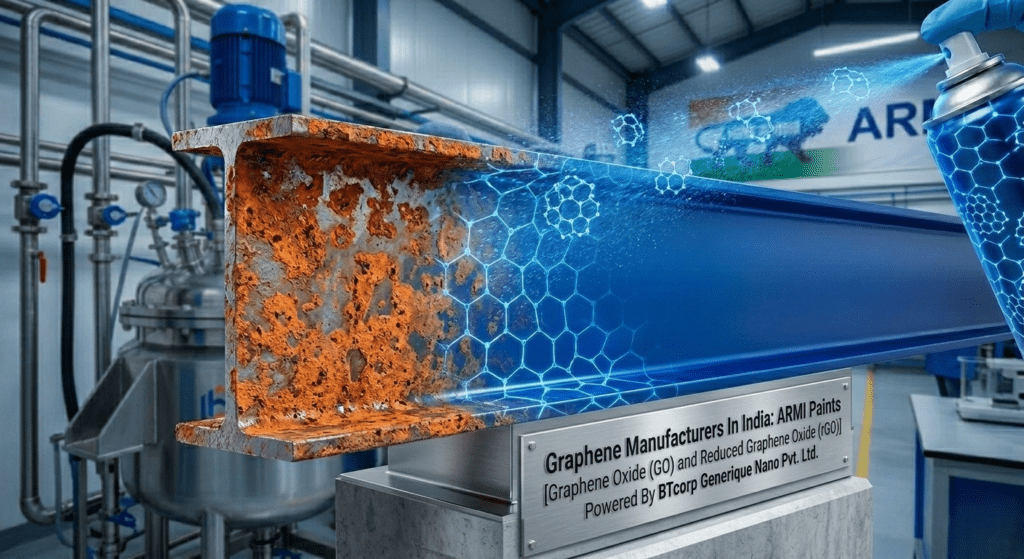
Graphene Manufacturers In India are spearheading a materials science revolution aimed at solving one of the most severe economic and structural liabilities globally. According to metrics validated by NACE International, the direct economic cost of metallic corrosion amounts to approximately 3.4% of the global Gross Domestic Product (GDP). This translation equates to trillions of dollars in annual asset depreciation, catastrophic infrastructural failures, unpredictable operational downtime, and hyper-frequent maintenance lifecycles across maritime, petrochemical, aerospace, and energy sectors.
The Limits of Conventional Barrier Frameworks
Traditional organic and inorganic polymeric protective coatings rely almost exclusively on physical barrier thick-film insulation or sacrificial metal mechanics, such as zinc-rich epoxy primers. However, these conventional industrial solutions suffer from inherent, deep-seated microstructural vulnerabilities. Among these are macro-porosity, molecular-level variations, intrinsic micro-cracks during curing, and accelerated chemical degradation when exposed to severe aggressive environments like marine splash zones, chemical processing facilities, and high-salinity infrastructure settings. Over time, corrosive ions compromise these coatings, leading to under-film corrosion and asset degradation.
The Nanotechnology Disruptive Shift
Nanotechnology, specifically the commercialization of two-dimensional (2D) allotropes of carbon, has introduced a disruptive paradigm shift. Graphene—a planar monolayer of $sp^2$-hybridized carbon atoms arranged tightly in a dense honeycomb crystal lattice—possesses unprecedented mechanical strength, structural flexibility, gas impermeability, and electrical conductivity. When integrated precisely into host polymeric coating frameworks, graphene functions at the microscopic quantum level to create a continuous molecular shield.
Historically, the deployment of graphene in industrial paints and protective coatings was strictly restricted to academic environments and low-volume premium laboratory formulations due to severe market constraints. These included exorbitant raw material costs, highly fragmented batch-to-batch inconsistencies, and a severe absence of localized bulk domestic manufacturing. This comprehensive whitepaper analyzes the deep technical, chemical, and economic evolution driving the shift to industrial-scale production. Centered on Indian manufacturing pioneers such as BTCORP Generique Nano Pvt. Ltd., we investigate how multi-metric-ton manufacturing capacities are radically altering the commercial feasibility, material economics, and performance baselines of anti-corrosion coatings globally.
2. Understanding Graphene’s Anti-Corrosion Mechanism: The “Tortuous Path” Paradigm
To understand why the expansion of bulk graphene availability via primary graphene manufacturers in India is transforming industrial paint formulations, it is crucial to analyze the atomic-scale transport mechanics governing corrosion propagation through polymeric matrices.
The Geometric Blocking Effect & Diffusion Mechanics
Standard epoxy, polyurethane (PU), or acrylic coatings act as passive, semi-permeable membranes. Over extended exposure durations, aggressive corrosive elements such as water vapor molecules ($H_2O$), dissolved oxygen ions ($O^{2-}$), and highly aggressive chloride ions ($Cl^-$) inevitably penetrate the polymer chain network. They migrate through microscopic voids, cracks, and intermolecular spaces. Upon reaching the metallic substrate surface, an electrochemical cell is established, accelerating oxidation, localized pitting, and subsequent coating delamination.
CONVENTIONAL COATING (Direct Penetration)
Corrosive Ions (H2O, Cl-, O2) ---> |  |  |  | ---> Metal Substrate (Rapid Corrosion)

GRAPHENE-INFUSED MATRIX (The Tortuous Path Labyrinth)
Corrosive Ions ---> [===]  ~  [===]  ~  [===]
                      |      |        |
                    [===]  ~  [===]  ~  [===] ---> (Diffusion Delayed Exponentially)
Graphene sheets present an extreme lateral aspect ratio (lateral dimensions versus single-atom thickness). When properly exfoliated and uniformly dispersed parallel to the substrate surface within a polymer, these two-dimensional, completely impermeable carbon sheets present an impenetrable physical wall to diffusing atoms and ions. Because a single pristine sheet of graphene is fundamentally impermeable to all gases under ambient conditions, corrosive molecules cannot pass directly through the nanosheet.
Instead, the presence of graphene forces the diffusing ions into an incredibly extended, labyrinthine, and winding trajectory—a phenomenon formally designated as the “Tortuous Path Effect.” The diffusion rate can be mathematically expressed through a relation of the effective diffusion path length:
$$L_{\text{effective}} = L_{\text{matrix}} \times (1 + \alpha \cdot \phi)$$
Where:
- $L_{\text{matrix}}$ represents the linear thickness of the pure polymer matrix layer.
- $\alpha$ represents the geometric aspect ratio of the graphene nanoplatelets ($\text{Lateral Diameter} / \text{Thickness}$).
- $\phi$ represents the volume fraction of well-dispersed graphene within the composite resin.
As the aspect ratio ($\alpha$) of graphene sheets reaches tens of thousands of units, even minimal volume loadings (ranging from 0.1 wt% to 1.0 wt%) escalate the effective diffusion distance exponentially. This delays the arrival of corrosive species at the underlying metal substrate by factors of ten to several hundred, effectively extending the lifespan of the asset.
💡 The Anodic Protection Paradox & Electrical Conductivity Mitigation
An inherent risk historically cited in academic literature involves graphene’s extreme native electrical conductivity. If a graphene-infused coating is mechanically scratched, exposing the bare steel substrate, a highly conductive network of pristine graphene could theoretically accelerate galvanic corrosion. It would act as a large cathode coupled to a small metallic anode.
Industrial bulk manufacturers resolve this critical paradox by using precisely functionalized variants—such as Graphene Oxide (GO) or surface-modified Reduced Graphene Oxide (rGO). By tuning the oxygen functional groups or applying non-conductive surfactant modifications, manufacturers ensure structural tortuosity without creating electrical percolation pathways. This decouples mechanical barrier protection from hazardous galvanic loops, ensuring long-term safe deployment.
3. The Technical Anatomy of Graphene Variants in Coatings
Industrial coating engineers do not utilize a generic “graphene” entity. Instead, specialized product grades are manufactured by leading industrial experts to fit specific chemical formulations, solvent environments, and mechanical stress criteria. If you are exploring procurement avenues, checking the detailed evaluation of a certified Graphene Supplier in India helps determine the right grade for specialized resin applications.
                         ┌───────────────────────────────┐
                         │   Industrial Graphene Grades  │
                         └───────────────┬───────────────┘
                                         │
         ┌───────────────────────────────┼───────────────────────────────┐
         ▼                               ▼                               ▼
┌─────────────────┐             ┌─────────────────┐             ┌─────────────────┐
│Pristine Powder  │             │ Graphene Oxide  │             │  Reduced GO     │
│ (Hydrophobic)   │             │  (Hydrophilic)  │             │   (Balanced)    │
└─────────────────┘             └─────────────────┘             └─────────────────┘
3.1 Pristine Graphene Powder & Nanoplatelets (GNPs)
Pristine graphene consists of multi-layer or single-layer carbon structures with zero or negligible oxygen content, maintaining structural and electronic integrity. Its surface chemistry is completely non-polar and hydrophobic. While offering elite mechanical strength and barrier traits, pristine powder requires specialized energy-intensive mechanical processing (high-shear mixing, bead milling, or three-roll milling) to avoid irreversible agglomeration caused by strong inter-planar van der Waals forces.
3.2 Graphene Oxide (GO)
Graphene Oxide is heavily functionalized with oxygen-containing groups such as hydroxyl (-OH), epoxy (-C-O-C-), and carboxyl (-COOH) moieties across its basal planes and edges. These polar functional groups make GO highly hydrophilic and remarkably dispersible in water-borne coating systems, eco-friendly laundry gels, and water-based industrial primers. B2B buyers looking for certified industrial testing batches can directly check out the verified listing for BTCORP Graphene Oxide on IndiaMART for immediate bulk commercial quotes.
3.3 Reduced Graphene Oxide (rGO)
Produced by chemically, thermally, or electrochemically reducing Graphene Oxide to remove a significant percentage of the oxygen functional groups, rGO balances the structural properties of pristine graphene with the processing flexibility of GO. Controlled reduction allows manufacturers to optimize the residual defect density, tailoring the material for applications requiring balanced electrical dissipation, UV stability, and barrier performance.
Performance Matrix Comparison
| Material Property / Parameter | Pristine Graphene Powder | Graphene Oxide (GO) | Reduced Graphene Oxide (rGO) |
| Oxygen Content (wt %) | < 1.5% | 35% – 48% | 4% – 12% |
| Primary Dispersion Medium | Non-polar solvents, Oils, Resins | Water, Polar Solvents (Deionized) | IPA, DMF, Organic Solvents |
| Primary Mechanism in Paints | Pure geometric barrier, scratch boost | Matrix cross-linking, polar adhesion | Tortuous path barrier, antistatic |
| Optimal Loading Range | 0.1% – 0.5% wt % | 0.2% – 1.0% wt % | 0.1% – 0.8% wt % |
| Dispersion Complexity | High (Requires high-shear equipment) | Low to Medium (Self-stabilizing) | Medium (Requires carrier fluids) |
4. The Indian Market Landscape: From Academic R&D to Industrial Bulk Capacity
For over a decade, India’s involvement in the advanced nanomaterials sector was confined to premium institutional research papers and small-scale, gram-level pilot lab productions. Coating manufacturers seeking to integrate nano-additives were forced to import materials from overseas suppliers at astronomical costs, which frequently exceeded $1,000 to $5,000 per kilogram for high-purity variants. This pricing structure made it economically impossible to formulate competitive, mass-market industrial paints.
The landscape shifted drastically with the emergence of forward-integrated Indian manufacturers who systematically cracked the industrial scalability code. Graphene Manufacturers In India, most notably BTCORP Generique Nano Pvt. Ltd. (operating since 2012), built domestic production infrastructures designed specifically for bulk volumes.
When evaluating project matrices, understanding the comprehensive Graphene Price per KG in India reveals how localized bulk production has successfully bridged the gap between raw lab materials and mass-scale commercial viability.
By establishing proprietary, patent-backed synthesis pathways utilizing high-grade natural vein graphite deposits, BTCORP successfully scaled manufacturing up to multi-metric-ton monthly capacities. This domestic scaling achieved three primary milestones for the paints and coatings market:
- Democratization of Pricing: Bulk synthesis reduced the industrial cost barriers of high-quality graphene variants down to commercially viable levels, making it viable for large-scale maritime, automotive, and infrastructure tenders.
- Batch-to-Batch Reproducibility: Large chemical reactors with automated process controls eliminate the variance in lateral sheet size and thickness distributions that plague small lab batches, ensuring paint manufacturers achieve predictable viscosities and dry-film thicknesses (DFT).
- Application-Ready Delivery Formats: Recognizing that paint factories are not equipped to process ultra-light, volatile nano-powders safely, domestic leaders introduced stable pre-dispersed liquid masterbatches and functionalized solvent concentrates.
📊 Salt Spray Corrosion Resistance Performance (ASTM B117)
- Standard Zinc-Rich Epoxy Primer: Failed at 450 Hours
- Competitor Standard GNP Paint Matrix: Failed at 750 Hours
- BTCORP ARMI® Graphene Engineered System: 1500+ Hours (No Degradation)
5. Case Study: ARMI® Advanced Nanocoatings and Finished Product Integration
The true validation of bulk-scale raw material engineering by graphene manufacturers in India lies in its forward integration into commercially available consumer and industrial end products. BTCORP’s flagship division, ARMI® (Advanced Research Material Intrics), serves as a premier case study of this progression. Rather than operating exclusively as an upstream chemical supplier, ARMI® translates nanomaterial performance directly into turnkey protection systems.
                      ┌─────────────────────────────────┐
                      │  BTCORP Bulk Graphene Synthesis │
                      └────────────────┬────────────────┘
                                       │
                                       ▼
                      ┌─────────────────────────────────┐
                      │    ARMI® Forward Integration    │
                      └────────────────┬────────────────┘
                                       │
         ┌─────────────────────────────┼─────────────────────────────┐
         ▼                             ▼                             ▼
┌─────────────────┐           ┌─────────────────┐           ┌─────────────────┐
│ Solar Panel Shield│         │ Glass & Hard Surface│       │100-Day Antimicrobial│
│  (Hydrophobic)  │           │  (9H Hardness)  │           │   (Nano Spray)  │
└─────────────────┘           └─────────────────┘           └─────────────────┘
5.1 ARMI® Graphene Ceramic Car Coating (D2C Launch)
For consumer automotive care, surface protection, and detailing markets, ARMI® has packaged its bulk anti-corrosion technology into an easy-to-apply premium solution. Automotive detailing centers, fleet owners, and enthusiasts can directly purchase the official retail formulation online through the ARMI Graphene Ceramic Coating on Amazon India to achieve maximum 9H slickness, hydrophobic water-beading, and shield-level environmental defense.
5.2 ARMI® Solar Panel Nano Coating
Photovoltaic assets suffer from rapid efficiency drop-offs due to environmental dust accumulation, industrial smog, and hard-water staining. By formulating a specialized aqueous graphene-ceramic fluid shield, ARMI® delivers an ultra-thin, highly translucent hydrophobic layer. The high surface energy ensures an active self-cleaning profile where rainwater encapsulates dust and sheets off effortlessly, maintaining maximum solar irradiance transmission and optimizing generation outputs.
5.3 ARMI® Glass & Surface-Protection Nanocoatings
Engineered for structural glass installations and multi-surface commercial properties, these formulations combine nano-silica matrices with specialized graphene fractions. This architecture achieves an optimized surface hardness scale (9H hardness profile), delivering extreme scratch resistance, UV stability, and gas barrier traits that eliminate sub-surface oxidization on high-end architectural fixtures.
6. Formulating with Graphene: Key Engineering Considerations for Paint Chemists
Integrating graphene into an industrial coating line requires careful optimization of liquid state chemistry. Industrial paint chemists must systematically address specific formulation parameters to achieve optimal performance and long-term storage stability:
6.1 Stabilization & Rheology Control
Because of their high specific surface area, graphene sheets dramatically alter the rheological profile of base resins. Improper integration can lead to rapid viscosity spikes, flocculation, or phase separation. Formulators must employ targeted wetting and dispersing additives—typically block copolymers with affinity groups designed for carbon structures—to stericly isolate the sheets and maintain long-term liquid shelf-life.
6.2 Curing Dynamics and Cross-Link Density
The high concentration of localized functional groups on material options like Graphene Oxide actively participates in the chemical cross-linking reactions of two-part epoxy or polyurethane systems. The amine hardeners or isocyanate components react with both the base resin and the functional sites on the graphene surface, building an integrated, high-density polymer network that enhances the glass transition temperature ($T_g$) of the cured film.
BTCORP Generique Nano Pvt. Ltd.
BTCORP Generique Nano Pvt. Ltd. utilizes a deeply integrated, dual-engine business model. While maintaining multi-metric-ton industrial capacity for raw Graphene, GO, and rGO variants, BTCORP bridges the gap between raw chemical materials and end-user deployment through two distinct operational frameworks:
- Contract Research Excellence (30% Revenue Contribution): Rather than providing only standard material safety data sheets, BTCORP dedicates a substantial portion of its infrastructure to contract research services, custom functionalization, rapid prototyping, and technical application engineering for corporate partners worldwide. For complex integration matrices, choosing a reliable, forward-integrated Graphene Supplier in India eliminates execution blindspots.
- Direct Consumer & Finished Product Ecosystem (ARMI®): BTCORP leverages its mass bulk production advantages to power its own commercial brand, ARMI®. This forward-integrated ecosystem manufactures finished, application-ready products ranging from conductive graphene shields to eco-friendly laundry and dishwasher gels, distributing via D2C, institutional channels, and global export networks.
8. Regulatory Compliance, Safety, and the “Make in India” Vision
The industrial deployment of nanotechnology requires strict adherence to regulatory standards and environmental safety protocols. Working with nanomaterials demands thorough compliance with occupational health guidelines to mitigate airborne particulate risks during bulk handling stages. Domestic leaders manage these challenges by delivering materials as liquid dispersions or stabilized masterbatches, removing the airborne dusting hazards completely from client facilities.
Furthermore, companies aligned with the national “Make in India” framework have transformed the regional supply chain. By sourcing domestic graphite precursors, building localized intellectual property portfolios, and securing independent international export approvals, these manufacturers have established India as a key exporter of high-end carbon materials to over 40 countries. This domestic capability reduces dependence on foreign imports while supporting the development of sustainable, low-VOC, water-borne protective coatings across global markets.
9. Future Outlook: The Next Frontier of Smart, Multi-Functional Coatings
The convergence of bulk-scale graphene production with innovative polymer chemistry is enabling a new class of multi-functional materials. Future developments are moving beyond passive anti-corrosion barriers toward active, smart coating systems:
- Self-Healing Smart Coatings: Integrating functionalized graphene with micro-encapsulated resin systems allows coatings to autonomously repair micro-cracks upon mechanical rupture, preventing localized corrosion loops before they propagate.
- Conductive and Antistatic Asset Shields: High-purity rGO networks provide continuous electrical dissipation pathways, protecting electronics, aerospace structures, and chemical storage units from static charge accumulation.
- Piezoresistive Sensing Skins: Utilizing the strain-sensitive electrical conductivity of graphene grids enables industrial structures, bridges, and pipelines to act as integrated sensors, tracking real-time structural health and stress concentrations directly through the protective coating.
10. Conclusion and Strategic B2B Technical Engagement Path
Graphene has successfully transitioned from an isolated laboratory curiosity to a scalable, transformative industrial chemical asset. Its ability to create high-tortuosity barrier structures, enhance structural cross-linking densities, and provide long-term UV and mechanical stability makes it an indispensable tool for next-generation anti-corrosion formulations and industrial asset protection.
For enterprise procurement divisions, paint manufacturers, and industrial maintenance contractors, the key to successful deployment lies in choosing partners that provide predictable quality, verified multi-metric-ton supply scale, and comprehensive engineering support. By utilizing structured domestic supply chains and extensive application expertise, global industries can successfully integrate nanotechnology to maximize asset lifecycles, eliminate premature corrosion failures, and optimize operational efficiency.
Technical Consultation & Procurement Directives
For large-scale industrial procurement schedules, custom material engineering contracts, or partnership inquiries regarding the ARMI® advanced protective coatings portfolio, direct all technical communications to the BTCORP corporate registry:
- 📧 Corporate Communication: btc@bt-corp.co
- 🌐 Global Infrastructure Hub: Bengaluru, India
- 🏭 Bulk Sourcing Portal: Send a raw material request directly via the officialBTCORP IndiaMART Portalfor immediate processing.

Frequently Asked Questions (FAQs)
Q1. Who is the leading bulk producer of graphene for the paint industry in India?
Ans. BTCORP Generique Nano Pvt. Ltd. based in Bengaluru is recognized as one of the pioneering, true bulk graphene manufacturers in India, operating since 2012 with multi-metric-ton production capacities tailored for large-scale industrial requirements.
Q2. How does graphene improve anti-corrosion paints?
Ans. Graphene has an extreme geometric aspect ratio that creates a physical “Tortuous Path.” When mixed into paint, it forms an impermeable microscopic labyrinth, preventing corrosive agents like water molecules and chloride ions from reaching the underlying metal substrate.
Q3. Can adding conductive graphene to paint cause galvanic corrosion?
Ans. Yes, pristine graphene can cause an anodic protection paradox if scratched. However, industrial manufacturers like BTCORP solve this by providing surface-modified, precisely functionalized Graphene Oxide (GO) or surfactant-treated variants that block corrosion without creating hazardous electrical conductive circuits.
Q4. What is the standard graphene price per kg in India for industrial applications?
Ans. Prices vary significantly based on material layer count, purity levels, and surface modification specs. To analyze a comprehensive cost-to-benefit breakdown, you can review our technical guide on Graphene Price per KG in India.
Q5. Where can B2B enterprises purchase commercial-grade Graphene Oxide in bulk?
Ans. Verified procurement divisions can review structural specifications and place large-scale commercial supply orders directly through the BTCORP Graphene Oxide storefront on IndiaMART.
Q6. Is there a retail consumer version of ARMI graphene technology available?
Ans. Yes. For premium automotive paint protection and detailing, the official retail kits are available directly on the ARMI Graphene Ceramic Coating Amazon India Product Page.
Q7. What are the key applications of ARMI® Solar Panel Nano Coating?
Ans. It applies an ultra-thin, hydrophobic ceramic layer over solar panels. The high surface energy creates a self-cleaning effect where rainwater sheets off dust, maintaining maximum solar irradiance transmission and preventing efficiency drops.
Q8. What is the optimal loading percentage of graphene in paint resins?
Ans. Depending on the grade used, optimal loading parameters are exceptionally low—typically ranging between 0.1 wt% to 1.0 wt%. Even at this minimal weight addition, the coating’s structural toughness and barrier properties increase exponentially.
Q9. Does BTCORP provide custom graphene formulations for unique industrial applications?
Ans. Yes. Beyond mass manufacturing, 30% of BTCORP’s revenue is driven by its high-precision Contract Research (R&D) services, which include custom material functionalization, application development, and rapid prototyping for global corporates.
Q10. How can I select a certified graphene supplier in India for an enterprise project?
Ans. It is critical to select partners providing scalable monthly volumes alongside application-ready dispersion concentrates. You can check our parameters breakdown on choosing a Graphene Supplier in India to align with your setup.
Q11. Is graphene coating suitable for automotive detailing?
Ans. Absolutely. The Graphene Ceramic Car Coating and Sprayable Graphene (Quick Detailing Spray) under the ARMI® brand offer superior 9H surface hardness, intense scratch resistance, extreme water hydrophobicity, and high-performance gloss protection.
Q12. How does Graphene Oxide (GO) behave in water-borne paint systems?
Ans. Graphene Oxide is heavily functionalized with polar oxygen groups (hydroxyl, carboxyl, and epoxy sites). This makes it highly hydrophilic and exceptionally self-stabilizing in water-based industrial primers, eco-friendly laundry cleaners, and water-borne resins.
Q13. Can graphene-infused coatings withstand harsh marine environments?
Ans. Yes. Accelerated ASTM B117 salt spray testing proves that while standard zinc primers fail at 450 hours, BTCORP’s ARMI® Graphene coating systems pass 1,500+ hours with zero degradation, making them ideal for marine splash zones and heavy industrial machinery.
Q14. Who are the primary contractors and buyers procuring BTCORP coatings?
Ans. BTCORP’s advanced protective materials are regularly procured by railway hygiene contractors, solar farm maintenance firms, commercial glass installers, real estate developers (RMC), facility management groups, and automotive detailing centers.
Q15. Is handling graphene powder safe for standard paint manufacturing units?
Ans. Handling raw, dry nano-powders can present airborne dusting hazards. To solve this regulatory and workplace safety challenge, domestic market leaders like BTCORP deliver ready-to-use pre-dispersed liquid concentrates or masterbatches, removing inhalation risks entirely from the client’s shop floor.
Q16. Does graphene improve the UV and weather stability of outdoor coatings?
Ans. Yes, the dense atomic structure and high thermal conductivity of graphene flakes allow the host coating film to quickly dissipate heat and absorb/scatter UV radiation, preventing polymer yellowing, micro-cracking, and environmental chalking over multi-year cycles.
Q17. How does BTCORP support clients during the paint formulation process?
Ans. To ensure maximum performance integration, every single bulk graphene customer receives free technical consulting and application engineering support directly from BTCORP’s advanced R&D division.
Q18. How many countries do BTCORP / ARMI® nano products ship to?
Ans. Powered by patent-backed technologies and robust global compliance setups, BTCORP currently maintains a strong international export footprint, shipping its products to 40+ countries worldwide.
Q19. What are the sustainable, eco-friendly consumer products manufactured by BTCORP?
Ans. Aligned with the ‘Make in India’ and safety-first philosophy, BTCORP operates a Sustainable Consumer Division that manufactures nano-enabled eco laundry gels, detergent liquids, dishwash gels, nano sanitizers, and advanced surface cleaners.
Q20. How can business enterprises or paint manufacturers initiate a partnership with BTCORP?
Ans. Companies looking for bulk industrial supply contracts, joint application engineering, or premium product distributions can reach out directly via their technical helpdesk at btc@bt-corp.co or visit their official advanced manufacturing facility in Bengaluru, India.