


What is Graphene? Complete Properties, Uses, & Price Guide
The Ultimate Graphene Guide: Properties, Industrial Applications, Pricing, and Comparative Market Matrix
An Authoritative Technical and Commercial Analysis by Arminano (BTcorp Generique Nano Pvt Ltd)
1. Introduction to the Nanomaterial Revolution
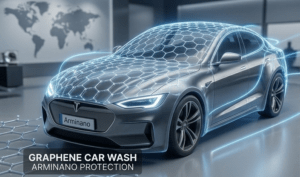
The global materials science landscape underwent a fundamental structural paradigm shift when researchers successfully isolated a single atom-thick layer of carbon arranged in a perfect, two-dimensional honeycomb lattice layout. This breakthrough substance, universally recognized across scientific documentation as graphene, transitioned with unprecedented speed from a theoretical laboratory curiosity into the core foundational pillar of modern nanotechnology solutions. As an advanced allotrope of carbon, graphene represents a unique structural configuration where every single carbon atom is hybridized precisely in an sp² configuration. This forms a remarkably dense, robust, and exceptionally resilient planar layout that alters historical mechanical expectations. This precise structural framework gives rise to exceptional chemical, optical, and thermal behaviors, laying an industrial path toward engineering breakthroughs across numerous consumer electronics, commercial systems, energy infrastructure networks, and multi-layered surface coat segments.
At Arminano (BTcorp Generique Nano Pvt Ltd), our core commercial vision centers directly on bridging the historical operational gap that exists between advanced, laboratory-scale nanomaterial synthesis and practical, high-throughput industrial deployment lines. While international product developers widely recognize the sheer theoretical performance capacity of carbon-based nano-allotropes, scaling large production volumes while systematically preserving absolute structural purity remains a demanding chemical engineering milestone. By standardizing our proprietary high-yield mechanical exfoliation processes alongside highly specialized chemical synthesis pathways, we successfully produce certified, elite grades of graphene variants. These materials span from highly conductible liquid carrier suspensions to premium dry micro-powders, engineered intentionally for real-world enhancements in surface chemistry, electrochemical energy storage, advanced automotive engineering coatings, and premium semiconductor layouts globally.
2. Fundamental Graphene Properties & Chemical Formula
To fully comprehend why this specific nanomaterial commands a prominent position across international research protocols and active high-margin manufacturing pipelines, industrial engineers must systematically break down its underlying atomic and structural features. From an exact analytical chemistry perspective, the absolute, foundational graphene formula is documented simply as C. However, its complex physical identity cannot be captured or defined by a traditional molecular formula alone. Instead, its identity is fully defined by its strict two-dimensional structural topology and localized electrical properties. The carbon-to-carbon bond distance within each interconnected hexagonal ring configuration measures approximately 0.142 nanometers. This highly compact, symmetrical spacing creates an exceptionally stable electronic field configuration, displaying a near-zero resistance profile to charge carriers moving along its atomic plane.
Is Graphene Stronger Than Diamond? This question stands as one of the most prominent queries across global industrial engineering indices. To deliver a definitive scientific answer: Yes, but with essential structural context. Diamond represents a three-dimensional covalent crystal network of carbon atoms tightly locked together in a rigid sp³ tetrahedra distribution, rendering it the hardest naturally occurring bulk material regarding surface scratch resistance. Conversely, graphene possesses an intrinsic, in-plane tensile strength of approximately 130 Gigapascals (GPa) alongside a true Young’s modulus scaling up to 1 Terapascal (TPa). Measured on an atom-for-atom basis within its specific two-dimensional horizon, single-layer graphene is roughly 200 times stronger than premium structural steel while significantly outclassing the planar structural thresholds of diamond, cementing its position as the strongest material ever subjected to laboratory tension metrics.
The core physical, thermal, and electrical metrics that define graphene’s operational advantages include the following key attributes:
- Electrical Charge Conductivity: Intrinsic charge carrier mobility within a pristine, defect-free monolayer sheet can easily exceed an unmatched 200,000 cm²/V·s under ambient room temperature conditions, enabling electrical energy tracking with virtually zero internal resistance losses.
- Thermal Dissipation Conductivity: It exhibits a phenomenal thermal dissipation rating, achieving clear experimental values ranging up to 5,000 W/m·K, which completely outclasses standard commercial heat conductors like refined copper and pure silver.
- Absolute Optical Transparency: Despite its dense atomic structure, a single monolayer absorbs only 2.3% of incident white light, remaining essentially invisible to the naked human eye and allowing for clear integration into optical sensor matrices.
- Massive Specific Surface Area: The theoretical specific boundary surface area stands at an incredible 2,630 square meters per gram (m²/g), offering an expansive structural contact plane for electrochemical energy transfers and protective atomic linkages.
3. Comparative Matrix: Graphene vs. Borophene vs. Carbon Nanotubes
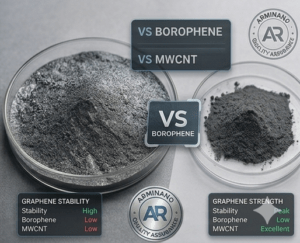
To establish a clear structural overview of where graphene fits in the hierarchy of advanced nanotechnology materials, it is highly beneficial to evaluate it directly alongside alternative next-generation allotropes and complex nanostructures. Recently, there has been a significant surge in technical exploration regarding the competitive traits of borophene vs graphene. Borophene, a single-layer arrangement of boron atoms synthesized under extreme, ultra-high vacuum environments, has revealed captivating metallic conductivity metrics alongside a highly pronounced degree of mechanical flexibility. However, unlike the natural ambient stability found in refined carbon structures, borophene remains highly reactive. It suffers from rapid, catastrophic oxidation risks when exposed to normal atmospheric conditions and currently lacks a scalable, cost-effective commercial synthesis methodology.
Similarly, Multi-Walled Carbon Nanotubes (MWCNTs) represent a closely related structural framework where multiple concentric sheets of graphene are rolled tightly into a one-dimensional cylinder layout. While MWCNTs offer fantastic structural reinforcement benefits within vertical polymer composites, they display directional limitations along their curved cross-sections. Graphene provides isotropic stability in two dimensions, which makes horizontal thin coatings and integrated surface film components significantly more reliable during uniform structural loading phases. The matrix table below outlines a comparative assessment across these advanced nanomaterial segments:
| Material Metric & Parameter | Graphene (Monolayer / Few-Layer) | Borophene (2D Monolayer) | Carbon Nanotubes (MWCNTs) |
|---|---|---|---|
| Dimensional Topology | 2D Continuous Planar Sheet | 2D Non-planar Corrugated Layer | 1D Concentric Cylindrical Tube |
| Tensile Strength Limit | ~130 GPa (Extremely Homogeneous) | Highly Variable (Anisotropic Based) | ~60 to 100 GPa (Directional Axis) |
| Ambient Stability Profile | Excellent (Chemically Inert in Air) | Extremely Poor (Rapid Degradation) | Excellent (Highly Stable Matrix) |
| Thermal Conductivity | ~5,000 W/m·K (Peak Flow) | Directional Restraints (Lower) | ~3,000 W/m·K (Axial Flow Only) |
| Commercial Availability | High Scaling (Powders & Dispersions) | Strictly Experimental (Lab Level) | Established Multi-Ton Scaling |
4. Transformative Real-World Graphene Uses & Industrial Applications

The vast range of real-world graphene uses extends dynamically from heavy-duty industrial energy grids down to high-turnover consumer personal care systems. Its structural flexibility and atomic surface area allow it to operate effectively as an internal reinforcing filler, an active electro-conductive additive, or a smooth surface protective layer across modern manufacturing ecosystems.
A. The Advanced Graphene Battery Ecosystem
Conventional lithium-ion battery configurations encounter hard physical barriers regarding energy storage density, localized internal heat accumulation, and long-term capacity degradation over standard usage cycles. Integrating an optimized graphene battery core architecture redefines these essential performance limits. When blended smoothly into advanced anode composites or active cathode matrices, functionalized graphene acts as an exceptionally efficient conductive grid network. This allows for significantly accelerated diffusion tracks for lithium ions during demanding fast-charging states, compressing charging wait times down from hours to single-digit minutes while effectively conducting damaging thermal signatures away from delicate internal systems. This material advancement holds critical value for the evolution of modern Electric Vehicles (EVs) and smart high-drain processing hardware.
B. Next-Generation Graphene Phone Technology
In the highly competitive electronics sector, consumer electronics manufacturers are actively deploying advanced materials to handle intensive processing thermal cycles. The modern graphene phone incorporates micro-thin, multi-layered films for internal thermal management, safely channeling concentrated heat fields away from core CPU and processing components during complex application operations. Furthermore, active commercial research into flexible, graphene-based transparent conductive films (TCFs) intends to replace brittle, conventional Indium Tin Oxide (ITO) electronics coatings, rendering future curved displays and touchscreen panels highly impact-resistant and structurally sound under prolonged physical flex stress.

C. Automotive Care & Surface Nanocoatings
One of the most immediate, high-margin commercial applications of this technology resides within the specialized professional graphene car wash and protective surface coating sector. Standard ceramic coatings utilize traditional silicon dioxide (SiO₂) compounds to form a rigid sacrificial hard layer over an automobile’s clear coat. By seamlessly infusing structural nano-graphene sheets into advanced polymeric blends, we formulate highly specialized protective solutions, including our premium Arminano Graphene Super Grade Powder and tailored Graphene Conductive Coating. These advanced formulas impart an exceptionally low sliding angle for water droplets, deliver superior anti-static dust rejection properties, and provide highly resilient chemical defense barriers against acid rain compounds, industrial pollutants, and harsh ultraviolet solar radiation fields.
D. Everyday Consumer Goods: The Graphene Toothbrush
The everyday fast-moving consumer goods (FMCG) market has adopted interesting adaptations of this nanomaterial, including the development of the functional graphene toothbrush. By infusing high-grade nylon brush bristles with active anti-bacterial graphene nanoparticles, these personal care products leverage the material’s structural properties to naturally inhibit micro-bacterial accumulation on the filament surfaces over time. Additionally, the remarkable inherent resilience of the carbon nanostructure significantly limits bristle deformation and fraying over prolonged use, illustrating how advanced materials science can elevate simple personal care devices into long-lasting, hygienic consumer products.
Estimated Global Graphene Consumption by Industrial Segment
5. Commercial Reality & Market Dynamics: Graphene Price Analysis
Navigating the complex procurement economics of modern nanomaterials requires a thorough understanding of synthesis methodologies and structural purity parameters. Commercial inquiries regarding the exact graphene price vary broadly across public forums because the material does not exist as a uniform commodity. Instead, it encompasses a wide spectrum of physical purity grades, structural layer numbers, and carrier formats that directly dictate its final pricing profile. For high-end semiconductor prototyping, pure monolayer configurations grown meticulously via Chemical Vapor Deposition (CVD) on specialized copper substrates command a steep price premium reflecting complex cleanroom requirements. Conversely, for large-scale industrial blending, composite reinforcement, and automotive chemical formulation, bulk liquid dispersions and functionalized multi-layer powders offer an exceptionally practical financial route to high-performance integration.
At Arminano, we provide straightforward commercial access to premium-grade, certified nanomaterials structured for varied deployment scales. Our standard commercial catalog options reflect this commitment to domestic supply reliability and industrial scalability across India and broader global logistics networks:
| Product Formulation Grade | Packaging Size Metric | Commercial Price Value (INR) |
|---|---|---|
| Graphene Conductive Coating | 100 GM Pack | ₹998.00 |
| Graphene Technical Grade Powder | 1 KG Pack | ₹18,000.00 |
| Pure Graphene Dry Powder | 1 KG Pack | ₹44,000.00 |
| Stable Graphene Liquid Dispersion | 1 Litre Pack | ₹10,000.00 |
| Reduced Graphene Oxide [RGO] Powder | 10 GM Pack | ₹4,500.00 |
6. Strategic Conclusion: Securing the Nanotech Edge with Arminano
Integrating advanced nanomaterials into commercial workflows is no longer a distant academic vision; it is a live market reality that separates technological innovators from historical models. Whether your organization aims to maximize the scratch-resistant qualities of automotive coatings, extend the cycle life of performance battery setups, or incorporate highly efficient thermal management fields within consumer electronic hardware, graphene delivers a clear technical path forward. Aligning your production systems with a trusted, consistent nanomaterials partner helps ensure your product lines sustain structural and commercial advantages over the long term. We invite you to explore our verified range of certified powders, highly stable dispersions, and advanced functional surface coatings at arminano.com to secure your organization’s technological edge today.
7. Deep-Dive Frequently Asked Questions (FAQ)
A1: The term is officially pronounced as “graf-een” ( /ˈɡræf.iːn/ ). The core prefix “graph-” references its direct structural link to its historical source element, graphite, while the specialized suffix “-ene” denotes its unsaturated mono-layered carbon ring configuration, aligning precisely with international IUPAC chemical nomenclature standards used by global suppliers and advanced nanotechnology research labs.
A2: Both unique configurations share the exact elemental symbol C because they are composed entirely of pure carbon atoms. Their starkly different physical behaviors stem from dimensional arrangement: common bulk graphite is a three-dimensional vertical stack held together weakly by Van der Waals attractions, whereas graphene is a single, isolated two-dimensional atomic canvas tied by robust in-plane covalent bonds.
A3: Traditional car waxes rely on natural organic carnauba bases that break down quickly under engine operating heat and ambient solar UV rays. Graphene-infused washes suspend micro-thin, resilient carbon structures that anchor directly into the paint’s clear coat pores, forming an ultra-hydrophobic slick barrier that easily resists heavy surfactants, wash marring, and chemical water spotting.
A4: Pure, single-atomic-layer sheets naturally tend to restack back into graphite forms due to high surface energy when dried into bulk powder packs. Consequently, viable commercial bulk powders consist of “few-layer graphene” (typically 2 to 10 atomic layers thick). This structural layout perfectly retains the material’s exceptional electrical and mechanical capabilities while remaining scalable for industrial compounding line systems.
A5: Standard lithium cells can experience localized high thermal points and internal short circuits during rapid power tracking, occasionally creating thermal runaway hazards. Graphene’s exceptional horizontal thermal conductivity spreads internal heat signatures evenly across the absolute surface area, reducing thermal stress peaks and improving safety metrics under intensive multi-amp fast charging conditions.
Explore the full certified catalog at arminano.com — Empowering Global Engineering Pipelines.