

Graphene Synthesis: A Comprehensive Guide to Industrial Innovation and Development
The Atomic Architect
A Visual Journey into Graphene Synthesis & Industrial Innovation
The world of materials engineering is undergoing a seismic shift, moving from macro-scale solutions to the manipulation of atoms. At the heart of this revolution lies graphene, a two-dimensional lattice of carbon atoms that redefines the limits of strength, thermal conductivity, and lubricity.
For companies like BTCORP GENERIQUE NANO PVT. LTD., graphene is not just a scientific curiosity; it is the building block of the next generation of industrial products. By mastering the synthesis of these nanomaterials, we are enabling industries to move beyond conventional limitations and into a future defined by efficiency and durability.
The Engineering Paradigm Shift
Traditional manufacturing often relies on subtractive or bulk additive processes. However, graphene synthesis demands a bottom-up approach that respects the atomic integrity of the carbon lattice. Our expertise at BTCORP involves bridging the gap between theoretical R&D and commercial viability.
| Material Property | Benchmark |
|---|---|
| Tensile Strength | 130 GPa |
| Thermal Conductivity | 5,000 W/mK |
| Application Focus | Industrial Lubricants / Coatings |
We are at the precipice of a new era where material constraints—once thought to be immutable—are being bypassed through molecular design. From heavy-duty mining lubricants to high-precision automotive coatings, our roadmap focuses on providing the documentation and scale-up guidance essential for the modern engineer.
II. The Foundation: Understanding the Two Philosophies
To truly appreciate the quality of graphene produced by BTCORP GENERIQUE NANO PVT. LTD., one must understand the two primary pathways of creation. The art of graphene synthesis is a balancing act between cost, scalability, and structural perfection. As illustrated in our core manufacturing documentation, there are two distinct, scientifically rigorous approaches to producing this material.
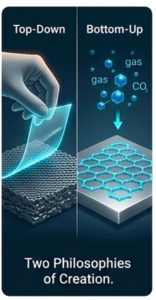
The “Top-Down” Approach
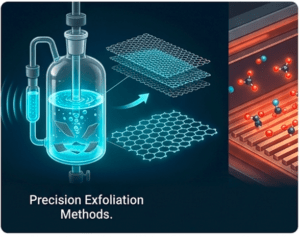
Think of this as a sculptor carving a masterpiece from a block of marble. It involves taking high-quality graphite and systematically peeling away layers to reach a single-atom thickness.
The “Bottom-Up” Approach
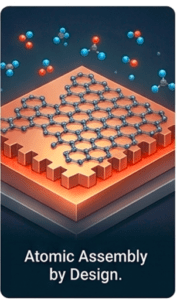
This is the architect’s method, building the structure atom by atom. We “grow” graphene on metal substrates, ensuring a high degree of crystalline perfection.
Deep Dive: The Mechanical vs. Chemical Paradigm
The Top-Down Philosophy (Bulk Production):
The Top-Down approach relies on the exploitation of weak Van der Waals forces between graphene layers in bulk graphite. At BTCORP, we utilize advanced mechanical exfoliation and controlled chemical oxidation to isolate these layers. This method is the workhorse of industrial applications. Why? Because it allows for the mass production of flakes that can be processed into liquid dispersions, polymer composites, and conductive inks. The efficiency here lies in volume; it is the most economically viable method for the lubricants and coatings sector where precise single-crystal orientation is less critical than bulk material properties.
The Bottom-Up Philosophy (Electronic & Precision):
Conversely, the Bottom-Up approach is reserved for high-performance applications. Using Chemical Vapor Deposition (CVD), we introduce a carbon-rich gas, such as methane, into a high-temperature chamber containing a catalytic metal substrate (like copper or nickel). At the molecular level, this is a controlled precipitation of carbon atoms. The resulting graphene is essentially a single, seamless sheet—devoid of the defects common in exfoliated flakes. This technique is the gold standard for semi-conductors, ultra-sensitive sensors, and high-speed flexible electronics.
| Criteria | Top-Down | Bottom-Up |
|---|---|---|
| Primary Output | Graphene Flakes / rGO | Continuous Sheets |
| Scalability | High (Industrial) | Medium (Lab/Specialized) |
| Best For | Lubricants, Coatings | Electronics, Sensors |
At BTCORP GENERIQUE NANO PVT. LTD., our consultancy role involves determining the right path for your product. We do not believe in a one-size-fits-all synthesis model. We evaluate your product’s performance needs—mechanical strength vs. electrical conductivity—to guide you toward the synthesis philosophy that guarantees ROI and performance.
III. Deep Dive: The Strategic Synthesis Choice
Determining the optimal technical route for industrial success.
The selection of a graphene synthesis route is not merely a technical preference—it is a strategic decision that dictates the final utility of the material. At BTCORP GENERIQUE NANO PVT. LTD., we understand that “graphene” is a broad term, and the specific architecture of the carbon lattice must match the intended application. Our dual-domain expertise allows us to audit your project requirements and select the exact synthesis pathway that guarantees technical performance and long-term commercial viability.
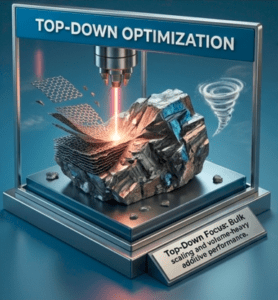
The Top-Down Philosophy
The top-down approach, primarily leveraging graphite oxidation (Hummers’ method) and mechanical exfoliation, remains the undisputed champion for bulk material applications. By peeling layers from high-quality graphite, we produce Graphene Oxide (GO) and Reduced Graphene Oxide (rGO) in industrial volumes. This is the workhorse of the industry—the “bulk material” specialist. If your goal is to enhance the structural integrity of lubricants, create conductive polymer composites, or develop anti-corrosion coatings, this method provides the cost-effectiveness and volume scalability that mass-market production demands. It is about economic efficiency meeting material durability.
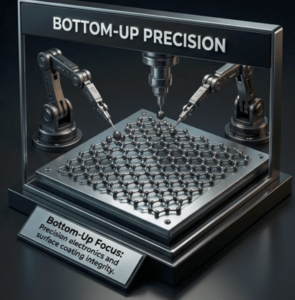
The Bottom-Up Philosophy
Conversely, the bottom-up approach is the architect’s methodology—engineered for extreme precision. Using Chemical Vapor Deposition (CVD) or epitaxial growth on metallic substrates (like copper or nickel), we precipitate carbon atoms to “grow” a seamless, single-atom-thick lattice. This isn’t just graphene; it is high-crystalline perfection. Where top-down deals in flakes and dispersions, bottom-up deals in large-area sheets. This is the gold standard for high-performance electronics, flexible displays, ultra-sensitive diagnostic sensors, and semiconductor components. While the operational cost is higher, the defect-free surface area justifies the investment in applications where every electron must flow without resistance.
Synthesis Decision Matrix
| Feature | Top-Down (Bulk) | Bottom-Up (Precision) |
|---|---|---|
| Best For | Lubricants, Coatings, Additives | Electronics, Sensors, Displays |
| Production Scale | Massively Scalable (Tons) | Moderate (Sheet-fed / Wafer) |
| Crystalline Quality | Good (Contains Defects) | Excellent (Single Crystal) |
| Cost Profile | Highly Economical | Premium Investment |
The BTCORP Consultancy Approach
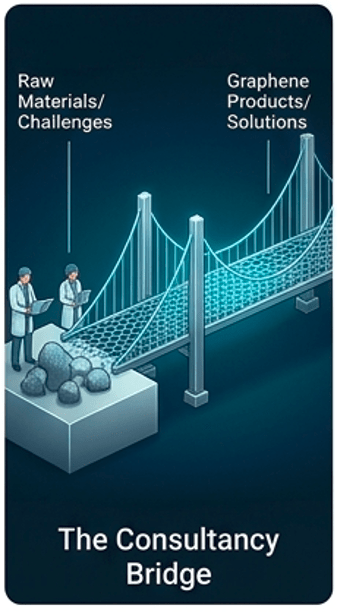
At BTCORP GENERIQUE NANO PVT. LTD., we recognize that the “better” synthesis method depends entirely on your product roadmap. A lubricant manufacturer does not need the crystalline purity of a sensor manufacturer, and a sensor manufacturer cannot rely on the disordered flakes required for bulk additives. We act as an extension of your R&D team, auditing your performance metrics to eliminate trial-and-error costs. By selecting the correct synthesis pathway from Day 1, we ensure that your product enters the market optimized for both function and cost.
Technical Specifications
- ● Purity: 99.9% Monolayer
- ● Scalability: Multi-ton capacity
- ● Custom Synthesis: Yes
- ● Standard: ISO/ASTM
Our Core Philosophy
“Precision at the atomic level, scalability at the industrial level.”
The Strategic Conclusion: Catalyst for Industrial Dominance
We have traversed the entire graphene value chain—from atomic synthesis and molecular kinetics to rigorous metrological validation and industrial-scale implementation. The evidence is irrefutable: graphene is no longer a material of hypothetical interest; it is the fundamental engine of the next generation of industrial innovation.
The Dispersion Imperative: Solving the “Chasm”
The primary failure of many R&D initiatives in the nanotech sector is not the lack of material quality, but the failure of integration. Raw graphene, by nature of its Van der Waals forces, tends to agglomerate. Without advanced interfacial chemistry, these particles clump together, rendering the material’s extraordinary electronic and structural properties completely inert. At BTCORP GENERIQUE NANO, our strategic methodology focuses on stabilizing these particles within your specific polymer or metal matrix. We don’t just supply a product; we provide the solution to the integration bottleneck.
From Lab-Scale to Multi-Ton Realities
The transition from a laboratory setting to a multi-ton manufacturing floor is the “Valley of Death” for most nanotechnology firms. Our industrial scale-up protocols are engineered to maintain atomic integrity throughout the expansion process. By leveraging automated reactor controls and real-time crystalline analysis, we ensure that every gram of graphene produced in a ton-scale run matches the structural performance of the original prototype. This consistency is the foundation of our consultancy model, providing our partners with the reliability required for high-stakes aerospace, automotive, and energy applications.
Metrological Rigor as a Service
Our commitment to quality extends beyond the manufacturing plant. We believe that transparent metrology is the bridge to market trust. Every batch we produce is subjected to rigorous characterization using Raman spectroscopy, electron microscopy, and conductivity testing. We provide our partners with comprehensive documentation that satisfies the strictest ISO and ASTM standards. When you partner with us, you are not simply receiving a commodity; you are receiving a certified performance standard.
Ultimately, the path to commercial leadership requires more than just possessing the material; it demands the architectural mastery to integrate it reliably, economically, and at scale. Your search for a synthesis partner that operates at the intersection of scientific excellence and industrial practicality ends here. We are the partners you need to turn high-performance theory into high-profit reality.
Graphene-Enhanced Lithium Grease
Redefining Boundary Lubrication through Atomic Architectures.
A prime example of our consultancy in action is our specialized program for the development of Graphene-Enhanced Lithium Grease. For decades, the lubricant industry has relied on traditional additive packages—molybdenum disulfide or graphite—to mitigate wear and friction in high-load machinery. However, as mechanical systems push toward tighter tolerances, higher pressures, and increased thermal stress, these conventional additives are approaching their performance ceiling. Lubricant manufacturers are now at a critical juncture: they are not just looking for “better” grease; they are seeking a paradigm shift in tribological energy efficiency. Our Graphene-Enhanced Lithium Grease is that shift. By integrating high-purity, monolayer graphene into standard lithium-based matrices, we are creating a “smart” lubricant that dynamically responds to localized stress, extending maintenance intervals by orders of magnitude.
Our Development Roadmap
Performance Series (GP-500/1000)
Heavy-Duty Industrial Application
Engineered for the most demanding environments on Earth—mining excavation sites, continuous casting steel plants, and heavy marine gearboxes. At these loading levels, the graphene acts as a sacrificial barrier, creating a “tribofilm” that is orders of magnitude tougher than pure lithium grease.
Cost-Optimized Nano Series
General Automotive & Maintenance
This series is our answer to mass-market adoption. By utilizing Reduced Graphene Oxide (rGO) in precise, minimal amounts, we provide performance gains in anti-corrosion and extreme pressure resistance without the price premium of high-loading variants. Ideal for automotive chassis lubrication.
The Dispersion Imperative
By partnering with BTCORP GENERIQUE NANO PVT. LTD., you gain access to our proprietary dispersion methodologies, which solve the critical industry challenge of nanoparticle agglomeration. Raw graphene, due to intense Van der Waals attraction, naturally clumps together, effectively neutralizing its surface area. We overcome this by utilizing a multi-stage surfactant-assisted shear process.
The Mathematical Solution: Shear Energy vs. Viscosity
                        // Energy Balance for Dispersion

                        E_disp = ∫ (η_matrix * γ_shear) dt

                        // Where:

                        // η = Base Viscosity

                        // γ = Applied Shear Rate

                        // Result: Stabilized Suspension > 99.9%
This formula ensures that the Graphene/Lithium matrix maintains homogenous distribution over 6 months of shelf life.
Mechanical Protection Mechanism
- 1. Adsorption: Graphene nanoplatelets adsorb onto metal asperities.
- 2. Intercalation: Nanoparticles act as “ball bearings” within the contact zone.
- 3. Self-Healing: Localized stress triggers thermal integration, sealing micro-cracks.
The Synthesis Methodology
Pre-Treatment
Preparation of hydrophobic Graphene flakes using silane-coupling agents for matrix compatibility.
High-Shear Dispersion
Nanoparticles are introduced via ultrasonic cavitators at 20kHz, ensuring uniform dispersion without degradation.
Lithium Thickening
Controlled blending with lithium soap matrix to finalize the crystalline structure of the grease.